
ENGLAND - LAKE DISTRICT June 17 – July 11, 2022
KESWICK
Keswick Buzz (kez-ICK)
Never mind the downpour had only slowed to drizzle, and we’d be waiting outdoors with our luggage for another hour before gaining access to our holiday apartment, we were loving the vibes of little Keswick before we stepped off our soggy intercity bus. The first of our 2 stops in the Lake District looked like our kind of place.
Predominantly a 2-3 story village, the older storefronts near the bus stand were filled with one sporting goods store after another. Interspersed between them, were cheery, colorful, merchandise displays in other shop windows designed to beckon tourists seeking shelter from the rain.
The previously unknown-to-us Booth’s supermarket 2 blocks from our apartment looked guaranteed to please us, and the sidewalks on this June Friday afternoon were all but mobbed by rain-suit-clad walkers with their children and dogs. We loved the upbeat buzz created by the outdoors people who looked like they were on a mission. It was an exciting scene that could have been in Bend, Oregon; Colorado; or the Italian Dolomites; and we immediately felt at home.
KESWICK
Keswick Buzz (kez-ICK)
Never mind the downpour had only slowed to drizzle, and we’d be waiting outdoors with our luggage for another hour before gaining access to our holiday apartment, we were loving the vibes of little Keswick before we stepped off our soggy intercity bus. The first of our 2 stops in the Lake District looked like our kind of place.
Predominantly a 2-3 story village, the older storefronts near the bus stand were filled with one sporting goods store after another. Interspersed between them, were cheery, colorful, merchandise displays in other shop windows designed to beckon tourists seeking shelter from the rain.
The previously unknown-to-us Booth’s supermarket 2 blocks from our apartment looked guaranteed to please us, and the sidewalks on this June Friday afternoon were all but mobbed by rain-suit-clad walkers with their children and dogs. We loved the upbeat buzz created by the outdoors people who looked like they were on a mission. It was an exciting scene that could have been in Bend, Oregon; Colorado; or the Italian Dolomites; and we immediately felt at home.
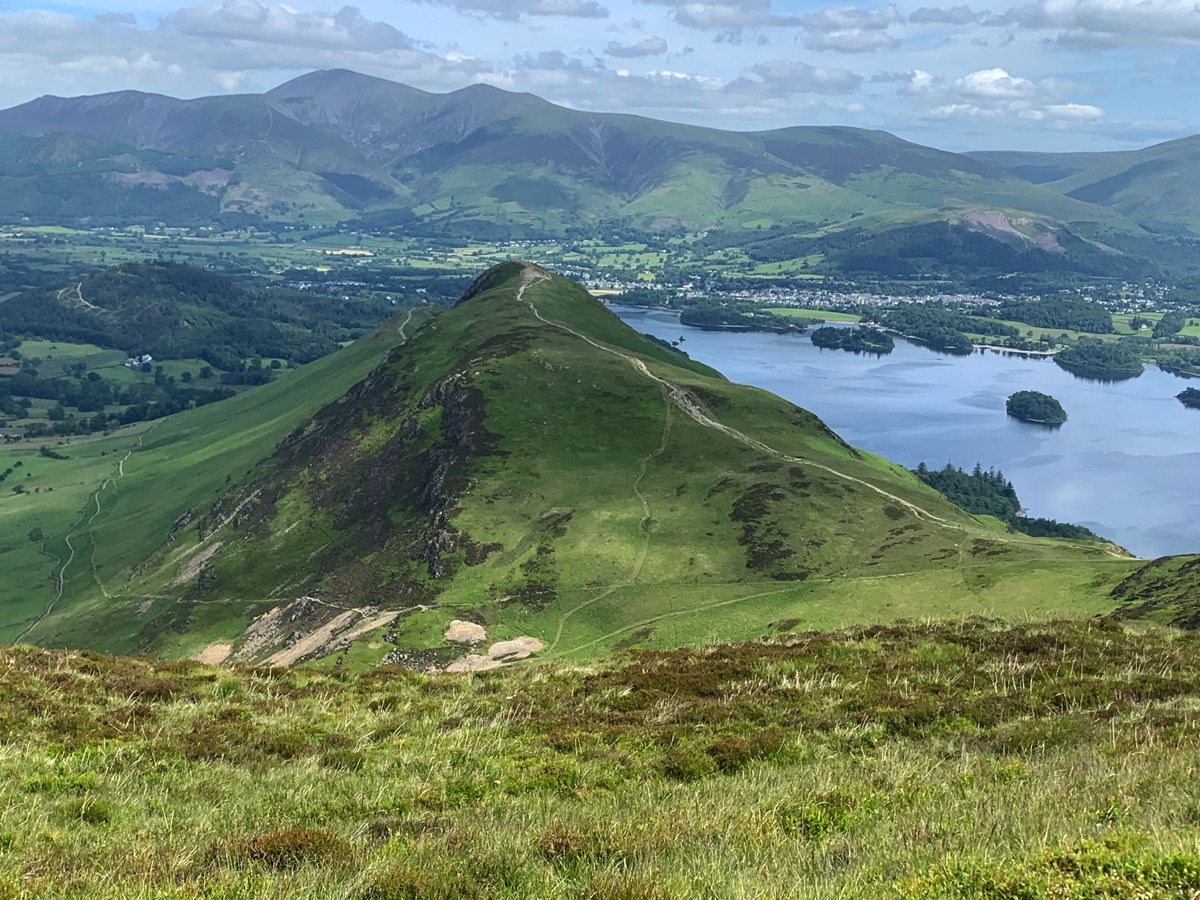
Looking back at Cat Bells fell from the next fell.
The Lake District isn’t just a regional nickname but the official name of Britain’s largest national park, a designation warranted by the “fells,” the high hills. Always fascinated by the geologic pasts of interesting places, I quickly looked to learn more but, just as quickly, my eyes glazed over. A half billion years in the making, including processes that cover almost all the Table of Contents in a geology book, it was hard to match what I read with what I saw.
My bit of reading did allow me to annotate Bill’s comments, like when he again said “There is a lot of water here” while tiptoeing around flowing water on the trail. “Yes, it’s the base layer of volcanic rock that retains the rainfall in the fells” I vaguely responded, not knowing if there was volcanic rock where we were. My confidence in identifying volcanic rock wanes when looking at other than distinctive basalt or pumice. We both did better when gazing from a high point at the U-shaped valley filled with lake water and confidently labeled it as a product of glaciation, which was one of the dominant forces in the area. Sorting uplift-and-tilt and erosion from the volcanic action and other forces here was beyond us.
Our applied geology in the fells was weak, but we were complete failures when it came to fawning over the fells. One guidebook author viewed the fells as a “piece of heaven on earth.” The “perfection of scale and sublime beauty” were lost on us, though we also have tin-ears and can’t be bothered with too much time spent on wine tasting. With them all, we either like it or don’t. We immediately gave the fells high marks for supporting our athleticism, but they didn’t rock our souls. But, lucky for the rest of the world, William Wordsworth and Beatrix Potter were more deeply moved than us by the region and shared it in their writing.
In contrast to those authors, my mind is made ravenous by spending so many hours per week walking year-round and I was soon challenging Bill to play my latest game: “Heaven on Earth”. We both agreed that the fells weren’t it, so what were the visual elements that qualified for a “heaven on earth” designation by our standards?
Bill’s first candidate feature was “vertical.” We long ago agreed that we both are uplifted by strong vertical lines, like at the Grand Canyon, and an interesting diagonal line, like a river, can add more excitement to a scene or photo of it. “Color” was my first impulse, in the form of flowers or rocks, or even the rosy tones of some twigs in the spring. “Motion” was my second element, such as when seeing blue ocean water turn white when its waves crash against rocks on a forested coastline, a scene we both knew from our childhood near the Pacific Ocean. None of these highlighted visual elements were strong suits of the fells.
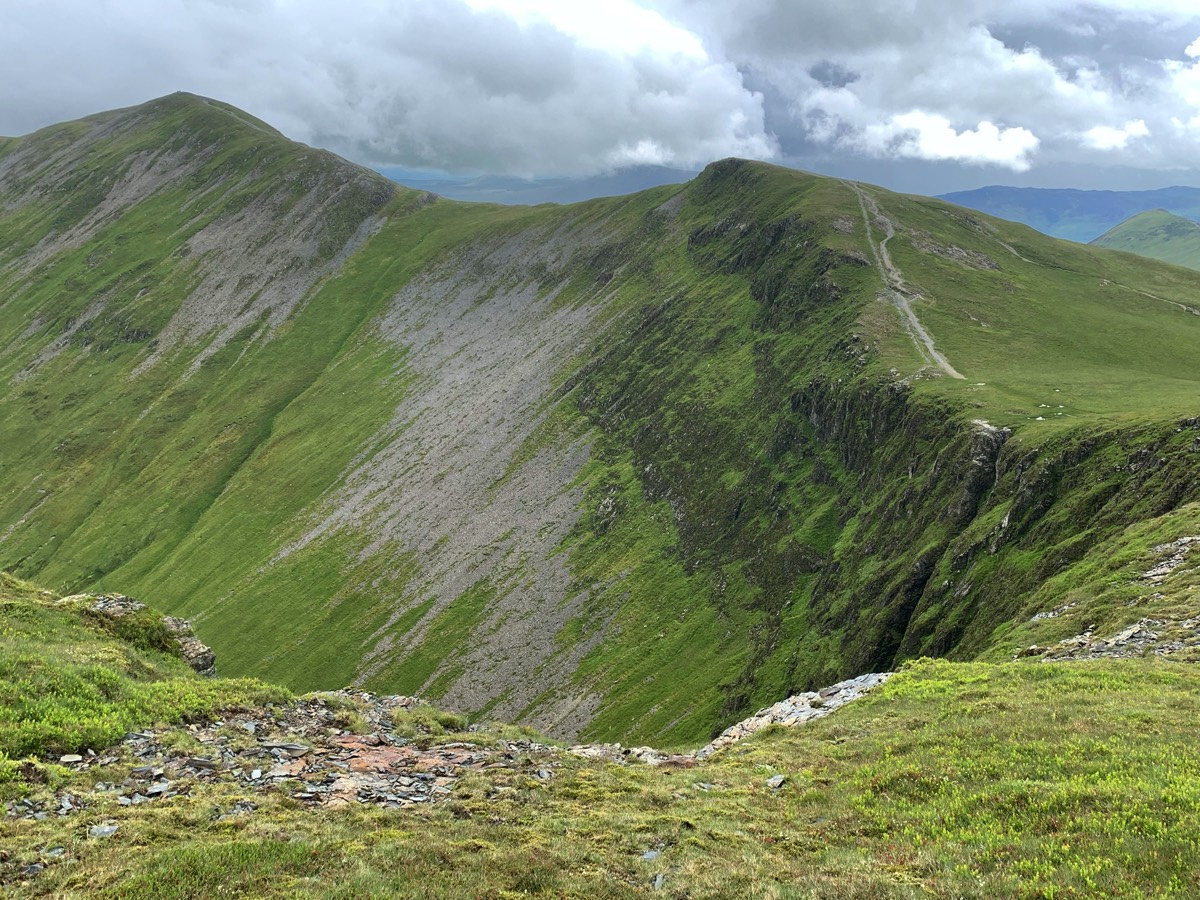
The smooth lines of many fells.
In the Lake District, there were only scattered stands of planted trees because the native forests had all been harvested centuries ago, so almost all the green was contributed by grasses closely cut by free-range sheep. The steep, smooth, egg-crate like hills were distinctive, but not unique, having seen similar terrain in coastal northern California and in central Italy. A few days later, after viewing so many smooth hills, we could feel the excitement in our brains when our eyes landed on crags or rocky outcroppings. However, what was truly unique, was that all these fells were on public lands and were crisscrossed with numerous trails, making the area a feast of walking opportunities in which we were heavily and happily indulging.
What A Week!
Our first full week in the Lake District was a welcome record-breaker for us in the last 7 months: we logged over 60 miles (almost 100 km) and over 12,000’ (3700 m) of elevation gain in those 7 days! We consider 10,000’ of gain an excellent week, something we usually only achieve in the Italian Dolomites, and yet we wrangled more than that with the biggest day on the highest fell around only yielding 3,300’. In the Grand Canyon, we only match that elevation gain when we do a Rim-2-Rim-2-Rim, in which we accumulate 11,000’ of gain in 2 days.
We desperately needed suitable conditioning for our upcoming 5 weeks in the Dolomites, beginning in August, and we were unexpectedly getting it on the fells. There was no opportunity in the Lake District to make sustained 5,000’ gain hikes like we would do in August in Italy and again in October in the Grand Canyon, but the fells were far, far steeper than anything else on the calendar.
None of Bill’s maps or online resources estimated trail grade percentages but based on our experience, primarily on bikes, we guessed that these “fellsides” were in the mid-20’s. Too many trails went straight-up the fall line. Mercifully, on a few occasions, the issue with erosion had been noted and a segment of incredibly steep trail was recently bypassed with switchbacks.
We are meticulous about specifically keeping our Achilles’ tendons, at the backs of our ankles, stretched and conditioned for such abrupt terrain shifts, but I couldn’t help but wonder how many visitors tore theirs on these wicked, wicked trails. It’s such a difficult injury from which to recover, such a difficult injury with which to even hike off the trail to get help.
Once again, I was grateful for our year-round commitment to our overall fitness. All parts of our bodies were well-tuned, even for the unanticipated extreme conditions. We again demonstrated that we could double or triple our recent elevation gain in a week without being punished by our bodies for the excess demands. Even our knees were unscathed, unlike more regionally experienced, younger, fell’s walkers on the trails with us that were lamenting their knee pain, pain that was also revealed by their altered gaits.
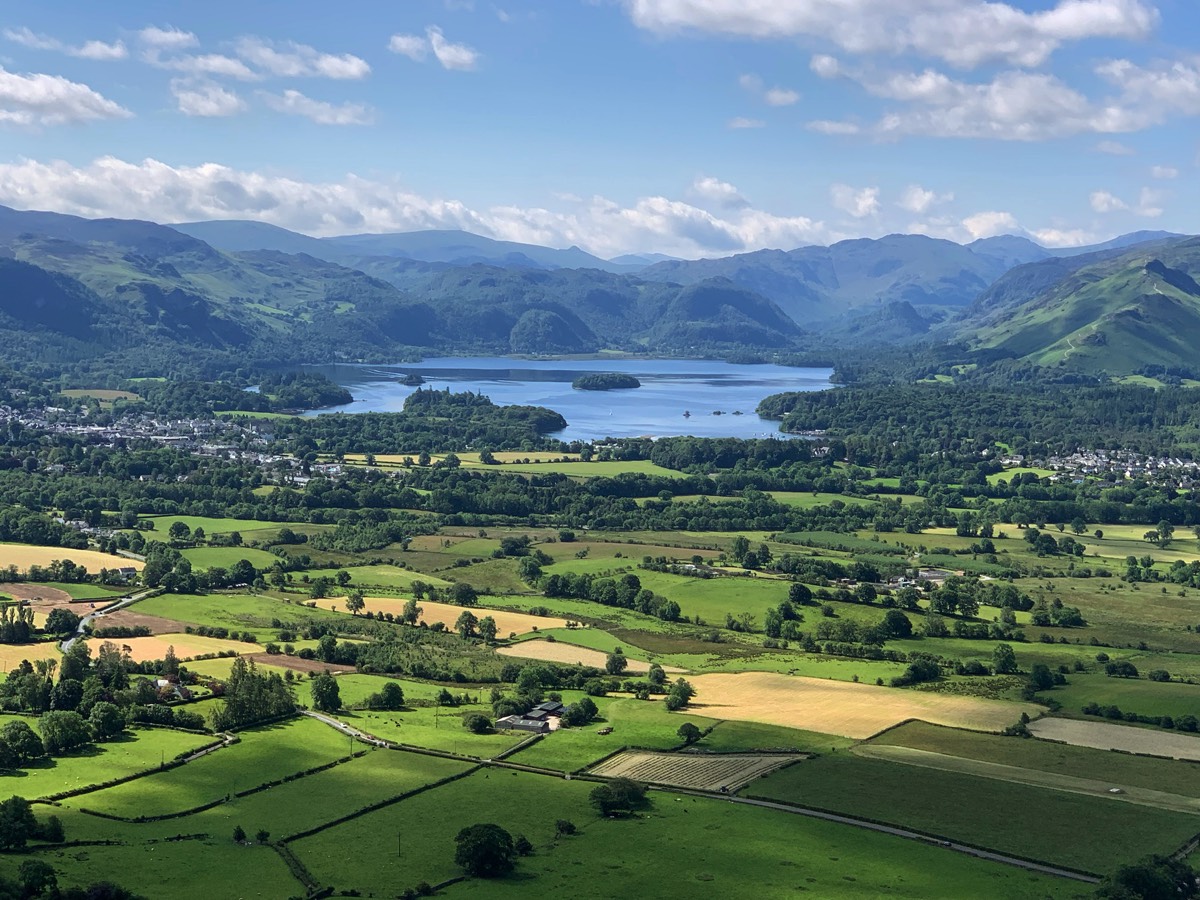
A pastoral view above Keswick.
We were also relieved to have spent very little time on buses during our first days in the Lake District. Almost all our daily hikes were in the 10 mile range the first week, with as much as half of our daily mileage being “approaches”. The day we did the most difficult hike up the Skiddaw fell with 3,330’ of gain, we did 5 of our 11 miles on roads and in pastures while essentially everyone else did it as a 5-6 mile hike from a nearby parking lot. No matter to us, it’s all miles, but it helped explain why we were by far among the most fit looking hikers on these low summits.
Mind Play
BMX Bikes
Generally, when we aren’t hiking in the mountains, occupying our minds while moving is a challenge. Outside of the mountains, route finding tends to be more straightforward and foot placement doesn’t demand much mental activity. Gratefully, Keswick tossed us little treats for our hungry minds in unexpected ways and, like a good chew-toy for a dog, we can occupy ourselves for a surprising amount of time on a small, juicy bit.
Hoping the break in the showers would hold, Bill suggested we swing by the Keswick BMX Pump Track in the park that was rebuilt after the devastating regional flood in 2015 for our picnic lunch. Within 10 minutes of our apartment, we’d walked by it several times but had only seen one kid riding the track, but this was lunchtime on a Saturday and the show had already begun.
To our delight, a 3-year-old girl in pink who looked terrified but determined, was about to launch for the first time ever on the track on her pedal-less bike. Watching her 7-year-old brother had made her “desperate,” in her mother’s words, to ride the course. The half dozen little boys patiently waited, mama picked their moment, and they were off. Mama had a clumsy grip on the girl’s jacket, was apparently slipping on the damp asphalt in her shoes, but controlled their speed in going over the first few bumps. Mama then pulled them off the course to rest. We never heard the little girl say a peep, but there weren’t any tears either. The duo took another run at the track in front of us, and a bit later, papa worked with the girl on a lower section of track out of sight from us. They left a bit later, with the girl never displaying much emotion but she clearly had had an epic experience that we envied.
A bit later, we saw a 4-year-old boy with blond curls make his debut ride on the track, also with his papa hanging on to him while running alongside. And then, when all of the boys had left, an apprehensive, heavy-set, 8-year-old girl arrived, by herself. Dad soon showed up and she was off, flawlessly making the entire loop. She was clearly more cautious than the boys her age had been, but she knew what she was doing.
After a bit, I passed on Bill’s observation to her about her having her timing just right when she approached each high point on the track. I hadn’t put words to it but had also noticed the precision with which she handled those needs for more power with just enough extra oomph through the peddles and commented to her. She was quick to repeat my word, “timing,” and seriously explained a bit about her process.
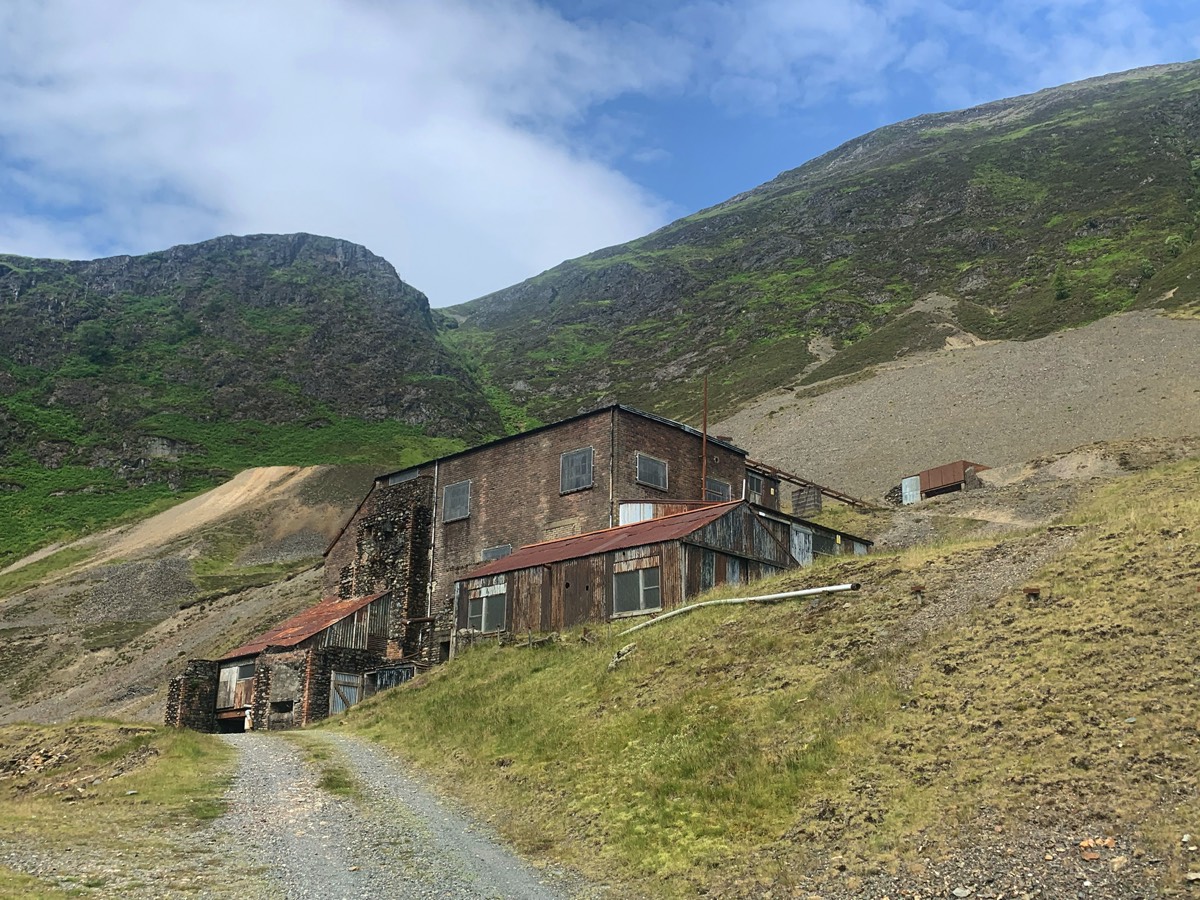
Force Crag’s mine.
One of our traveling routines is to watch kids at playgrounds for entertainment while we picnic, and the Pump Track delivered on unexpected observations. We knew that for months, or perhaps years, we’d reference the experience by saying “That reminds me of that little kid on the Pump Track in England….”
Metals Mine
Coming upon the Force Crag mine that was in operation from 1835 to 1991, was another little tasty bit to add to our rumination menu while in the area. It was the last working metal ore mine in the Lake District and had an incredibly long lifespan. We read the all the information about the environmental enhancement projects underway since 2015, carefully crossed the stream to the other side, and then proceeded above the level of the mine to have our picnic.
We noted that unlike us, all the dozen or so other hikers parked themselves on the stream’s edge for their picnics, below the mine and containment ponds, below the seepage contaminated by cadmium, zinc and lead. Bill interjected that it was only lunch, and that would limit their exposure to the deadly metals, but seeing them reminded us that we are, perhaps obsessively, scrupulous in avoiding any known contacts with such toxins. Even without the historical signs, we would have parked ourselves upstream of the inevitable hazard the mine presented.
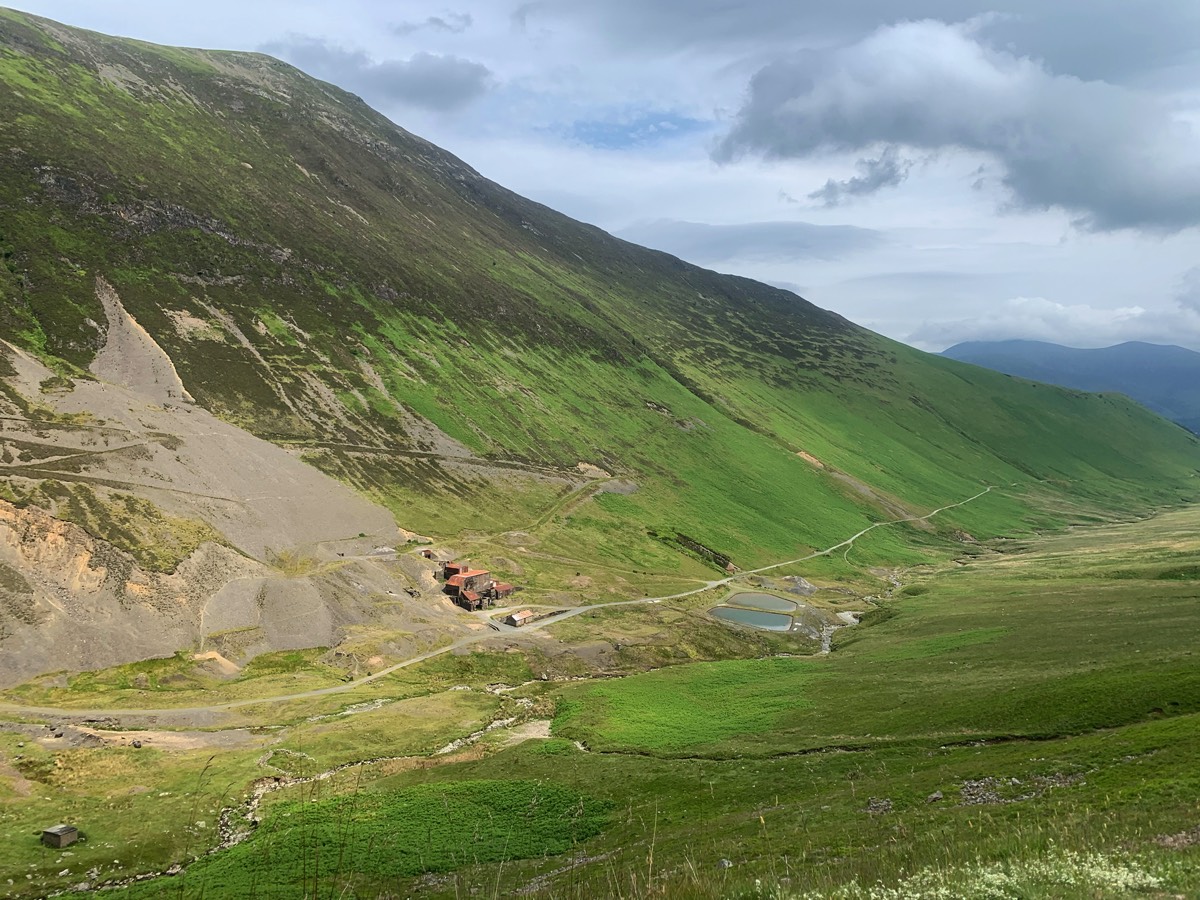
Force Crag’s mine in a U-shaded, glaciated valley.
Dogs
In the Lake District, like on the Thames and in the Cotswolds, we’d been stunned by the large number of dogs on the English paths. Contrary to our presumption, the UK does not have a high per capita rate of dog ownership but instead, we were the important variable: we happened to be walking in areas in which dogs were welcome. In all 3 areas, we saw an endless number of signs about keeping dogs on leashes because of the sheep, but otherwise, they were welcome on the field paths. And they were definitely welcome on the local buses in the Lake District.
A 2nd Cultural Opportunity Via TV
In Bristol, watching the Queen’s Platinum Jubilee Parade in its entirety on the BBC, will long be remembered by us as a special event for our 2022 trip in England. While in Keswick, it was our one-off satellite TV service proving us with CNN International, which allowed us to hear parts of the January 6 Select Committee Hearings #4, and #5, and all of #6, that was deeply satisfying.
Hearings #4 and #5 intruded on our early bedtime, so we missed the endings of both, but Cassidy Hutchinson’s stunning testimony in #6 concluded minutes before lights out at our apartment. We had entirely missed all of the first 3 hearings but felt what we did experience realtime more than made up for the immediacy of viewing those first 3.
“Just Wow!” What else can be said about that young woman’s presence, integrity, determination, and bravery? “Thank you, Cassidy!” We of course, are among those who worry for her safety and the implosion of her career goals to work within Republican politics but trust she will ultimately regain some semblance of a satisfying life.
Generally, only BBC local news is available to us on TV in England, though we can augment it with 5 minutes of BBC radio international news every half hour. We’d likely have to settle for snippets of the next hearings, but it was hard to imagine that they would pack the punch of Cassidy’s revelations and exquisite presentation of them.
WINDERMERE & BOWNESS
First Impressions
We triggered a frown, a wrinkled nose, and “It’s too touristy” comments after sharing that upon leaving Keswick, we’d base in Windermere, also in the Lake District. We were booked and had partially paid, so Windermere it would be, regardless. Not surprisingly, we were delighted with Windermere as soon as we arrived because, after all, we are tourists, and we need of what tourist’s need.
Like with our previous 5 apartments on this England trip, Bill did a perfect job of siting us in Windermere. Our “Traveler’s Triangle” is nice, quiet lodging; a food market with good to great product line depth; and close proximity to public transportation or trailheads, and he again scored. While we were becoming familiar with the area on foot the next day, he explained why nearby Bowness and Ambleside missed the mark for us in comparison to what was readily available in Windermere.
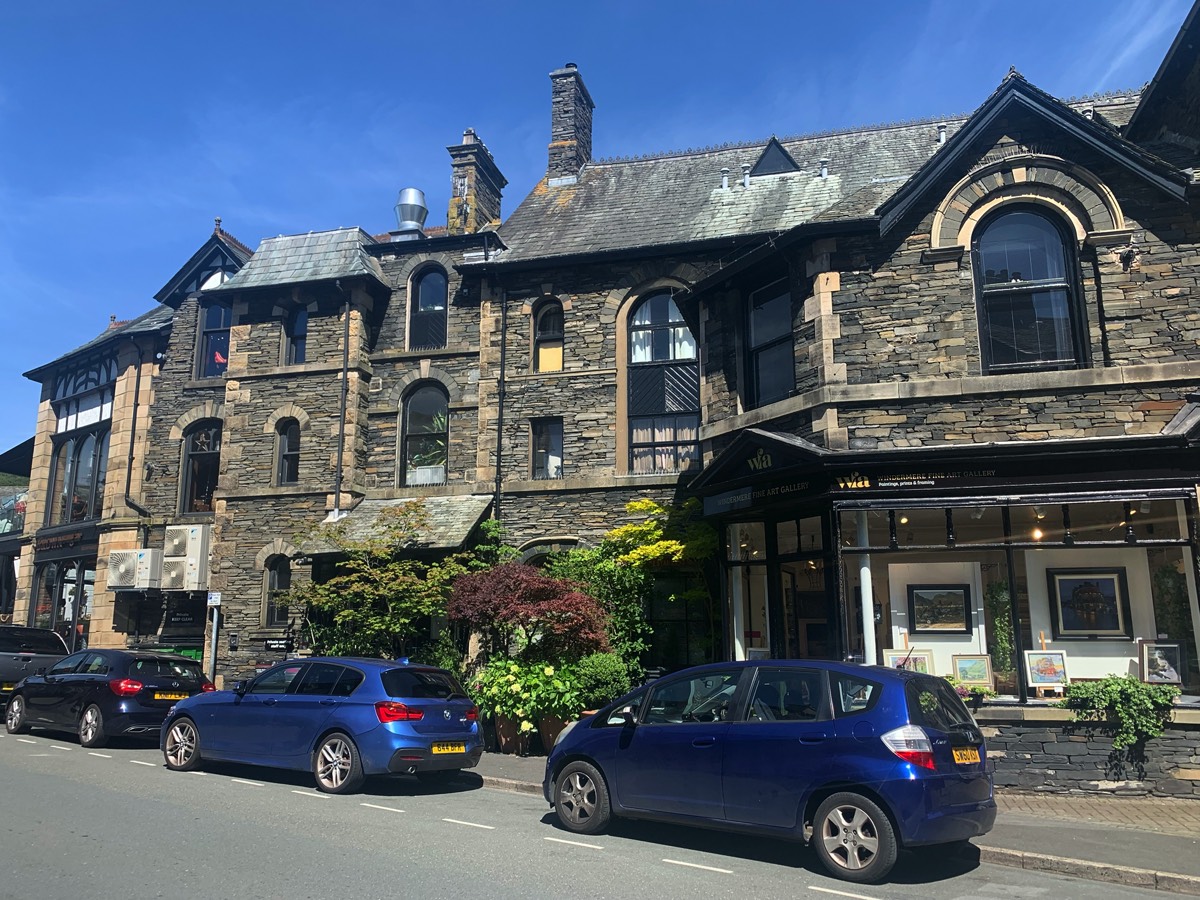
We saw lovely stone buildings like these in Windermere throughout the Lake District.
The pedestrian and shopping areas of Windermere and nearby Bowness were long and charming, largely comprised of traditional, 2 story stone buildings with ornate woodwork. These weren’t strip malls selling redundant kitsch, but late 1800’s buildings sporting shops with affordable specialty fashions and art, and restaurants. Bill caved and bought a trendy “Herdy” fine China mug featuring a fanciful sheep at Keswick and discovered the same shop was in Bowness.
Enchanting sheep, cow, and rabbit decorative items were everywhere in the shop windows. I loved the knit-shop’s sweater for a 3-year-old with an additional layer of handwork of a sheep with 3 dimensional, dangling ears and all the other sheep whimsy. In US beach towns on the Pacific Ocean, the comparable shops would have featured wooden or metal seagulls on driftwood and myrtle wood bowls.
Bill’s planned Day 1 hike from Windermere devolved into a 7-mile tourist walk along the Windermere lake and through the villages. The proper hike would have to wait because we were both loving the festive energy of the crowds on the sidewalks and paths on the chilly weekend day that constantly switched between high winds and threatening rain to brief warming from welcome sun breaks. I enjoy being around people when they are having fun that doesn’t crowd my space or senses. The place was hopping but there were no loud, pushy, or inappropriate people; it was largely couples and families out for a boat ride or ice cream cone.
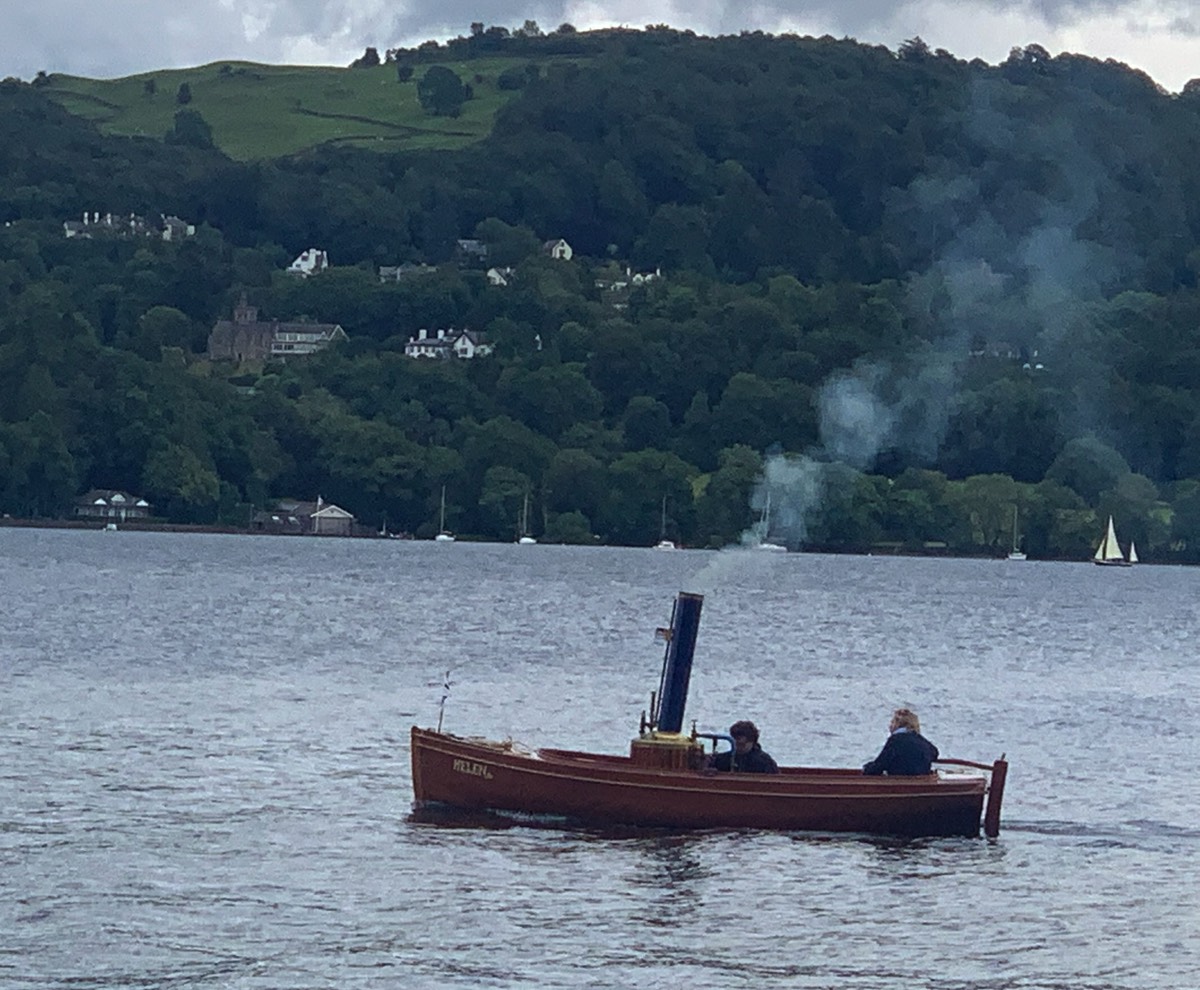
Steam powered, Edwardian-era launch replica.
The immersion in the up-energy of hundreds of tourists cruising around had been fun but spotting the steam-powered launch was a trophy find for the day, our first day in the area. This approximate identification of what must be a rare pleasure craft topped what I had thought was the funniest find of the day, which had been 2 youngish, weathered-looking fishermen pulling up to the dock in their battered boat to get ice cream cones. We’d seen ice cream trucks servicing hikers where small roads crossed the trails but working fisherman pulling in for a cone even outclassed hikers lining up in the drizzle to get a one.
Inside the Tourism Biz
Walking on a Windermere side street towards the Bowness ferry our second morning in town, we were again stunned by the huge volume of B&B’s, almost all with “No Vacancy” signs in the windows. The previous afternoon, we had read that in the late 1700’s and into the 1800’s, the idle rich had built “fantasy” castles along the lake and on its islands for their own amusement. Bill, who had researched the area during his trip planning, confirmed what I was beginning to suspect, that Windermere didn’t become a tourist town, it grew up as one.
We popped into a bookstore late in the afternoon on that second day looking for a corded phone case like I’d seen earlier on a merchant and when I inquired was told “Oh, no, there isn’t anything like that in town. We aren’t really a town but a village. It’s only the large number of tourists that allow us to call ourselves a town.” All of that was far more interesting than the phone case I was looking for and she happily answered all our questions until another customer came in the shop.
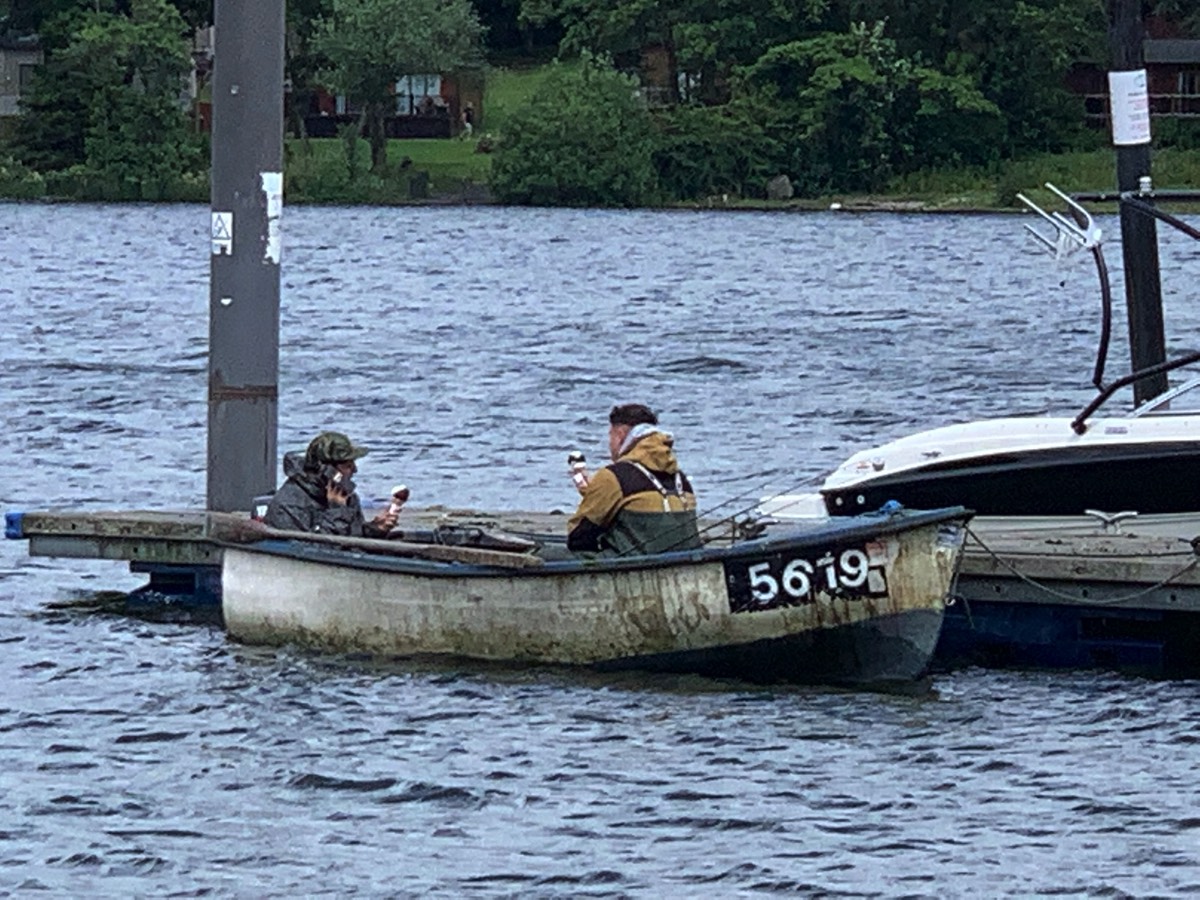
Even the fishermen stopped by for ice cream cones.
This middle-aged clerk was moving to a new rental over a 5-hours drive from Windermere and would look for a job closer to her new home because she couldn’t afford to buy property in the area. She indicated that this trend had been going on for years but had catapulted to a fevered pitch since covid.
I pressed a bit more, assuming that given all of the rain, wind, and gray days in July, that Windermere’s tourist trade was very seasonal. Amazingly, she said I was wrong, that walking the fells from Windermere was popular year-round, regardless of the weather, so tourism here wasn’t particularly seasonal. She commented that the equally popular, nearby Bowness, was especially a draw for stag and hen parties.
She confirmed again that the bad weather didn’t dampen business in Windermere, but the recent, almost doubling of the price of gas and diesel had hurt the local economy. We’d heard that from the lock wardens along the Thames, that canal boat traffic was drastically diminished this season because of the price of fuel, which was unimaginable to us. Few canal boats go much faster than a walking speed, so surely didn’t go through that much fuel on an outgoing, and it seemed one wouldn’t own a recreational canal boat if you lived on a tight budget. But both Windermere and Bowness have a huge day-tripper clientele from a radius of about a 2-hour drive and that clientele was being deterred by fuel prices.
Tackling the Ambleside Fells
Red Scree & Little Hart Crag
We figuratively put our heads down, though literally kept them up for the sake of good posture and steamed up the 20% grade of Kirkstone Road in Ambleside, the only road I’d ever seen with a professionally painted sign with its nickname on it: “The Struggle.” The half mile on it was made easier by the preceding quarter of a mile with a posted 13% grade on which to warm-up. We knew the 11-mile day with about 3,300’ of gain was going to be steep and getting some of it behind us while on asphalt was just as well.
There was almost no traffic on the one-lane road, which made it easy to meticulously scan our bodies for any trouble spots, of which there were none. We silently tended to the significant task at hand, maintaining a steady, powerful tempo without complaining—we were ready for some real hiking, even if it started on a road.
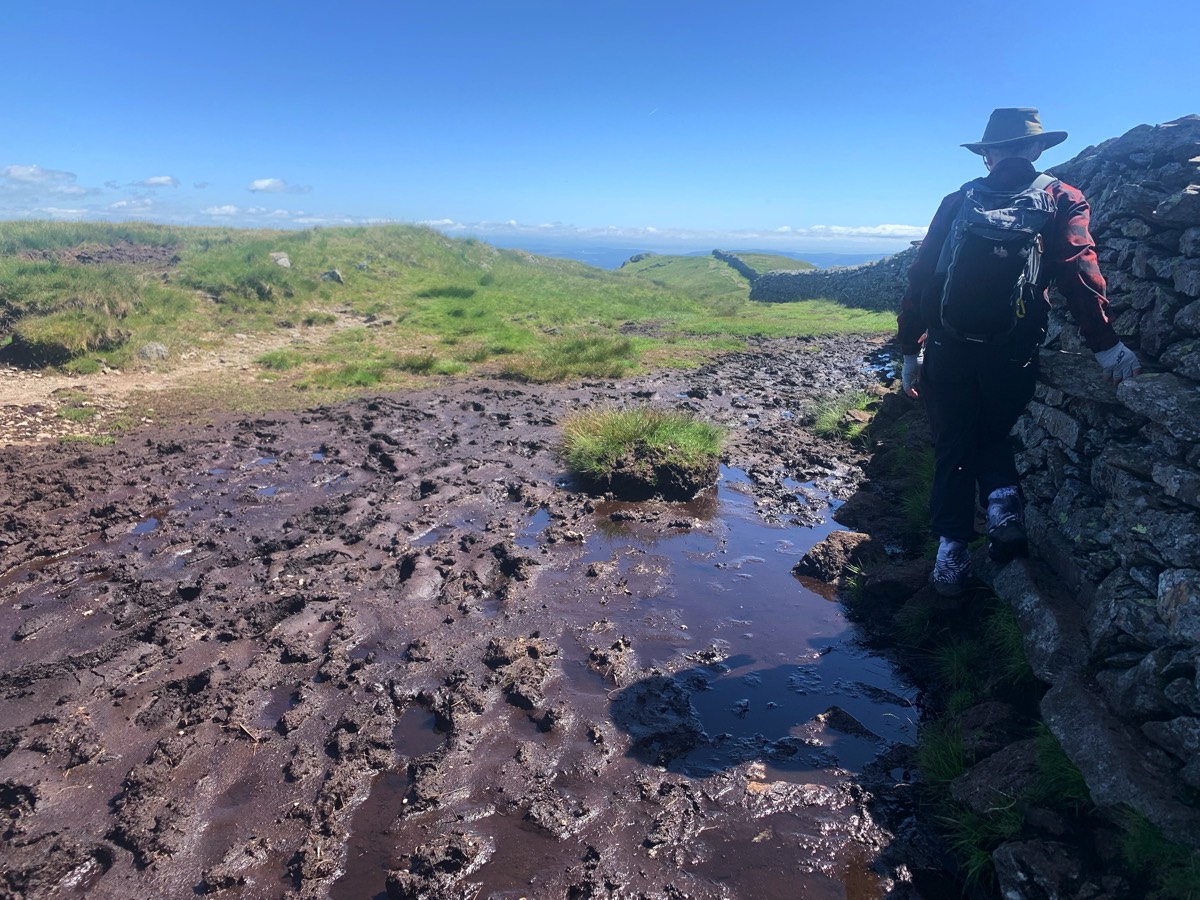
Dodging the slick mud at the top of a fell.
This day, July 7th, was a suddenly lovely day in the low 70’s with light winds and significant sun breaks and we intended to take full advantage of it in our last 4 days in the Lake District. It didn’t take long however, to discover the guidebook’s understatement about Bill’s carefully chosen route being “a little boggy” on the way up. We estimated that we spent roughly 3 hours picking our foot placements through standing water and broad water flows going up and down on both fells for the day, with the first descent being the worst by far.
We were absolutely baffled as to the source of the water and didn’t gain much clarity when speaking with a local person the next day. The water streamed through the grasses and over the rocks like snow melt on a hot day, but we were never as high as 3,000’ and there surely hadn’t been any snow for months, or perhaps years. We wondered if there were springs and yet it would have required there to have been dozens or hundreds of them to have soaked as much soggy land as we traipsed over.
Our 10-year-old, discontinued, Goretex socks were almost waterproof, though not quite, but it wasn’t the damp feet that irritated us, it was the incredibly slow going from needing to plan and test such a high percentage of the foot plants that day. We never knew how deeply our shoe would sink and if landing on a hidden rock would throw off our balance. I barely saved myself with my poles from falling backwards when both feet simultaneously went into a skid on rock-free mud. The occasional muddy patches were very slippery but, fortunately, most of our misery was only with the water depth and not mud.
For the first few hours in the muck, we were walking less than 2 miles an hour, whether going up or down. Unsurprisingly, we got in for the night about 2 hours later than we expected. Including the short bus rides, we were out for about 9 hours that day and were late in getting to bed.
For years, we’ve systematically conditioned ourselves for many challenges. Our longest-ever day hike was 27 miles and we intentionally maintain our ability to knock out a 20 mile day on short notice. We strive to keep our capacity for ‘big gain,’ like 5,000’ days, at hand. We are meticulous in fueling our bodies with low carb diets, which allow us to literally miss a meal or 2 without suffering or incurring a performance drag. And we obsessively manage our gear to keep us safe and comfortable in a wider range of conditions than expected. What we don’t train is our minds for protracted, miserable trail conditions; instead, we strive to avoid them. As a result, the challenge on this day was frustration management: dealing with our cranky minds that were out in a beautiful area on a rare, gorgeous day and yet we had to put all our attention into where to step next. That’s definitely not how we like to spend our time.
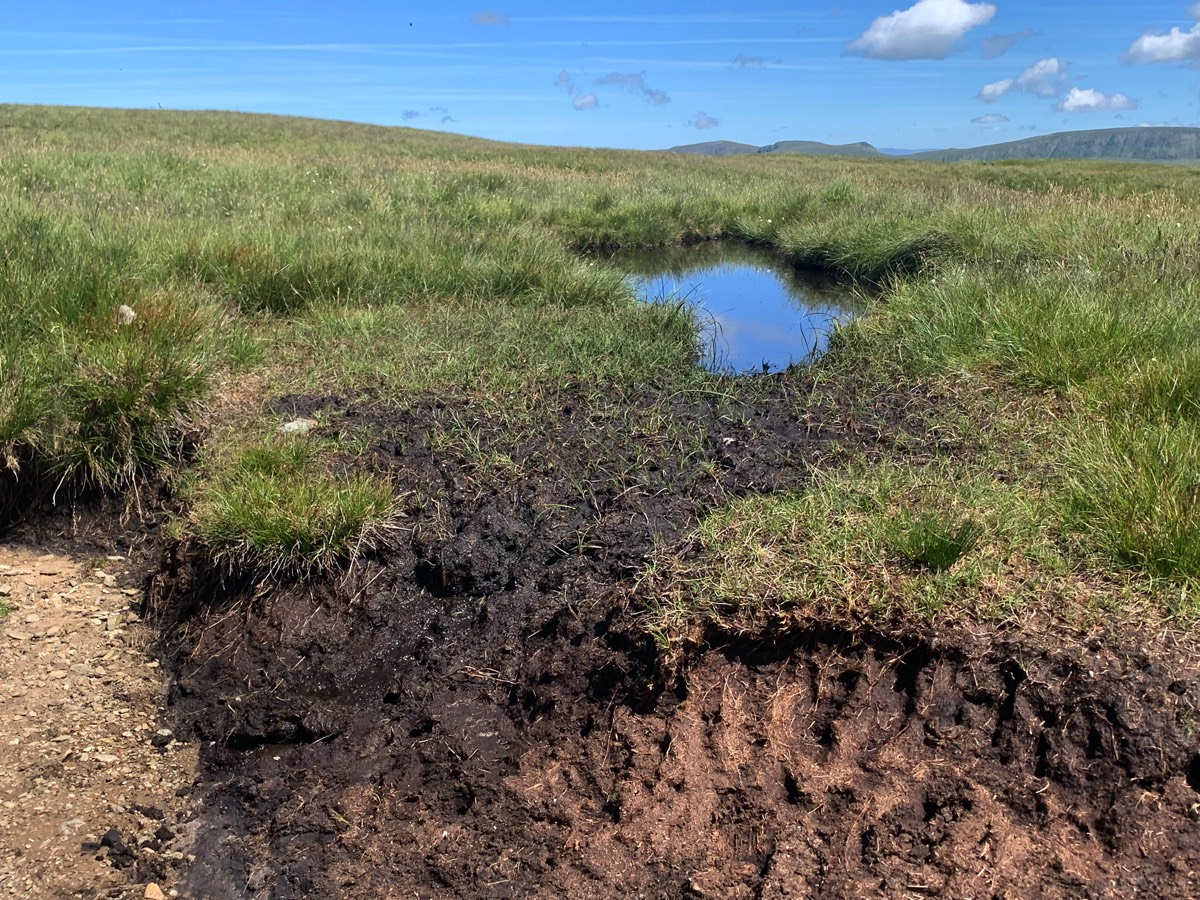
Saturated & dry soils side-by-side.
Adding to my frustration was learning that there was no way to know in advance if our next big hike in the fells would be through boggy pastures or not. Our guidebook had been useless for revealing the considerable extent of the bog hazards, the bogs were far more extensive than noted on Bill’s maps, and there was no local walkers bulletin board with shared trail reports to consult. The best local advice I could conjure was to avoid hanging valleys, which are remnants of glaciers, and hike on the routes with crowds on them. Frustratingly, it looked like trial and error was the standard approach in the fells whereas we prefer to tap local knowledge to spare us the disappointment of unpleasant hikes.
Fairfield Fell & The Horseshoe
Our moods were quite soured on our first soggy, boggy fell hike from Ambleside, but we were determined to make our last scheduled big hike in the Lake District. Bill revised his route to include a bail-out plan on a well traveled track should we again find ourselves in aggravating mess in mud.
Fortunately, our luck turned. The several days of dry weather since our immersion in the bogs substantially improved the trails for our last day. We were extremely pleased to conclude our time in the Lake District on a happier note.
NEXT UP: HADRIAN'S WALL
Walking along the English Roman wall on another National Trail that runs from the east coast to west coast was our 4th and final venue in England for 2022. Hadrian’s Wall was the only bucket list venue for Bill, the other 3 regions being good places to walk, but he wanted to experience the Wall because of its ancient history. We’d again pack our bags, hop a train, and hope for pleasing apartments and good weather in Carlisle and then Hexham. After that, it would be on to Italy!