
ITALIAN DOLOMITES August 2022
At Last, Our Heaven on Earth!
Close your eyes for a moment, imagining the sun warming your face while a pleasantly cool breeze helps your hard-working body relax into the sudden and welcome stillness. A clank of dishes pulls your attention to the plate of traditional mountain food set before you on a rustic wooden picnic table, perhaps with a glass of frothy cold beer or a slice of homemade apple strudel. Or maybe you are on the grassy slope below the hut’s wooden patio, or on a rocky perch above the small building, for your well-deserved picnic.
Your eyes lift past the food to see perhaps 100 named peaks encircling you at your 8000’ (2500m) refuge. Little more than a half an hour earlier on the trail, you were hearing the distinctive, mellow tones of a traditional alpine horns concert from the valley floor 3,000’ below.
Closer by, there were the occasional clanks of cow bells or the bleating of sheep. Now at the hut, it’s the buzz of dozens of jubilant hikers, largely Italians, savoring their respite in the middle of a hard, 6 hour or more, hiking day. For almost all, the details of the sweat and strain from hours of hard climbing in thin air fade in the presence of the awesome mountain majesty.
At Last, Our Heaven on Earth!
Close your eyes for a moment, imagining the sun warming your face while a pleasantly cool breeze helps your hard-working body relax into the sudden and welcome stillness. A clank of dishes pulls your attention to the plate of traditional mountain food set before you on a rustic wooden picnic table, perhaps with a glass of frothy cold beer or a slice of homemade apple strudel. Or maybe you are on the grassy slope below the hut’s wooden patio, or on a rocky perch above the small building, for your well-deserved picnic.
Your eyes lift past the food to see perhaps 100 named peaks encircling you at your 8000’ (2500m) refuge. Little more than a half an hour earlier on the trail, you were hearing the distinctive, mellow tones of a traditional alpine horns concert from the valley floor 3,000’ below.
Closer by, there were the occasional clanks of cow bells or the bleating of sheep. Now at the hut, it’s the buzz of dozens of jubilant hikers, largely Italians, savoring their respite in the middle of a hard, 6 hour or more, hiking day. For almost all, the details of the sweat and strain from hours of hard climbing in thin air fade in the presence of the awesome mountain majesty.
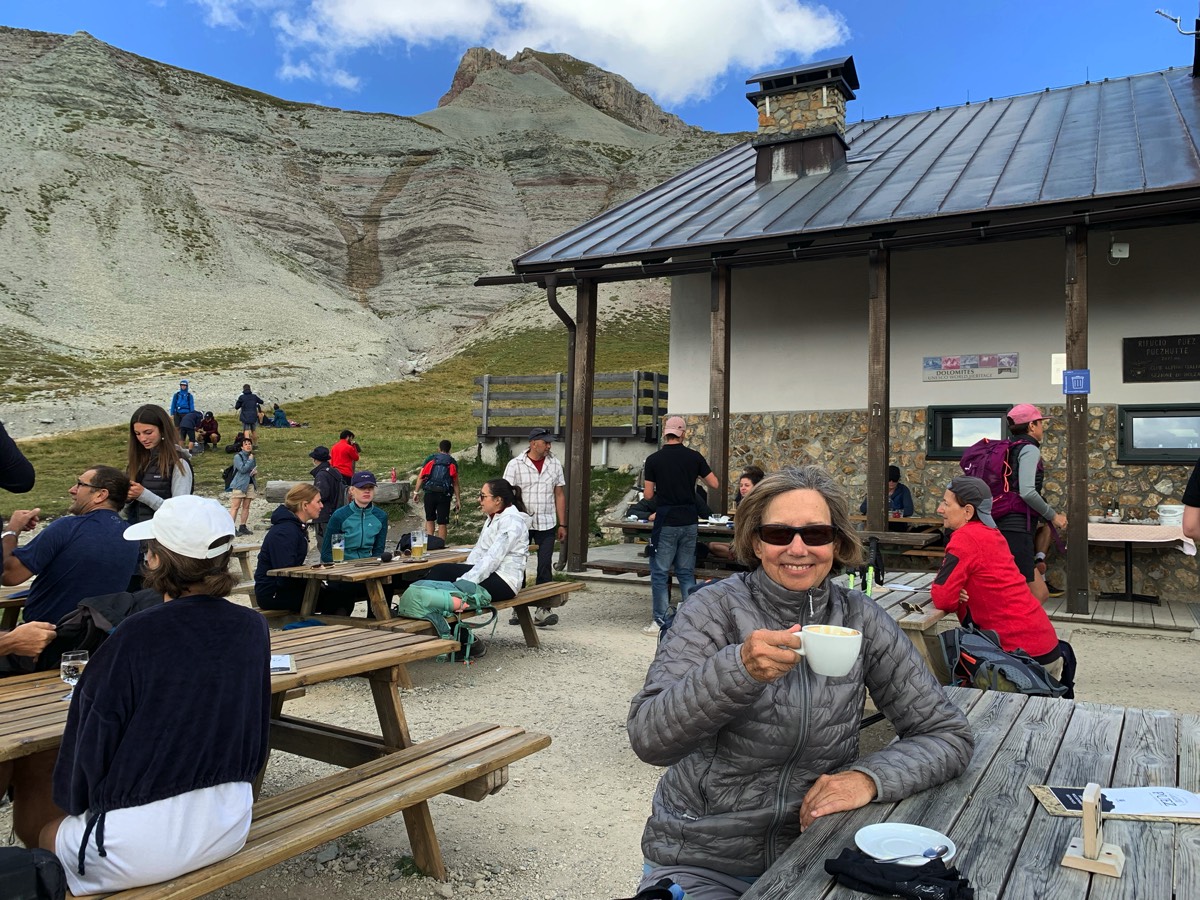
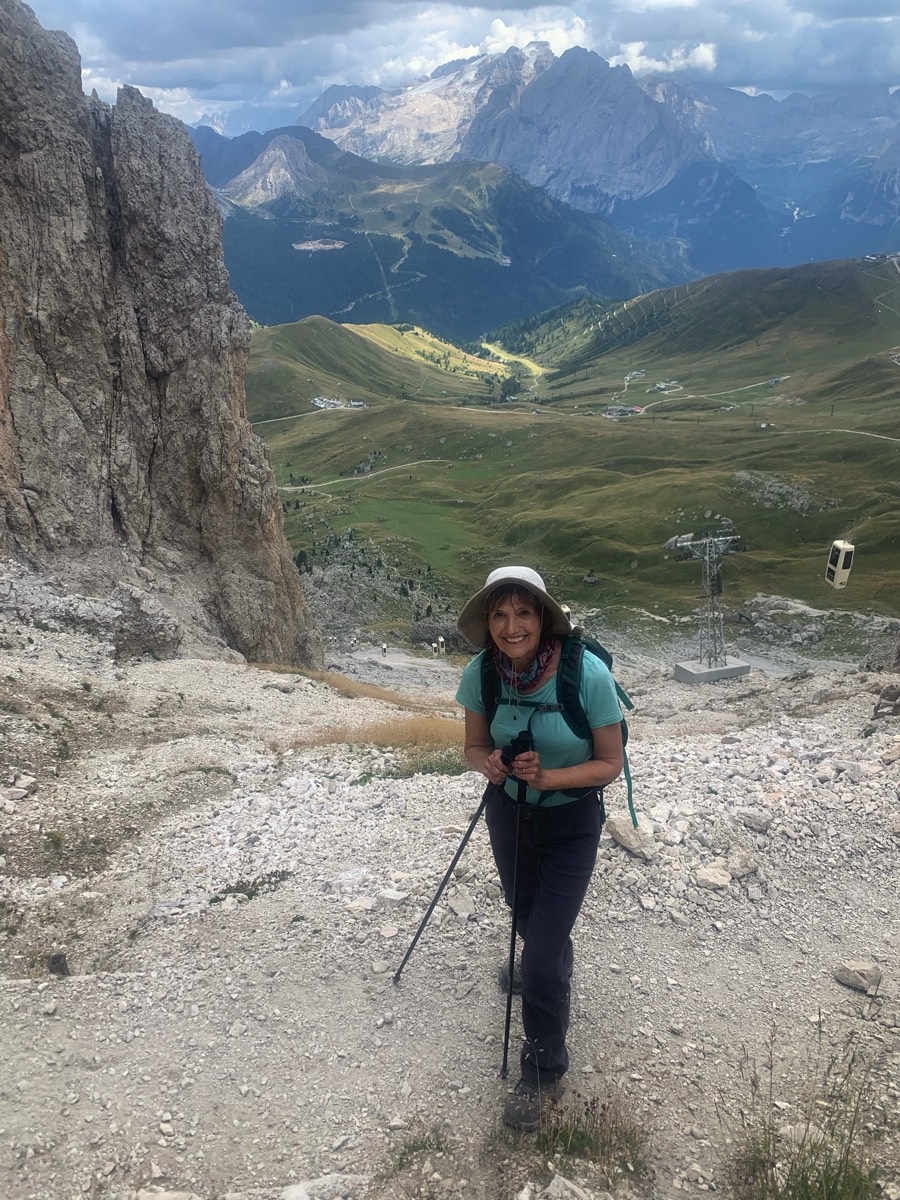
Our friend Margaret savoring her hard-earned cappuccino at Rifugio Puez.
The hike on our first day in the Dolomites this year wasn’t as epic as later going to Puez, but we were just as captivated by it. By design, we’d taken an unfamiliar route to Rifugio Comici on the way to Passo Sella. Unknown to us, the lift line trail through the forests had been officially relegated to mountain bikers sometime in the last 3 years and we were forced on to the steep, grassy slopes of the ski runs, which turned out to be a bonus because of the phenomenal panoramas on our way up to our 7,000’ destination. By the time we parked ourselves on the cow-trimmed pasture with other picnickers, we’d already identified many of the trails and peaks in the distance on which we had previously hiked. Almost slack-jawed, we marveled at how much of the scene before us that we knew by name.
The clouds obscured the sun, and the afternoon winds came up, urging us to move from our reminiscing trance. My plan for the day had been to walk unknown trails to a known place, so we headed down another ski slope for our return and immediately regretted that we’d previously shunned the route. The panoramas put our favorite sights in a new light, adding to our excitement, to our sense of being in our heaven on earth.
Little did we know however, that this visually stunning route would soon dish-out some drama for our bodies when we began descending on our first-ever, sustained, almost 60% grade. I had been taken aback by the severe inclines of some of the English fells ‘straight up the fall line’ slopes, definitely stating that nothing we’d done in the Dolomites was that steep. I immediately retracted that statement.
It must have taken us 10-15 minutes to carefully walk down the steepest segment of the racecourse on short grass and across a bit of soggy land. When researching the slope grade that evening, I learned that competitive skiers begin the course with a huge jump at the top where we had been and are at the bottom in two minutes. “Yikes! Yikes! Yikes!” was all that we could say while being grateful that we had kept our feet under us for the entire descent.
On another day during our first week in the Dolomites, we swung by the market at the end of a long hike and noticed the traffic was completely stalled on the main village road, a road that was the only access to the pass. I’d never seen a back-up in town in which all the vehicle engines were turned off. Normally, the local uniformed traffic cops keep things moving regardless of individual driver antics.
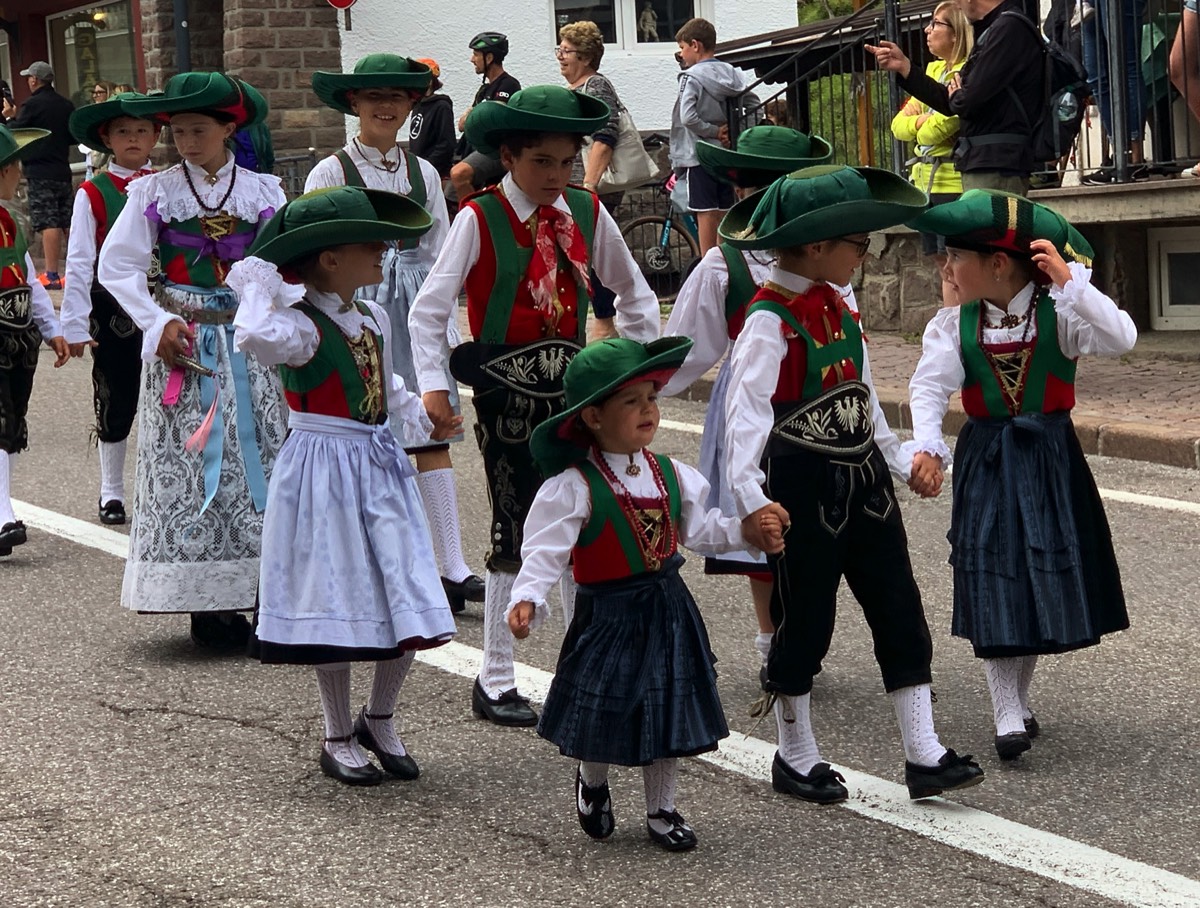
Teaching the Ladin language in schools also keeps the mountain culture alive.
E(asy)-Bikes
One of our more trivial sources of lament, regret, and fear during the first 2 years of the covid pandemic was the demise of our new e-bikes stashed in these Italian Alps. We were confident that the bikes themselves were safe and secure in the indoor storage room of our favorite mountain hostess, but the two $1000 batteries were surely suffering from neglect. Such lithium-ion batteries have specific storage requirements, like being stored with half a charge for no more than 6 months at a time, then being fully recharged, and being partially discharged before further storage. Our darlings were going on 3 years without a feeding. We hoped for the best but feared the worst.
Much to our delight upon our arrival in Selva at the end of July, when Bill pressed the buttons to display their level of charge, my battery had a reassuring amount remaining and Bill’s had just enough juice to register on the crude scale. Bill’s battery was a bit wonky when charging it, but both performed well on the first couple of short rides. With luck, any degradation in their health or longevity would escape our detection because of our lack of recent experience with them. We were so grateful to spend our time riding these beautiful bikes during our month in Selva after pumping-up their pancake-flat tires and not struggling to buy new batteries for the less common brand of bikes in Italy.
We’d only ridden these bikes a few weeks before putting them away for the winter in August of 2019. Embarrassingly, I had totally, I mean totally, forgotten how to operate them. I couldn’t even remember how to turn mine on. Bill kindly guided me through every function. Worse than feeling so ignorant and incompetent, was having my tens of thousands of riding miles reflexes be all wrong on the bike.
The most dangerous loss was grabbing for the brake levers in totally the wrong place. When in a pinch, I was also grabbing for the lower hand position of my road bike drop handlebars that didn’t exist on this mountain bike with straight bars. These phantom positions made me tense, anxious, and a tad unsafe the first several rides.
We had also forgotten how pleasing these bikes were to look at and how nicely they handled—they were dream bikes. Transitioning between the 4 levels of power assist on e-bikes can be jerky and downright dangerous, but these Bulls-brand bikes were smooth and immediately safe feeling.
Along with obsolete positional reflexes, in 3 years, my nervous system had lost its adaption to the dicey traffic on the sometimes one-lane mountain passes where full-sized buses squeeze by each other in opposite directions. On our old pedal bikes, it was the terror of potentially lacking both the leg and arm strength to sustain the needed momentum to make it to the summit, plus the steeled nerves. Mercifully, the e-bike covered the power need but added a tad more speed to sorting the tricky timing in traffic.
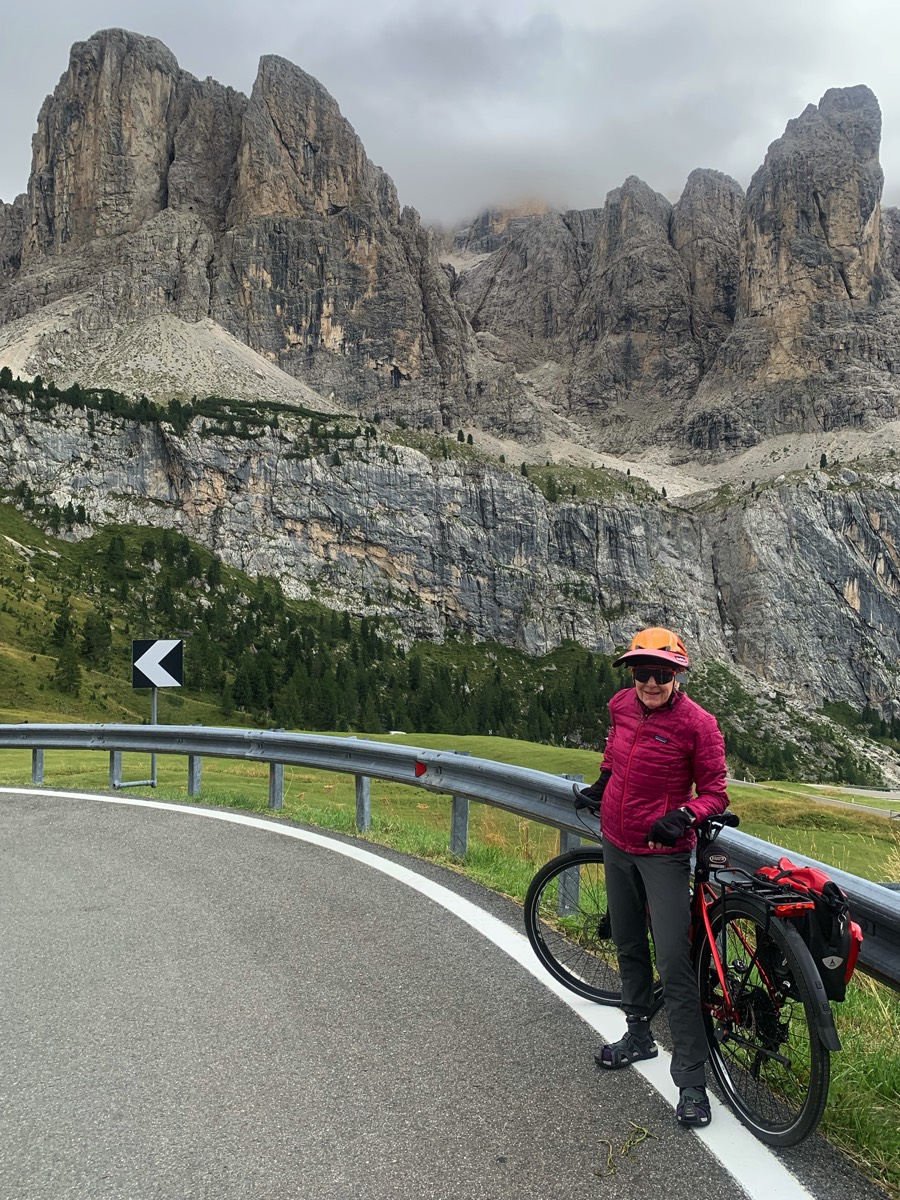
The thrill of driving or riding the successive switch backed passes is what draws many people to the Dolomites.
The luscious aspect of the e-bikes in the mountains was that unlike with regular bikes, we could actually indulge in day rides: we could cross-train at almost any level of effort. In our favorite village of Selva, there is no such thing as “flat”: it’s steep and steeper (remember that 60% ski slope?)
Since we had e-bikes, we could dare to bike the day after a hard, 15-mile hike to Rifugio Puez, a day when we had been too tired to also hike to the peak; we could do a 20-mile bike ride up and down 2 passes with the electric assist guaranteeing we could get home.
Our e-bikes don’t go if you don’t pedal, so it isn’t just a scooter ride, but we could ride together at different levels of effort. On one ride, I did all the climbing on the middle 2 power levels, whereas Bill favored the lower 2. We each attained the workout we wanted and didn’t have to worry about collapsing part way up the 2nd pass.
Like we had decided back in early March when Bill bought our round-trip air tickets through London, we would not bike tour in 2022, even if we were able to be in Italy in August. Lodging was already fully booked for the summer in some of our favorite Italian hiking venues in March and given that the welcome mat was not yet out in Italy because of covid, planning a bike tour didn’t pencil out. We instead cringed and resigned ourselves to paying high-season rates at 2 of our favorite places in the Dolomites where we could still make reservations when Italy cracked open its doors to tourists in May.
Instead of touring, we’d be happy to have revived or replaced our bike batteries and would use them for local transportation in the mountains. Like in England, getting around in the Dolomites can be expensive and time consuming without a car, which we never have. We’d risk parking our expensive bikes at trailheads, something we never did in the Dolomites with our regular bikes, because e-bikes are easier to replace than our custom touring bikes. We’d be biking but doing it differently than ever before.
It’s Binary
“It’s not binary” was a newly popularized phrase in the last year or so that I began repeating as a little household joke, but the composition of the crowds on the trails and sidewalks in Val Gardena and of those in their vehicles on the main road through the villages and on to the passes, were very binary.
We basically only overheard Italian spoken by the walkers and yet on the road when we cycled, Italian license plates were sometimes in the minority. After 2 rides over the 2 closest passes, I’d counted 15 foreign registrations; before we left the area, my count was up to 20. In addition, some of the Italian cars were likely rentals driven by visitors from far afield. We know that tourists from the Nordic countries often fly to Italy, then rent a vehicle. The most distant plate was from Greece.
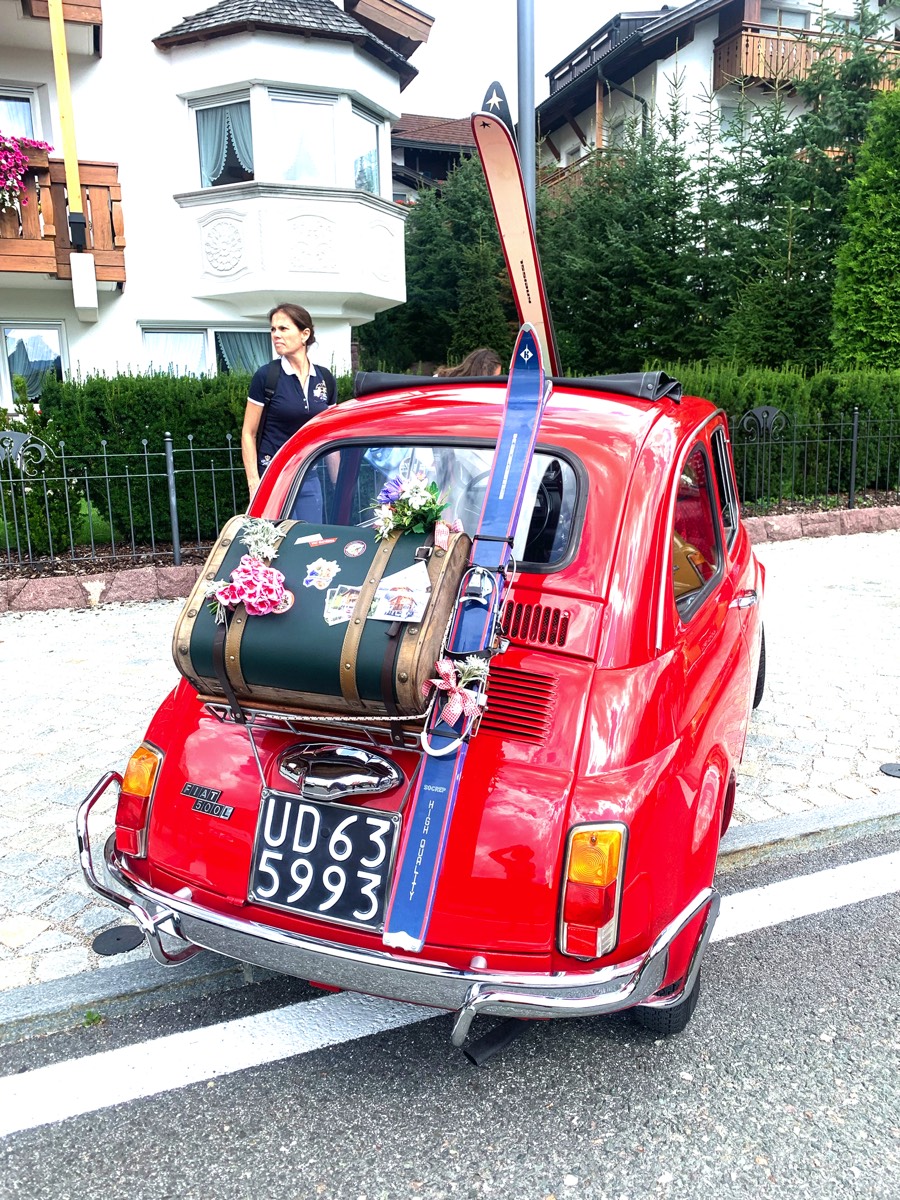
Tourist travel in the Alps the way it used to be done.
The overnighters were unmistakable first thing in the morning in their warm jackets with hoods, slumped in folding chairs with arms crossed for additional warmth, looking groggy because it was still too cold to wash up in unheated water. Some had small fry pans on compact cook stoves, others munched on a stale baguette from a long paper bag, and still others had unfolded solar panels upgrading their standard of living.
The nationalities of the free campers were diverse, and I briefly wondered what the appeal was in sitting in the cold of deep shade with dazed looks on their faces. But especially the French and Spanish plates reminded me that their countries were drying up, were literally in flames now, and the moist, cold air was likely a relief.
Anticipating Entertaining Guests
We were delighted that 2 of our strong hiking buddies from the desert hiking club decided to join us for a few days in Selva this season. They are both fun, capable hikers and international travelers and we were thrilled anticipating sharing some of the knowledge we’d acquired over 20 years of travel in the area with them.
Their pending visits during our 4th of 4 weeks in Selva motivated us to revisit via ferratas and trails we might not have otherwise done. Several times, I directed us to make small detours for the sake of “seeing what has changed.” There were little surprises with each jog in our route. A brand-new winter funicular had been added at the site of a pre-existing cable car and what was formerly a free shuttle bus between the village and another lift, was now 3.50 Euro. I appreciated this little bit self-imposed pressure to update our knowledge base after the 3-year hiatus.
Uncertain Future
All the crises that followed covid weighed heavily on us this summer, and seemingly everyone, for the future of the world and for travel. But, upon getting information from friends about the improved visa situation in France, Bill was eagerly planning an extension there for the summer of 2023. Concurrently, viewing the severe heat waves, wildfires, and then water shortages in France terrified me: how could we possibly travel on bikes in France, or anywhere else, in the future? The predictions that Europe would be hit harder next year with these new perils than other places in the world, made it seem like a potentially very uncomfortable gamble.
In the Dolomites in August, we were having unseasonably cool and wet weather, but given the world around us was melting down, we didn’t grumble. We lamented that the excess clouds were interfering with our views and photos of our views, and the rainstorms necessitated careful activity planning, but we weren’t sweltering in the heat day and night. Our friends in Switzerland were often having hotter days than we were.
It was hard for me to imagine risking any other destination than at the 5,000’ level in the Dolomites for future summers. Pre-covid when we would travel around the Alps for 3 months, we’d often encounter a few sweltering nights when at lower elevations and I wasn’t keen on doing that again, or worse.
Discouraged and terrified by the sudden, dire effects of climate change, we’d leave our delightful 5 weeks in the Dolomites this year hoping that there would be a few good traveling years ahead of us. Like the Portuguese man on the news had said, it would be years before the forests near him would revive after the wildfires were extinguished and he wouldn’t be alive to see them.
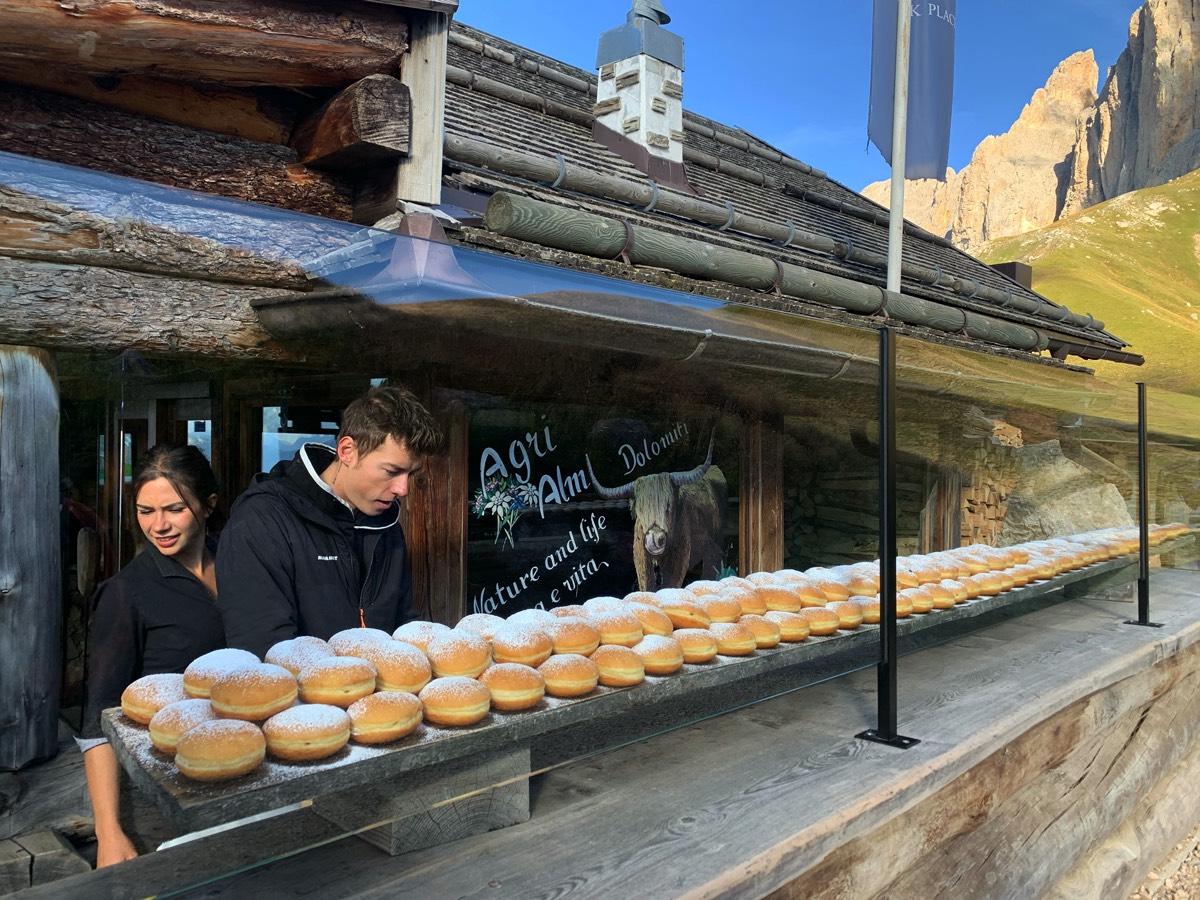
Over 200 freshly baked, cream-filled buns would be sold in less than 2 hours at the start of this trail around Sassolungo.
The one thing we would have loved to have changed in the Dolomites over these last three years was the regrettable etiquette of the Italian tourists. A 21-year-old hostess, originally from Rome sharing the views from Puez peak with us, summed up our sentiments well with her passionate lament: “They have no respect for anything!” Many Italians act like such careless disregard is a birthright.
During the 2008 global financial crisis, many European governments admonished their citizens to spend their holiday money at home rather than traveling to other countries. The Germans and Austrians, who had been our primary lodging neighbors and trail mates in the Dolomites, abruptly stopped coming to these mountains and never returned in numbers. Their void was filled by central Italy tourists and our Alpine Disneyland has never been the same.
Previously non-existent litter was suddenly everywhere. A favorite magical thinking act of Italians is to leave toilet paper behind or under benches, or 20’ off a main trail. Apparently, if the pile of TP is big enough, the mound of poop you leave in the middle of the trail is canceled. A scattering of orange and apple peels lay where dropped in front of a favorite panoramic bench; cucumber peels were stowed underneath another. Food wrappers and cigarette butts were a daily sighting on trails after the guest list changed to predominately Italians.
Our non-Italian apartment building housekeeper was totally exasperated by noon one Saturday, change-over day for weekly-only, high season reservations. There is a strict ‘leave by 9 am and check-in after 3 pm’ policy, which was blatantly being disregarded by the Italians.
One family arrived at 8 am demanding entry while another family due to depart began cooking their breakfast at 9 am. While chatting with our hostess around noon, she began rolling her eyes at a new guest who had been among those arriving hours early who couldn’t find her way back to her unit #250 because the numbers on our floor ended with #249. It took an inordinate amount of time, in Italian, to convince the woman to walk up the stairway she was already on to the next floor to find her apartment. Both hostesses complained about how endless demanding of their time that some of these Italians were.
The owner of our apartment building does however do her best to control the chaos. We learned a year later that a particularly obnoxious Italian family next to us was not allowed to return the following season. They heavily indulged in a southern Italian habit of only communicating within the family by shouting at each other. Screaming children, loudly making phone calls from the shared balcony area, and smoking are behaviors we never experienced in the mountains before the foreign visitors were displaced by Italians. Even before “the crisis,” a young Italian tourist information clerk had lamented “Then, the Italians will be coming!”
High-Season
Our decades of habitual frugality had made it easy to never be in Selva during high season, which was when the prices skyrocketed. Those prices were still a fraction of the ski season rates, but we easily developed a repertoire of more moderately priced venues in the Dolomites during the peak season. Covid made 2022 different, with the rules for foreign tourists visiting Italy being eased relatively late, resulting in our trip being a “tacked-on” destination. Lucky us, from the time we booked our flights in March until we arrived in Italy at the end of July, the value of the dollar shot up, making the Euro and dollar about equal in value, which nicely softened the sting of paying high season rates.
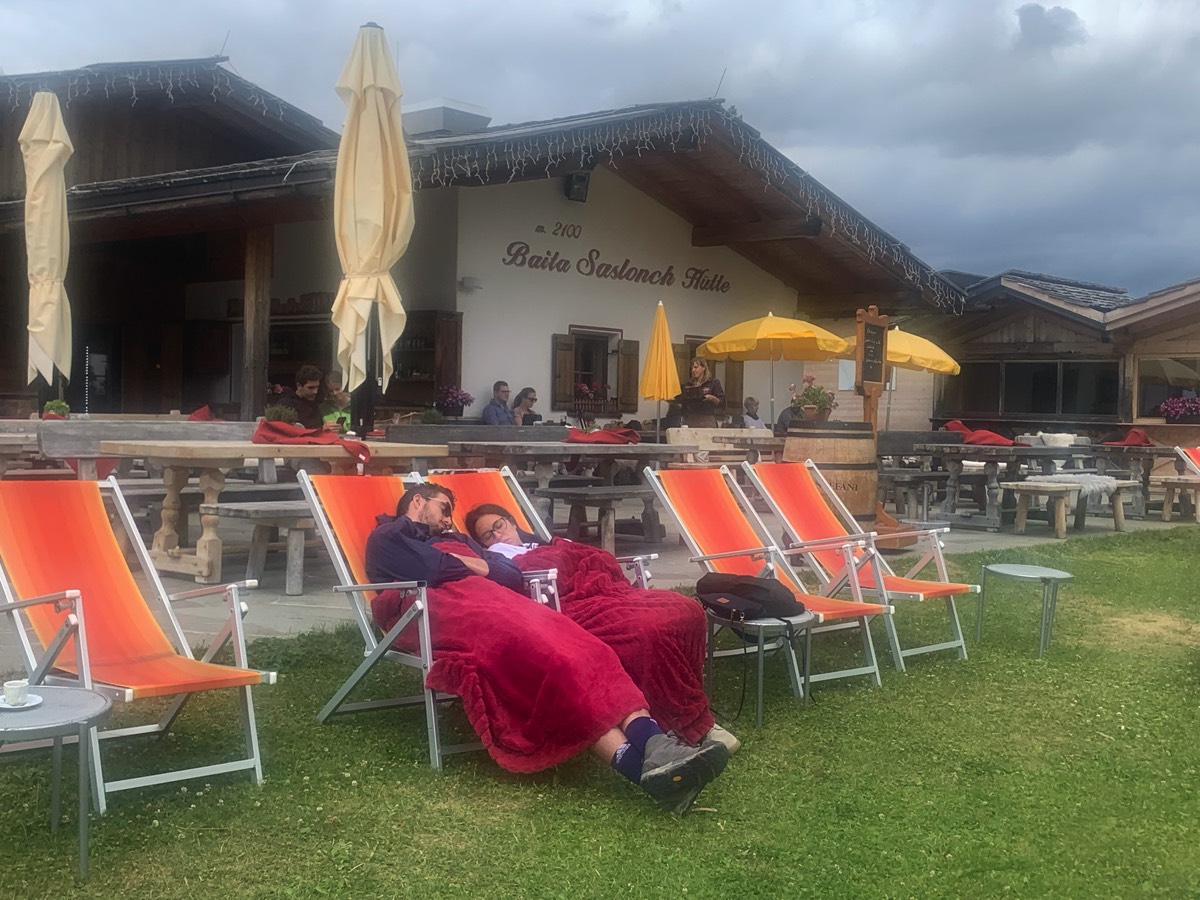
The look of a mountain holiday for some Italians.
We were however stunned by the differences in the high season scene from our usual shoulder or low season experiences in Selva. We were dumbfounded that there were more vacancy signs out than we remembered seeing in the past, especially since all of Europe was burning up in the succession of heatwaves. Each day, the TV map of greater Europe temperatures was usually solid red depicting the excessive heat and then there was a green strip starting in eastern Switzerland and extending into the Italian Alps.
We were also surprised to see the sidewalk scene at the peak of high season in Selva morph into a more upscale space than ever before. Such fashion promenading was what we associated with Cortina or Ortisei, but not Selva. Sprinkled among the hikers, bikers, and people strolling in trail attire, was a wave of more high-styling visitors.
Deeply tanned men in crisp, white, casually elegant shirts open at the collar just so with tight fitting designer jeans; a woman with her elegantly floppy, plunging neckline silk blouse with her pretty lace bra jauntily exposed; and a younger woman in Lederhosen hot pants, eyelet blouse, black velvet bustier vest, and urban hiking boots with bright red laces and edelweiss flowers embroidered on the ankles gave us more to notice on our way to the market than usual. We are meticulous in selecting our 3 shirts and 2 to 3 pairs of pants when we travel for 3 to 9 months, but these folks were spending vastly more time and money, as well as space in their luggage, on their presentation than us. With the usual scene, my eye is more likely left to be entertained by a men’s sports shirt that would look good on Bill or a splashy blouse on an older woman.
The new wave of mountain visitors was amazingly absent from the trails. As the high season momentum grew from the beginning of August to the peak of the season beginning on the 15th, we expected the lower trails to be swamped, but they weren’t. Over and over, we commented “Where are they?” Finally, we discovered that they were packing the urban asphalt multi-use paths in their beefy, new hiking boots and using their new trekking poles, which was a phenomenon we’d seen in nearby Ortisei, but never in Selva.
Previously in Ortisei, we came to understand that for a segment of the Italian tourists coming to the mountains, buying new outdoors outfits, and strolling around town in them was an important element of their holiday, with one man even topping-off his outfit with a mountaineering rope. We snickered at first and then found it endearing—it was how they celebrated their mountain holiday and we switched to loving seeing them so self-satisfied in their never-soiled new outfits.
Peak Experience!
“Wow, wow, wow!” describes it well: we had a FANTASTIC time in the Dolomites with our friends Bonnie and Margaret from our desert hiking club. I don’t believe that they had previously hiked with each other, and they didn’t travel together, but they are both strong, fit, capable, competent hikers with more diverse experiences than us.
Bonnie was all smiles upon reaching the 8800’ saddle on Sassolungo to ride the lift down.
We condensed our almost 20 years of experience in hiking, biking, and logistical problem solving in the small mountainous area, and combined it with our recent targeted recon, to create a head-spinning 4 days for them. What was most surprising, however, is that our heads were spinning on each of those days too. Margaret and Bonnie will have to judge for themselves if their brief visit to the Dolomites rates as a peak experience, or somewhere on the continuum, but it looked and felt like it to us.
Wiki summarizes Abraham Maslow’s peak experience research with:
“rare, exciting, oceanic, deeply moving, exhilarating, elevating experiences that generate an advanced form of perceiving reality…
According to Maslow, often reported emotions in a peak experience include ‘wonder, awe, reverence, humility, surrender, and even worship before the greatness of the experience’.
Specific examples of when peak experiences often occur:
..scientific discoveries; seeing or discovering some phenomenon for the first time
..extreme sports activities—mountain biking, motorcycling, mountain/rock climbing, sky diving, snowboarding.
Even more astonishing to us was that what we perceived as them having peak experiences was the infectiousness of their emotional states: we were very buzzed by their euphoria. Seemingly, peak experiences, or other highs like ‘sex, drugs, and rock & roll’ or endorphin highs, are self-contained, not radiating events. But we were overtly ecstatic by being in their presence while they seemed to be in raptures about our favorite places and events in the Dolomites. It was a profound, unique experience for both of us that we will always treasure. We quickly noticed pleasant memory pods of their joy had been formed and anchored for us in certain places that overlayed our own history which will forever be associated with those specific locations.
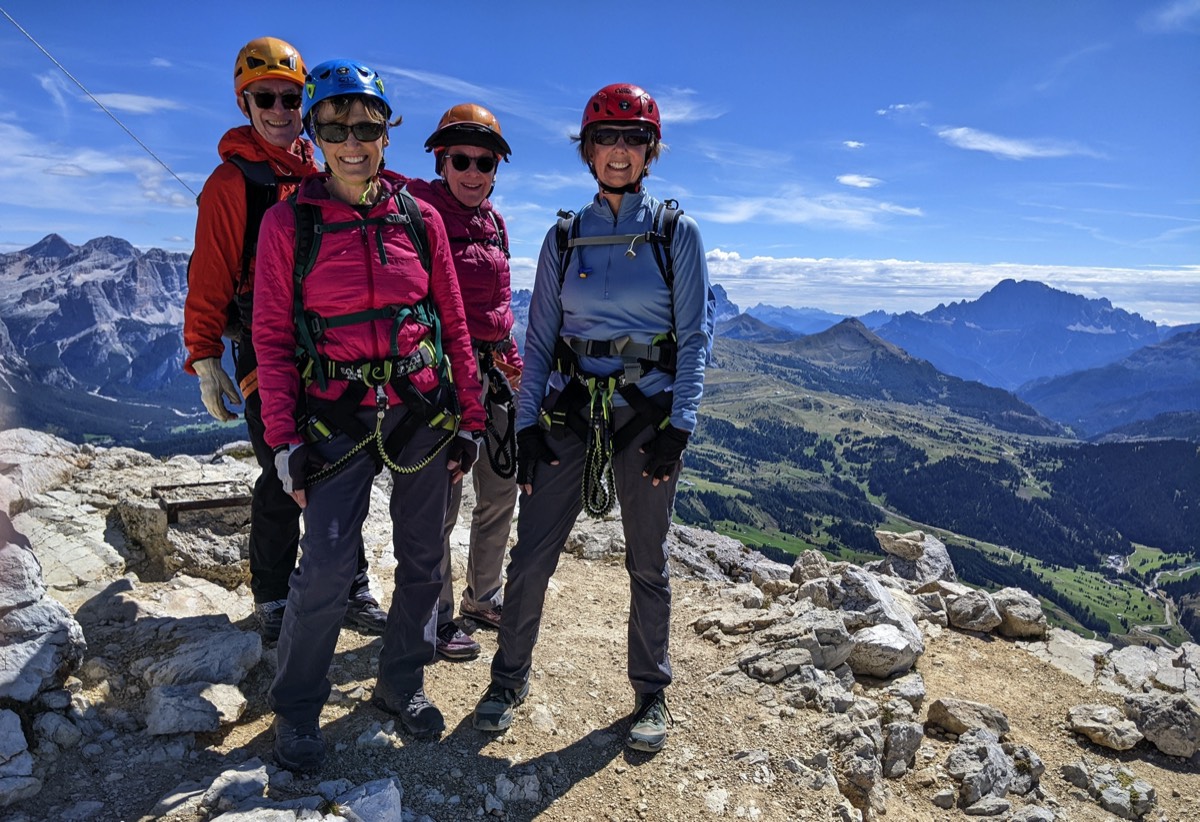
Summiting Sassongher via its via ferrata was an epic experience!
My most memorable comment from Bonnie was “I don’t want to leave!” when we were poised to board the bus back to Selva after our 3-hour meander at Passo Sella, 2200’ higher up the mountain than the village of Selva. I’d been overly ambitious for us the day before and stuck to my promise to be on the bus by noon this day. I happily obliged her, saying “We don’t have to leave.” She didn’t know what she wanted to do, but following her lead, we did a tough hike to 8800’ on an intensely switch backed, loose rock trail. There, like elsewhere with the two them, we’d never seen either of them smile so big with smiles that seemed to come from very deep places. Bill too was flashing grins I’d rarely seen, just from being on the trails with them.
Margaret loved the via ferrata hiking experience she requested we organize, and she and Bill did a more difficult route the next day. It’s clearly Margaret’s new sport. Bonnie didn’t know what a via ferrata hike with climbing equipment was about but read that it was the iconic thing to do in the Dolomites and steeled her nerves to join us on the first one. I suspect she was terrified at times, perhaps worst the night before when she was trying to sleep, but she did it, and was ecstatic that she was successful. Unlike Margaret, Bonnie wouldn’t be doing another one anytime soon, but she was immensely pleased to have done this moderate event in the middle of a challenging and dramatic hike.
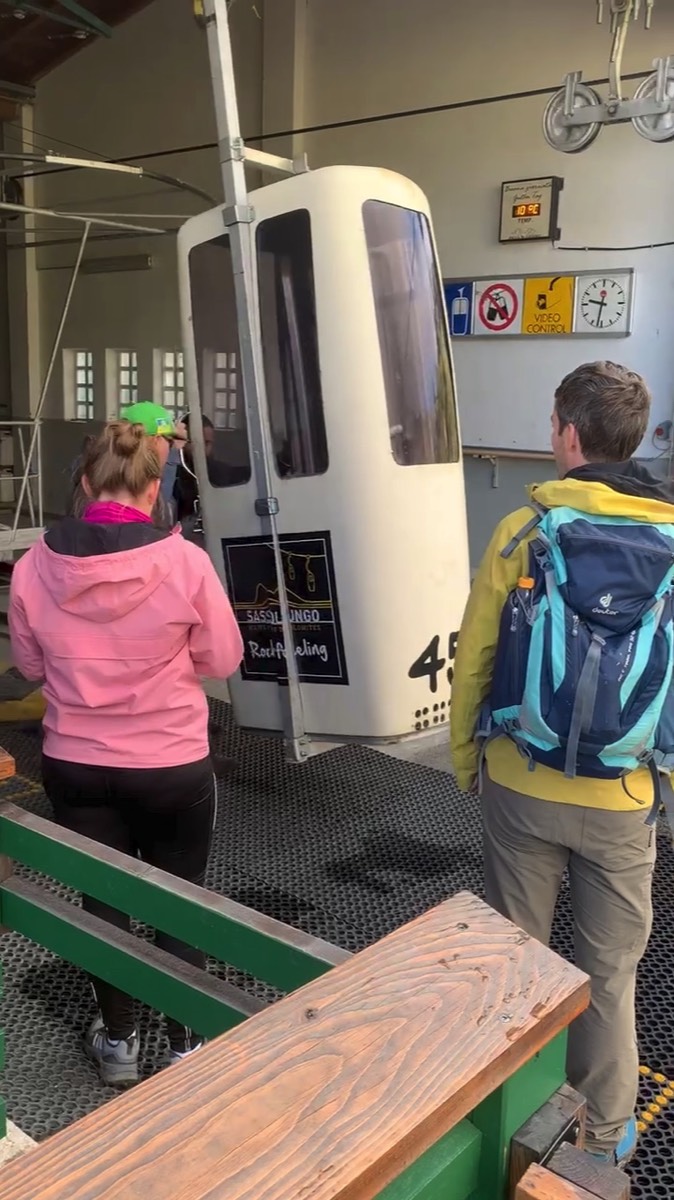
A wild ride like none other!
Bonnie was so thrilled with herself that she gave me a bear hug when I jumped in the tiny cable car behind her and squealed “That was SO fun.” We don’t often get to see, hear, and feel such profound joy of another, and I felt privileged to have been a part of her palpable delight, both at the mountain saddle and when boarding the unique lift from there.
One of my regrets in life is that Bill and I were both programmed to keep pushing and when we finally reached pivot points, important moments in our lives, we’d already moved on before savoring them. Things like graduations were presumed and we didn’t bother to go to the ceremonies or celebrate; we received the documents in the mail after we were already on to the next step in the planned progression of our lives. Even our simple wedding ceremony was packed in with a professional conference on a quick trip. Now, we take time to carefully savor the moment, but that’s usually a nice view for our daily picnic, not a major life event. Sharing the celebrations-in-the-moment of peak experiences of Margaret and Bonnie were akin to honoring in them what we’d neglected to honor in our own lives.
Passo Sella
Whoosh! Margaret and Bonnie were gone as quickly as they had arrived and we were once again a twosome, but now at our favorite place of all: Passo Sella. There we reveled in the deep tranquility of the rustic décor of a newer 4-star hotel at the top of the pass with our balconied room looking straight up at Sassolungo, the mountain Bonnie and I had walked up 2 days prior.
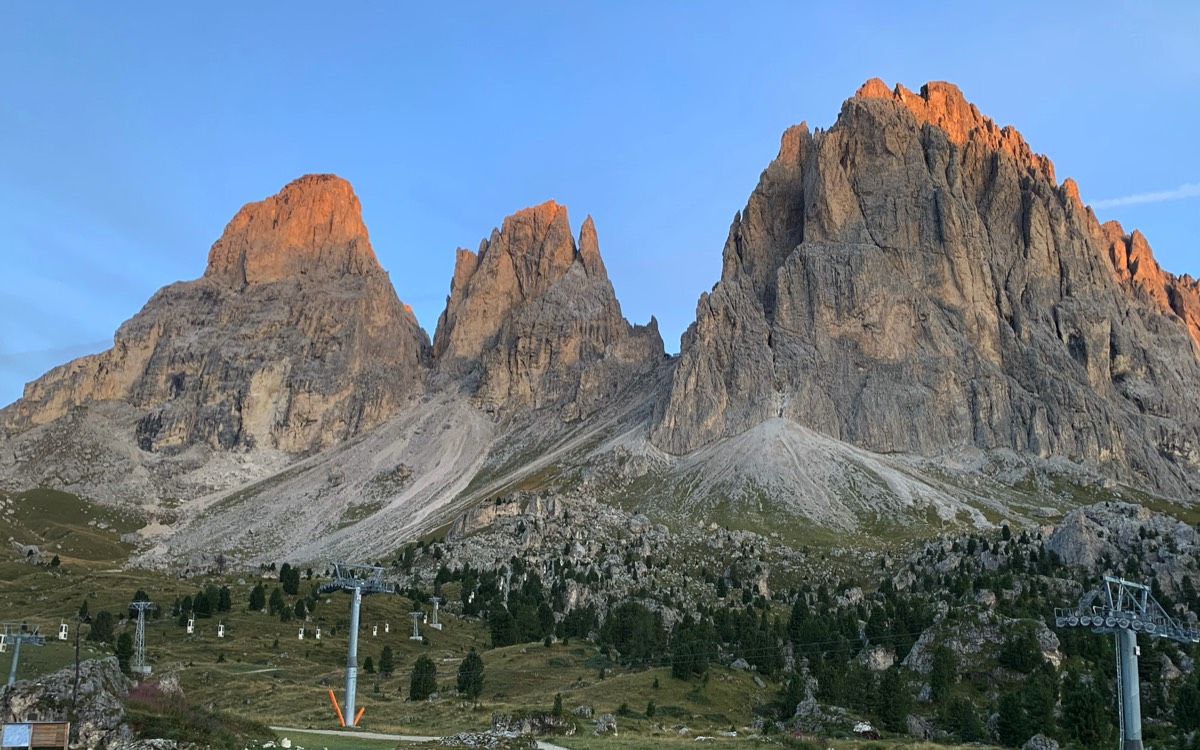
Sassolungo from our balcony, which we hiked up & around.
Heading Home
After an intense 4 days sharing our favorite Dolomite venues in and around Selva with Bonnie and Margaret, followed by a tranquil week exhausting ourselves on the trails at Passo Sella, we began our 5-day journey home. Bill is always meticulous in keeping our travel days short and low-keyed so as not to spoil the glow of our holiday.
Our nervous systems weren’t however, fooled by the ruse and immediately registered the jarring of riding 3 buses off the mountain to Bolzano, IT the first travel day. The loud chaos of urban traffic there jangled us as well after 5 weeks on the trails and in small mountain villages—the return to usual life was all around us.
The spectacular finale for our 4 months overseas was arriving back in the US in good weather, on schedule, with our luggage in hand, and without covid. We experienced none of the horrific, post-pandemic, interminable lines, delays and confusion that was the new norm in airports around the world. In fact, our entire international arrival experience at SeaTac airport was eerily quiet and calm, the way we like it.