
Cheltenham, Our 3rd Hub City
“People won’t remember what you do for them, they will remember how you made them feel” was on the wall behind a Portland podiatrist’s receptionist’s desk. A sweet sentiment that rung true 25 years ago was even more potent in our upscale Cheltenham tourist apartment where the first words out of our overbearing host’s mouth had been shaming and had us immediately lamenting our 7-day stay in his space while we walked the Cotswold Way.
There Bill sat the next morning on a dining room chair drinking his coffee in the center of the kitchen’s wood-like floor with a generous splash zone around him in hopes of shielding us from further insults. After being scolded by this most recent host for “costing him a lot of time” because of a collaborative glitch with his email replies going directly to our Junk box and him inexplicably not receiving Bill’s calls noted on his phone, we didn’t want to risk any further humiliating encounters with him.
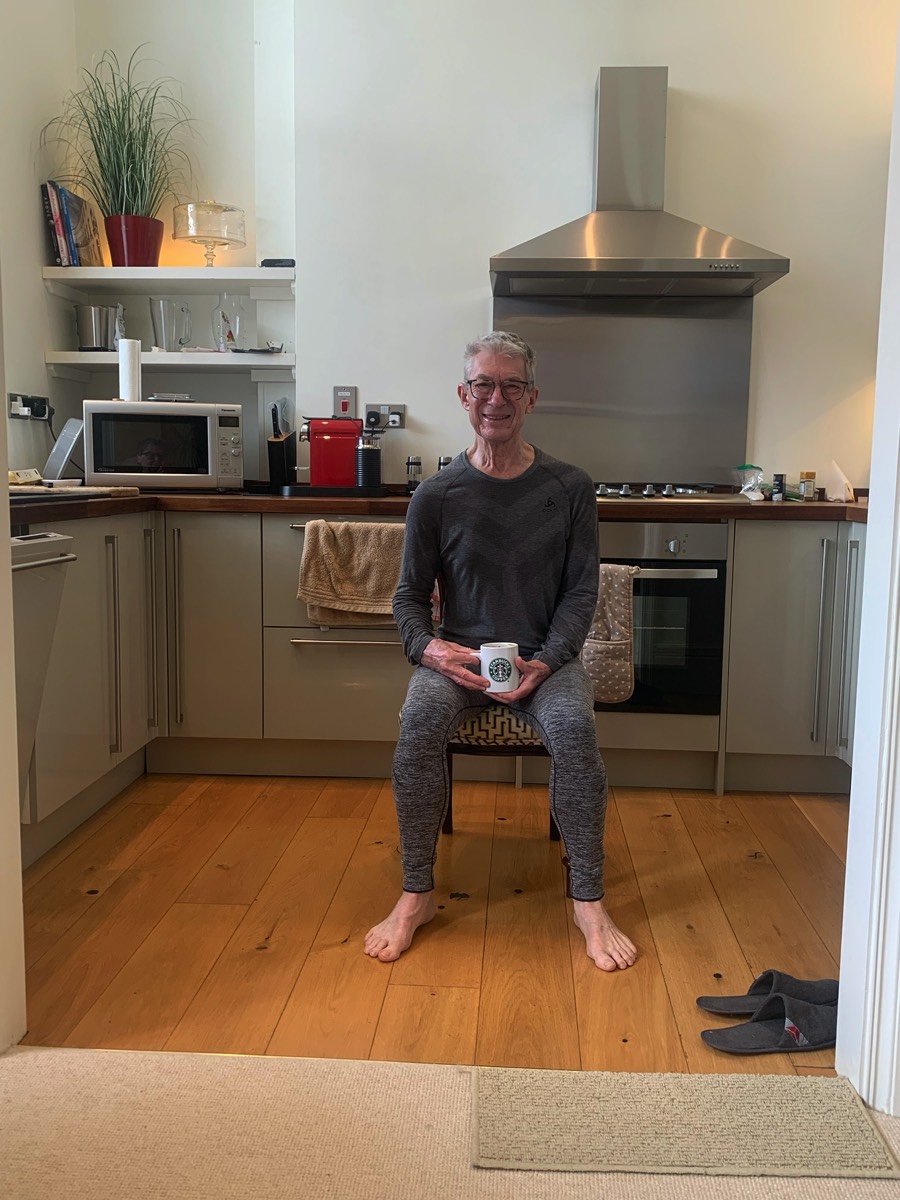
Sipping coffee safely away from the white carpet & upholstery in Cheltenham.
I dutifully read the thick guest instruction notebook from cover-to-cover that included admonitions to not attempt to clean any spills on the carpet or upholstery but to promptly notify him—within 48 hours. The tone of his booklet reinforced our decision to live in a small footprint within the lovely, larger space. The white carpet and light-colored upholstery looked like invitations to incur more criticism.
After hearing and reading his stories of conquests over others, we were further compelled to ‘lay low’. Suing, and winning, in a dispute with a neighbor over noise after 9 pm and appealing to get his apartment’s rating upgraded to a Gold Medal, even though it had a shower and not a tub, were not amusing one-offs but a pattern of behavior we wanted to dodge anyway we could. We enjoyed the straight-forward-to-use heat, hot water, and clothes washing machine, and side-stepped all the other amenities.
We are meticulous guests, always doing our best to ‘leave no trace’ indoors like we do outdoors. We take care to leave no stains on kitchen towels and clean-up our messes, especially since we do so much food prep in hotel rooms. In this apartment, we primarily used our travel kitchenware in the well-appointed kitchen to reduce our exposure to our host’s personality.
His long write-up about refurbishing his 5-Star, Gold Metal winning unit by always buying-up on quality, including all fittings being gold-colored, and his over-the-top collection of audio, video, and other gadgets, made us recoil. His frequently stated goal was to give his guests an above-average experience, but he neglected the fundamental entertainment rule, which is to make them feel welcome and at ease during their stay.
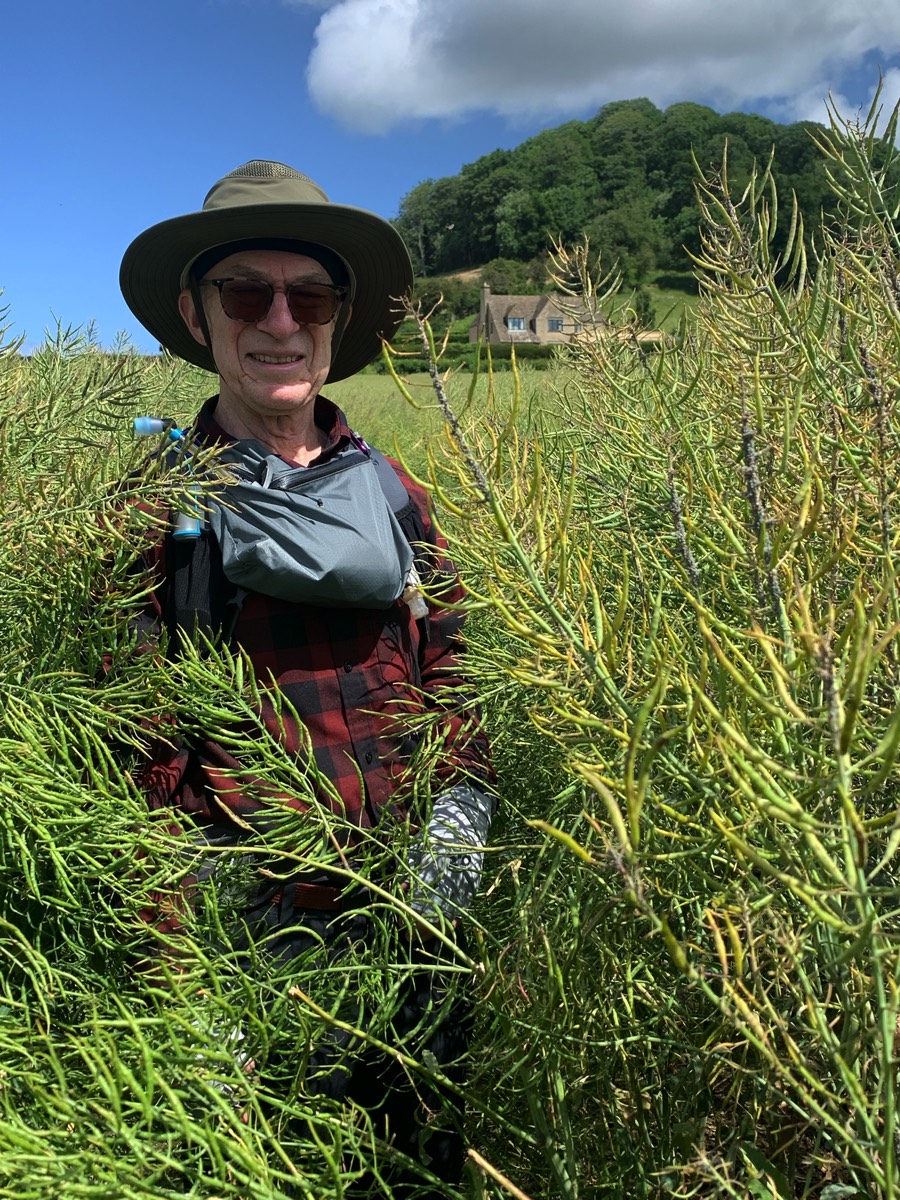
An annoying & challenging segment of official path involved beating our way through a rapeseed field.
Like Bill had promised, there were hills to be climbed on the Cotswold Way National Path that we accessed from Cheltenham and Bristol. Unlike the maps for our Thames River path, the new area’s maps sported topographic lines indicating elevation changes. The basic scenery was the same: lush green pastures, dense hedgerows, and strips of deciduous trees, but we now had grade changes and panoramas and occasionally, the subtle aroma of wild onion lingered in the air.
Our first day on the Cotswold Way, we reveled in the forgotten sensation of having our heart rates rise on the climbs and suddenly needing to engage our previously idle brains to plan our footsteps on the down sides. On our first 10-mile walk, we accumulated 1500’ in elevation gain, which was all we accumulated in 2 weeks on the Thames, where we successfully re-conditioned to daily long walks. Fortunately, our bodies were unruffled by the sudden addition of moderate climbing.
We were delighted and gobsmacked by sighting 3 to 4 vizslas a day in the Cotswold’s, especially at the more northernly end around Cheltenham. The one and only dog either of us had ever owned was one of these energetic red bird dogs that tended to be relatively rare, but not there. One young owner commented that they were almost the unofficial dog of the Cotswold’s, which triggered mountains of fun reminiscing after each encounter over a few days.
Unsurprisingly, the new route itself didn’t provide much more interest than The Thames River path. Both tended to skirt around traditional villages rather than going through them and we generally avoided the detours into towns where there would have been a little more eye candy because our days were long enough.
Finding a bench or large stone upon which to perch for our daily picnic was challenging on our old and new routes. The paths through the pastures and woods were so narrow that we couldn’t just plop ourselves down in a wide spot to eat because there generally weren’t any wide spots, though we literally did so if there was and if it wasn’t too wet or muddy.
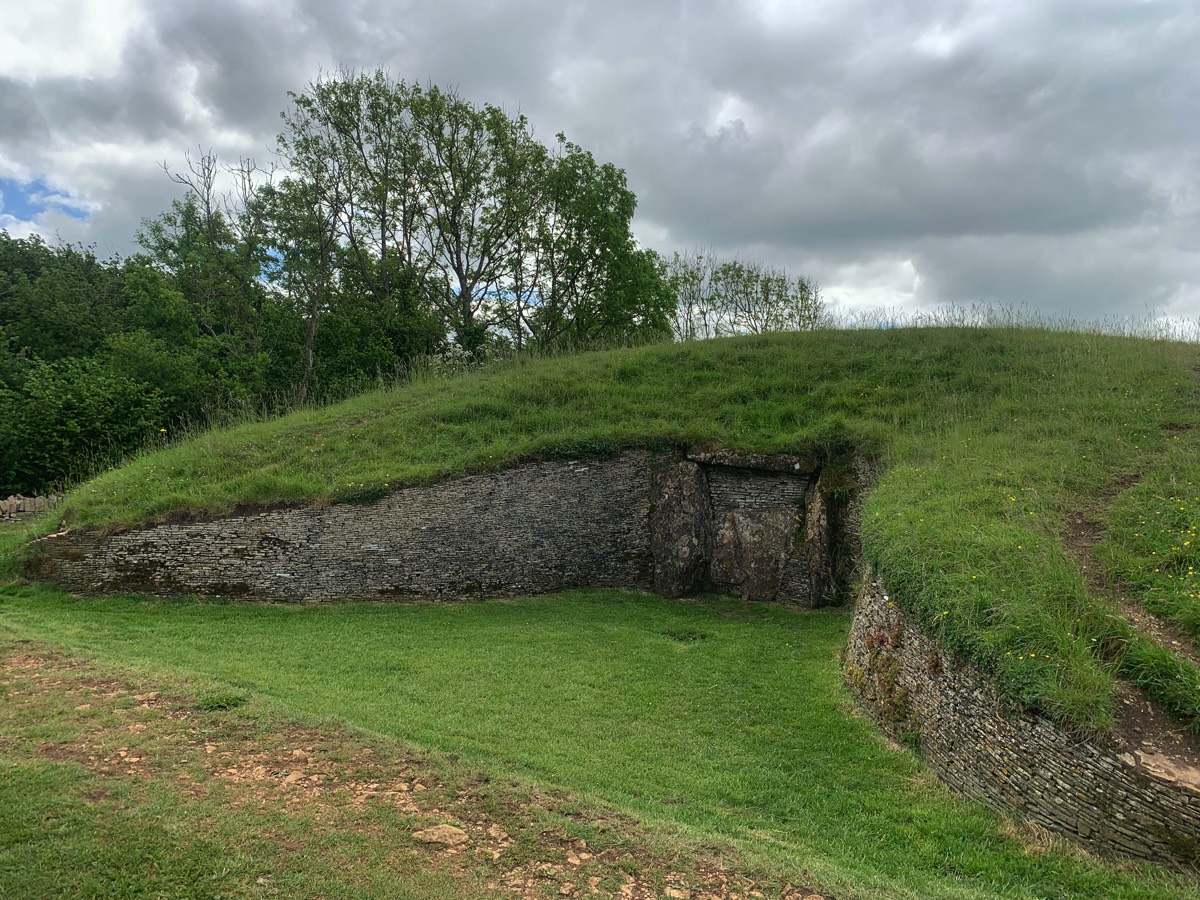
Belas Knap Long Barrow, an early Neolithic burial mound constructed more than 5,500 years ago.
Bill learned to spot from afar some of the 35 regional, unremarkable-looking, Iron Age hillforts while we approached them on the Way. To the untrained eye, these Iron Age hillforts constructed and occupied about 400 bce, looked like pastureland nibbled to the nubbins by sheep, which was indistinguishable from the rest of the dirt on the hill. We visited 2, much older Neolithic hillforts, including Crickley Hill, from which a million artifacts had been retrieved, though they didn’t look very different from the newer hillforts.
My clueless inquiry to a passing equestrian about her horse triggered “Icelandic,” which was a breed totally unknown to me. Welcome internet reception allowed me to read a bit about the breed and, more interestingly, to learn that no horses are allowed to enter Iceland, even returning resident horses, to control the spread of diseases. More than seeing the horse, that restriction proved to be a yummy nugget for my bored mind to contemplate, especially the chilling effect the rule had on being an internationally competitive Icelandic equestrian. The brief exchange also triggered a bit of reminiscing about our 3-week car tour of Iceland years ago.
Cruising along the top of the very bank from which the upcoming Gloucester Cheese Roll would be occurring stopped us in our tracks. I read about horses in Iceland on the fly, but the baffling cheese roll required stopping for more careful research. Bill estimated the 200-yard course to have about a 60% grade, something we couldn’t imagine running down, especially for an 8-pound wheel of cheese. Even after reading about it, there wasn’t anything profound to learn from this annual event in which the first person down the hill gets the chunk of cheese. It did however create an opportunity for sharing some laughs with fellow walkers in the drizzle.
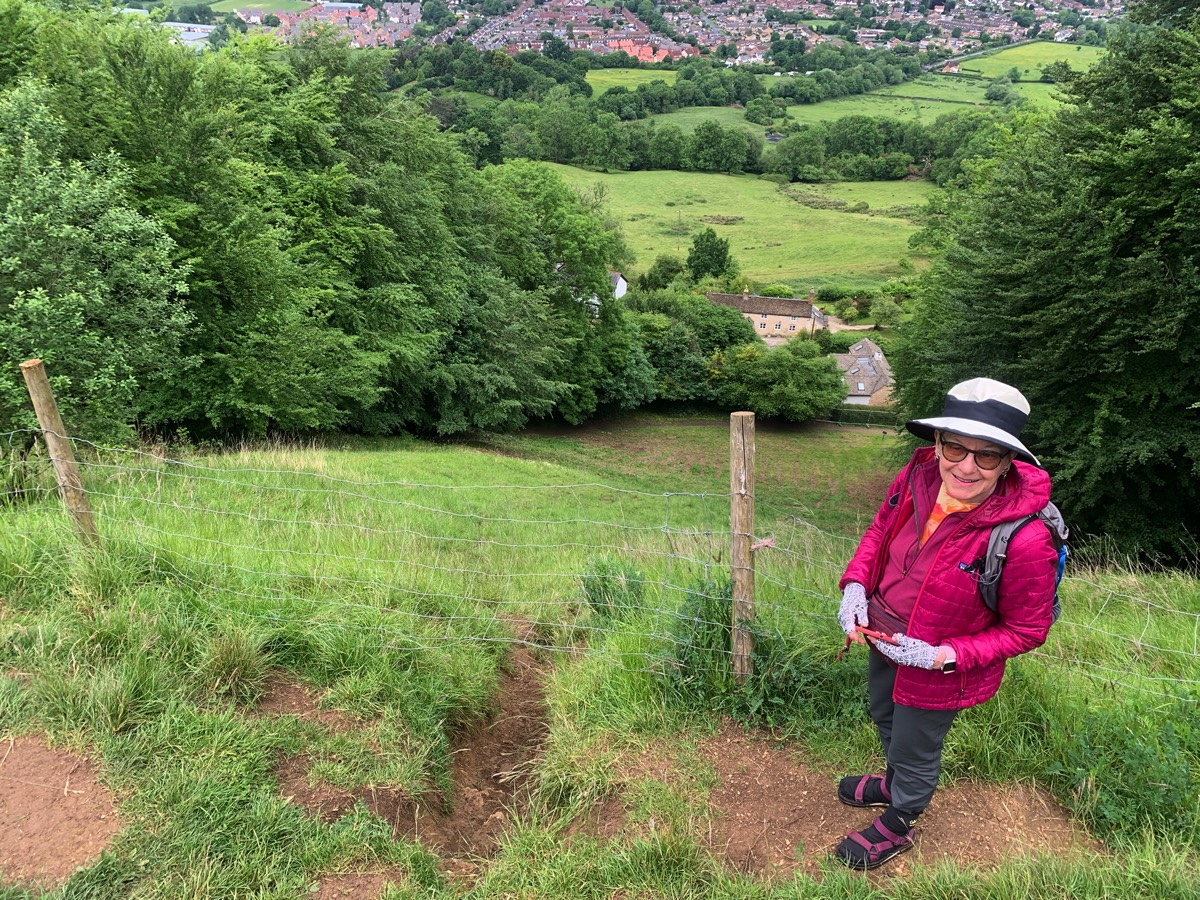
The start of the upcoming cheese roll event for which they remove the fence.
Bristol was the livelier of our two hub cities for our hub-and-spoke walking scheme on the hundred-mile-long Cotswold Way. We’d seen the very depressing, grungy side of town from a nice hotel when walking the more southern Coast Path several years ago, but our 2022 stay revealed a thriving, upbeat scene along the Avon River, which we thoroughly enjoyed. Because of rain and the threat of rain on our first days in the city, we opted for long urban walks in the mornings followed by comfortable lunches in our apartment, showcasing more of the city than we’d planned to see.
Bill had booked more days in Bristol than needed to do the 2nd half of the Cotswold Way, so we also took days off the muddy paths to be urban tourists by visiting the Roman Baths at Bath, to do the “Brunel Walk” with our friends Penny and Des that we met on a rainy day in a French campground over 20 years ago, and to take a bonus trip to nearby Bath to walk along the scenic Avon River canal. The sightseeing and social days provided a welcome change in focus from putting one foot in front of the other to walk the National Trails.
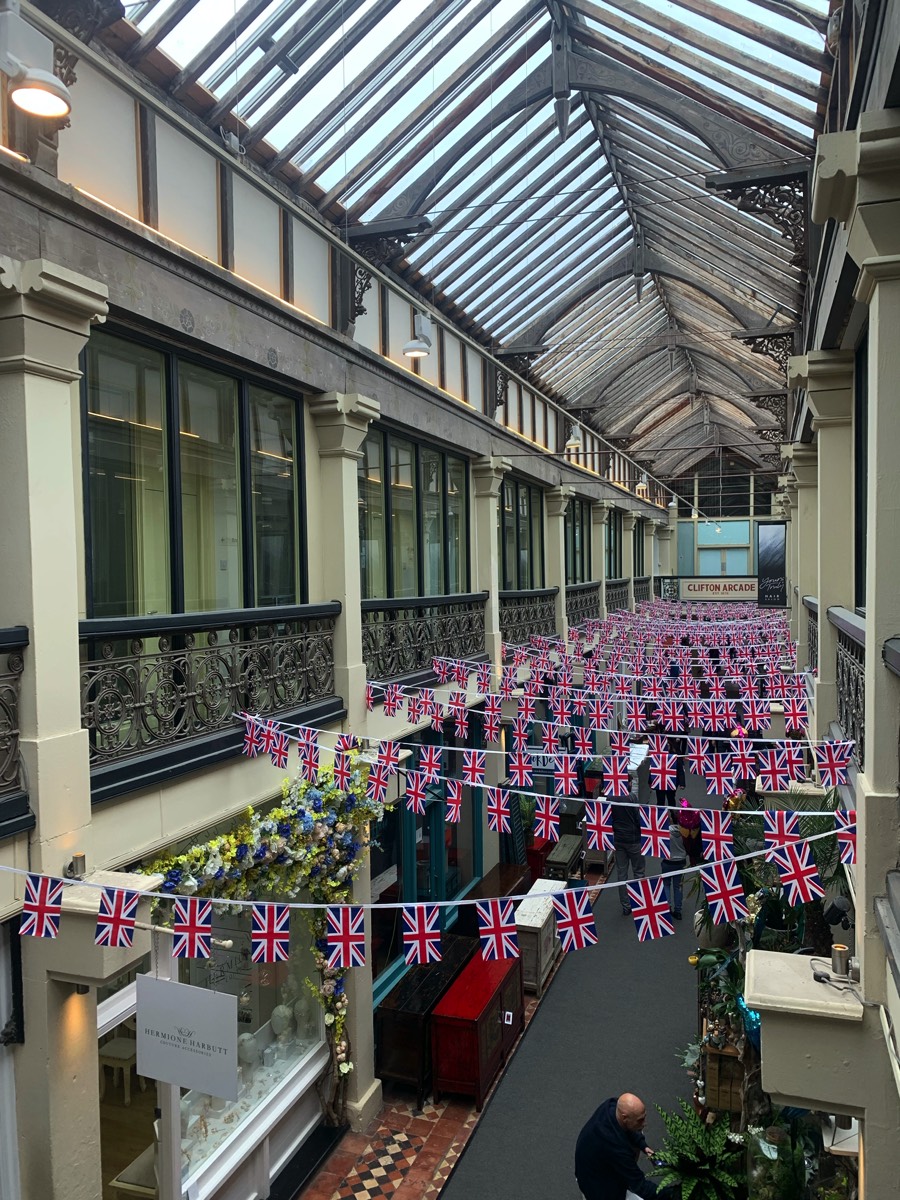
Clifton Mall: The over-rated, “must-see” Bristol Victorian building was decorated with the customary Jubilee banners.
One of our first of several damp days in Bristol, June 5th, coincided with the parade day for the Queen’s Platinum Jubilee. We dashed out after breakfast for a local walk so we could ‘get our miles’ and I could be back in time to watch about 20 minutes of the parade. Bill wasn’t interested, but I interrupted his small-screen time and urged him take a peek at the opening scene featuring a spectacular gilded carriage; he was immediately hooked. We both watched the entire parade; the best parade I’d ever seen. (We couldn’t help but think of how jealous Trump must have been on that day of the magnificent event in the Queen’s honor—Trump tried hard but never got his blockbuster parade like he had witnessed in France).
The parade was filled with dazzling, unusual participants. Sprinkled throughout were small groups of historic British cars, including all 7 Aston-Martins used in James Bond movies (the Queen is a huge fan of James Bond flicks) and Jaguars. There was a pack of cute, automated Corgi dogs and their human handlers, a nod to the Queen’s favorite breed, and numerous groups of spectacular performers and dancers. All parts of the military had small units in the parade and, with them, like for the entire parade, the TV commentators had fascinating narrative instead of the usual drivel. We couldn’t pull ourselves away from the unexpected pleasure and satisfaction with the efficient immersion in British culture and the entertaining review of the social history of our lifetimes.
A Little Misadventure
We’d sprinted to the nearby Bristol train station an hour early on a Saturday morning to return an hour earlier, which seemed simple enough. We did our planned walk, that amounted to about 11 miles total, arrived at our bus stop in the middle of nowhere, almost an hour early, and boarded on time. We were passengers #2 and #3. Part way to Yate, where we had only a few minutes to spare to catch our hourly train back to Bristol, the bus “split a pipe” and couldn’t continue.
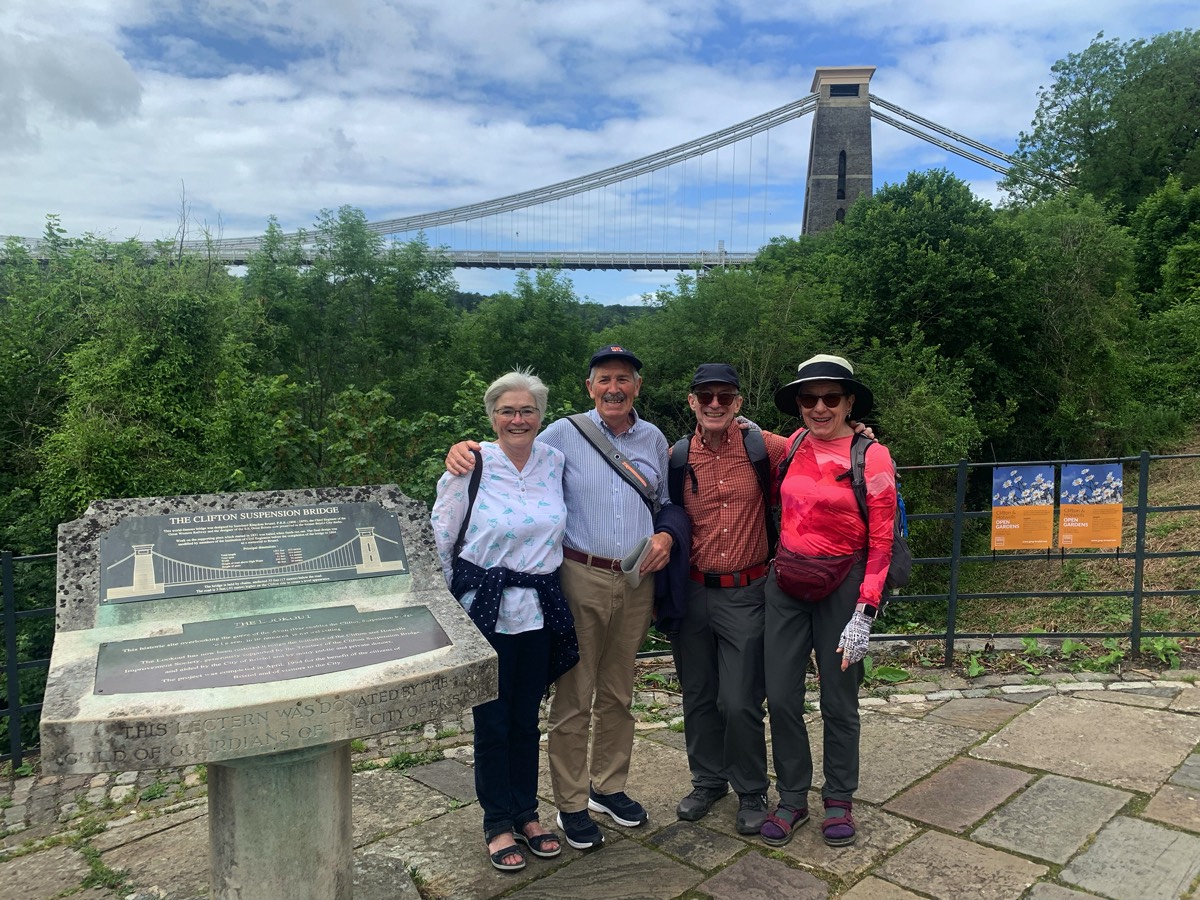
With our friends Des & Penny near
Bristol’s Clifton Suspension Bridge designed by the highly acclaimed Victorian engineer Isambard Kingdom Brunel (that really was his given name).
The next train back to Bristol was a bit late and consequently, had lost its place in the queue for a platform, so we waited and waited some more to debark at Bristol. Hardly a crisis but, darn, our 4 ½ hour moving-time day that already had a significant logistics burden, extended to almost 10 hours out.
“Mirroring Back”
Adding to our amusement some days, was what other people mirrored-back to us. The most frequent comment was “That’s why you are so trim and fit!” when comparing notes with others on their day’s activity and our summer itinerary. Of course, we loved the compliments and appreciated the validation for the days we wearily said, “And why are we doing this?”
One woman blurted out “Professional” when looking at our kit. Yes, compared to them, we were professionally outfitted. It was one of those days during which the sun and wind took turns being dominant, sometimes several times an hour, resulting in everyone’s ‘comfort index’ being in constant flux. Our layers of lightweight technical clothing were much easier to adjust and stow when needed with the changing conditions than their heavy streetwear outer coats and thick pullovers. Unlike ours, their garments were too bulky to stow in their packs. We later quickly did the arithmetic to remind ourselves that starting from scratch on re-outfitting to be more ‘professional’ could easily run $1000 for 2 if you bought ultra-lightweight rain gear like we had.
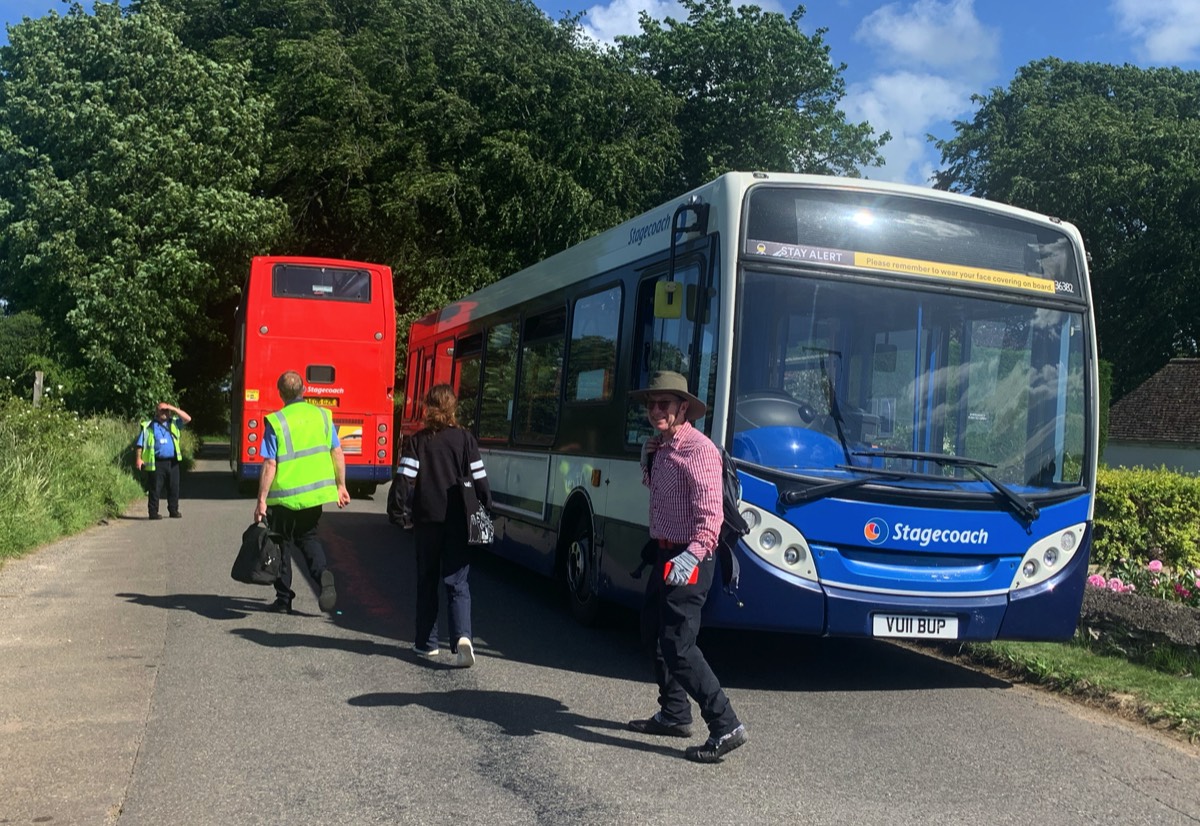
A double-decker bus to our rescue!
Another day, looking clean after describing all the mud we’d slogged through, became the subject of the conversation. Ah, another story to be shortened. It’s largely about fabric selection, an art we began perfecting when we became bike travelers 20 plus years ago. Waterproof over socks and gaiters are other tricks that help us quickly become presentable in urban settings after a day in the muck. Being very careful not to slip in a gloppy puddle also immensely improves our presentation.
These pleasant exchanges were consistent with how we generally felt received in England this year: people were friendly, helpful, and welcoming. Even when underfoot and blocking the way with our oversized bags on trains and buses, people were patient and quick to help rather than trying to elbow past us.
Hub & Spoke
Walkers on long trails generally organize their holiday either as a through-hike or as a hub-and-spoke event. The 3 consecutive years we walked the 660-mile Coast Path in southern England, we used the through-hike model. Each day, we started the day’s journey where we had ended it, often walking a mile or 2 off the path in the evening and the next morning, to reserved lodging and for groceries. The US, late-middle-aged, backpacking 4-some we met twice this year on the Cotswold Way, were doing the same, though spared themselves the walk into town by illegally free camping in the woods almost every night. Free camping is something we’d never done; jaywalking “Yes,” free camping “No.”
Our hub-and-spoke scheme this year, in which Bill often booked us for 10 nights in a city, spared us the considerable expense of paying for daily luggage transfer between B&Bs like we incurred on the Coast Path, though we paid for it in transportation costs to and from our trails.
This year, our time spent on logistics was often around 3 hours a day, plus Bill’s daily planning time to mesh bus and trail schedules, with the transportation costs generally running between $20-$80. Hardly cheap, but a built-in expense of the strategy. One year on the Coast Path, we spoke with members in a small group who contracted with a single taxi driver to haul their luggage and shuttle them each day, both in the morning and in the afternoon, on their hub-and-spoke itinerary; we had no idea as to the cost of that twice-a-day service.
Almost all long-distance walkers expend considerable time and money to support their journeys. It’s not as simple to ‘just get out and walk’ as it might seem. In the Grand Canyon, we quickly learned that it was a very, very expensive destination to ‘go thrash yourself,’ as well as being highly competitive make make arrangements, even to secure legal tent camping on remote trails. Through-hikers on 2600-mile-long routes, like the Pacific Crest Trail, buy food and other supplies in advance, which they mail to themselves for General Delivery pick-up at post offices near their trail to resupply and often hitchhike to those points.
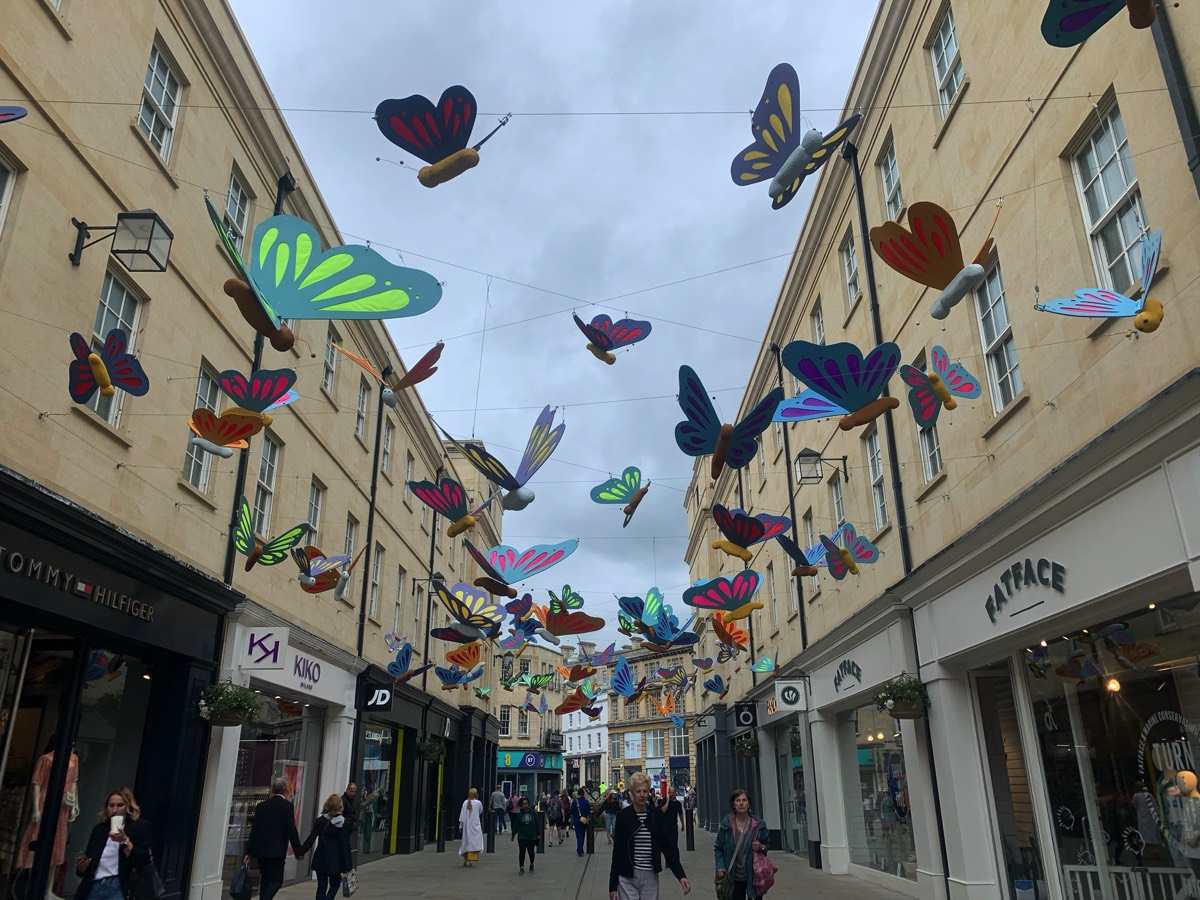
Such a joyous way to brighten the gray sky on a Bath pedestrian mall.
Group tours and having tour companies make all your arrangements are other ways to reduce the time spent on the overhead of being roaming mammals, but they too require considerable compromises. On this day of writing, I was reminded of one of those compromises that was currently occurring in hired rafting trips on the Grand Canyon’s Colorado River, which was several norovirus outbreaks. It’s a transient viral disease that one rarely gets from being in the wild but instead is contracted by poor hygiene practices of members or leaders in your travel group. Time, money, flexibility, comfort, safety, frustration abatement, and pleasure from the overall experience all tug at the traveler looking for the best balance for their situation.
Practical Matters
It didn’t take long to recognize that our 2 biggest nuisance issues in our English tourist apartments this year were the hot water and refuse disposal, with the hot water, of course, being the more critical issue. At almost every location, we had daily challenges with the water.
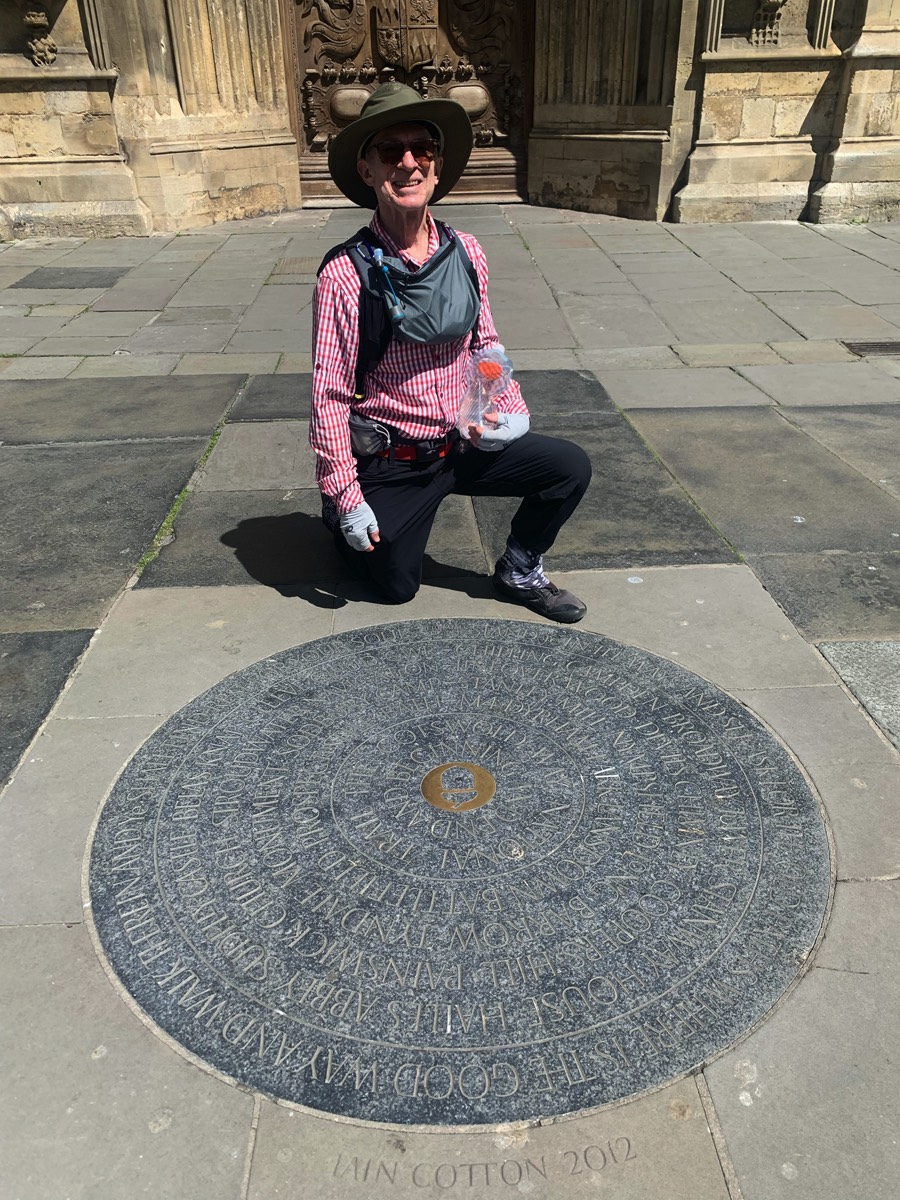
The easily overlooked terminus of the Cotswold Way at Bath.
Towards the end of each 10 to 14-day stay, I was ready to move on, I longed to be released from our current water woes, but the challenges in Keswick in our 5th apartment, were beyond my imagination. There, the scalding hot water from our unit’s tank would suddenly stop flowing, for minutes or hours, even when the water was still piping hot, which was wildly inconvenient when bathing. Inexplicability, the hot water, and only the hot water, relied upon a separate pump, which sounded like it belonged on a barge, to deliver water. We never found an on/off switch, reset button, or curse that would trigger it back into action, though it did happen to start-up once when the ceiling light was turned on.
One evening, Bill reconciled himself to bathing in my 2nd-hand tub water, not knowing if we’d have hot water in the morning. Luckily, towards the end of his quick bath, the hot water flowed again, and he could take a second, shallower, tub rinse to both feel cleaner and warm himself.
The Keswick tub had a separate point-of-service shower device, a system which we’d used in the past elsewhere and enjoyed. They too can be a bit touchy, but you always have hot water with them, except with ours in Keswick. We carefully followed the short list of instructions for the simple device in the unit’s manual and it didn’t work. We independently tried all our best tricks based on prior experience and logic, to no avail. The only sign of life from the supplemental water heater was, very reliably, with each tub bath we took, it would spontaneously turn on for about 30 seconds, spraying the current bather with cold water, one or 2 times.
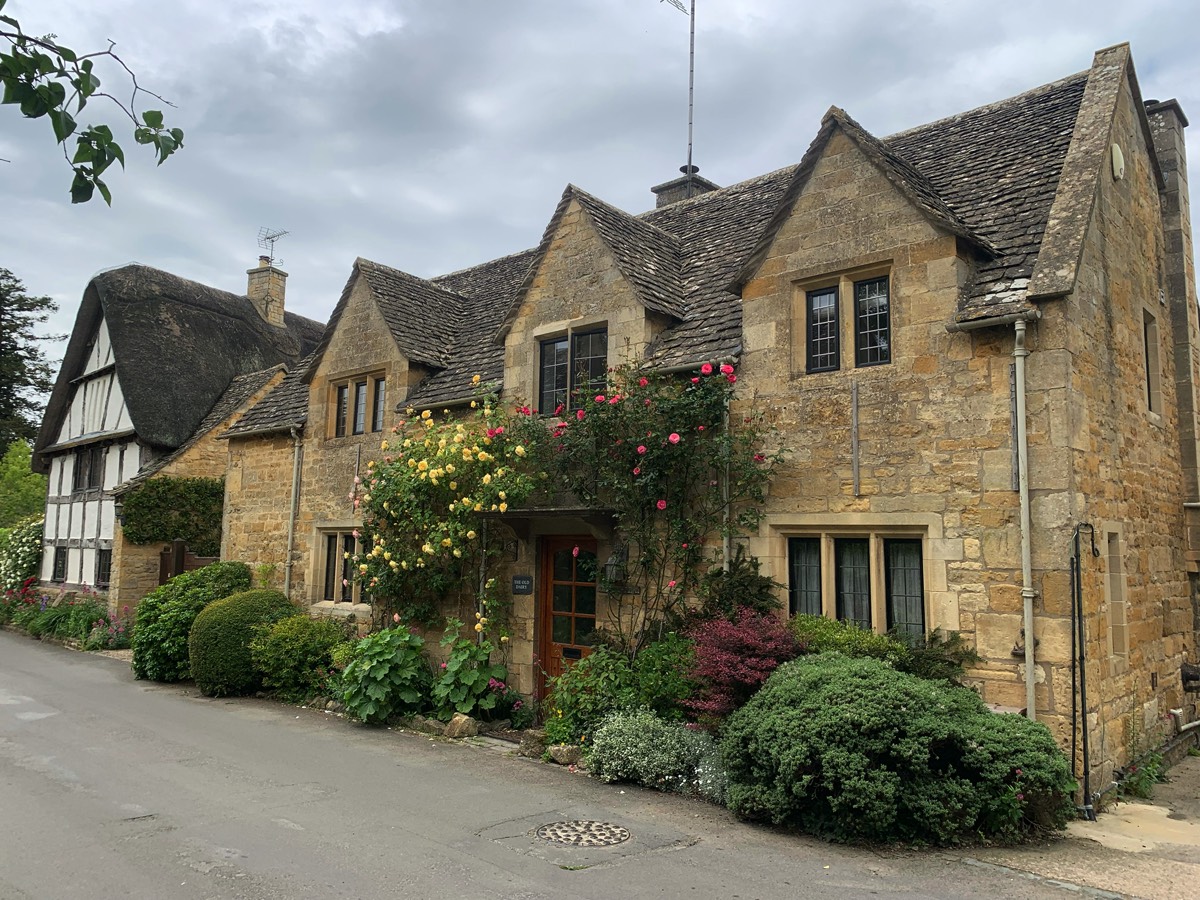
Anything can await you inside these handsome traditional buildings.
I concluded that an oil cloth apron would have been useless, that this kitchen’s ample supplies should have included a vinyl rain jacket to be worn at the sink. Lacking that, we each would emerge from even a brief stint at the kitchen sink with our torsos and arms half soaked from splashing hot water. Of course, the counters, window, floor, and our glasses were sprayed as well.
It was cringe-worthy how many gallons of water we wasted in a day while attempting to wash our hands, faces, or dishes in warm water. One had to begin with the hot water on full blast to activate the pump and fill the water line, then slowly decrease the volume, usually until it inadvertently shut-off the pump, then try again to get the lowest volume possible from the tank. Next, cold water had to be added with a separate faucet lever to achieve a safe, useable water temperature, which increased the volume of water and therefore the range of inevitable splashing.
Mindfully turning the water on and off as needed for one’s current chore wasn’t an option: titrating the temperature was so time consuming that one’s meticulously achieved temperature-mixed water had to be left running whether it was needed in the moment or not and, of course, splashing one the entire water session because of the excess volume at either sink.
The garbage issues were much easier to deal with than our hot water and bathing woes, but they were such silly distractions. In our first apartment in Swindon, we had an oversized garbage can in the kitchen lined with an appropriately sized bag but discovered that only about ¼ or less of the contents would pass through the slot in the garbage room chute.
There we were on our hands and knees in our ‘luxury’ apartment one evening, pawing through our garbage to divide it into 4 compact bags. In Maidenhead and in Keswick, we had specific written instructions to only deposit our garbage in outdoor bins labeled for our building name or our unit number, but none existed. Bill texted the property manager at Maidenhead and was specifically told to dump our garbage in the dumpster with the label stating that our building’s garbage was not to be placed in it. In Keswick, we short-circuited the problem and placed it in an unlabeled bin. In Cheltenham, our Gold Medal apartment owner confessed that there was no place to take our garbage and that we had to live with it until the unnamed pick-up day. Lucky for us, the unit had a large refrigerator, so we compactly stored items prone to rotting in the frig until the morning we departed and managed to fit the rest of it into the provided kitchen bin.
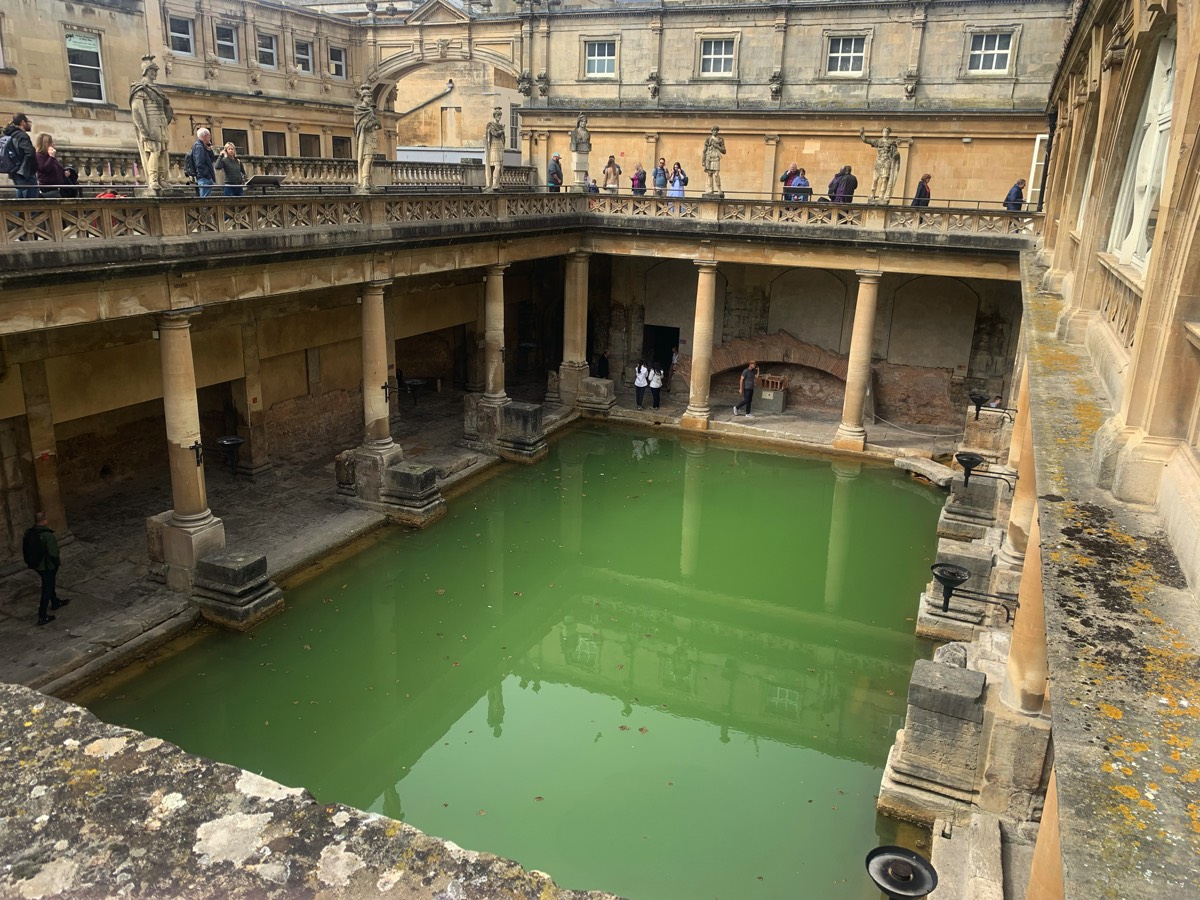
Unlike in Roman times when the structure was covered, the Roman bath at Bath now grows sun-nourished algae.
Wrapping Up The Way
The Cotswold Way has existed as a long-distance path since 1970, though only received its National Trail designation in 2007. The Way segment of our stay in England covered 20 days, with us walking 148 miles for the 107 mile route and missing 10 miles of the official track. After too much hair tearing, I suggested to Bill that we skip the remaining section at the far end from Chipping Campden to Stanton because we would have spent as much time or more on the transit system as we would have spent on walking. We had done that before, but the regrettable difference for this segment was that ALL the transit was by bus, whereas all the other long transit days included time on the much more expensive but wildly more comfortable, trains.
English bus travel on the equivalent of US interstates is a breeze, being almost as comfortable as the trains. In contrast, the local or regional bus rides were often like being in an off-road vehicle on a wash-board road: noisy, bouncy, jolting, and exhausting. Even after a 30-minute bus ride, I often needed as much time or more to feel well. We of course “walked it off” on our day’s route, but it wasn’t a pleasant way to start or finish a long walk. On the skipped segment, we’d have been on the local bus winding through the hills for over 2 hours each direction.
Bill jumped at the chance to skip this logistical nightmare and happily accepted my counteroffer to let it be the “seed” segment for a future visit by building a walking tour in that area, perhaps using one of the towns for a hub. Like the missing Thames River segment near London, it would go into Bill’s file for another year—a win-win.
With the historic Cotswold Way checked off the list, we’d board a train and then a bus to Keswick in the Lake District. Anyone who queried us about our itinerary always delighted in telling us how much we’d love the Lake District. We were feeling hard to impress after our first 6 weeks in England but braced ourselves to be dazzled by the new region that didn’t contain a National Trail like our first 2 areas, the Thames and Cotswold Way.