
Up To the Mountains March - April 2022
Hanging It Up
It was a brief, poignant, moment when I slipped our covered clipboard containing our hiking club name badges and notes on to an upper shelf of a small cabinet in our trailer. I heard “That’s it, that’s it until November” in my mind while my hand lingered on the red plastic clipboard.
We’d just come off the trail for the last club hike we’d lead for the 2021/2022 season, which made hanging it up feel more abrupt. Still in my dusty, sweat-dampened clothes, my thoughts flashed back to earlier in the day on the challenging Stubbe Springs hike in Joshua Tree National Park (JTNP) with our friend Margaret and 2 men, neither of whom had been on our hikes.
There had been reasons to expect a less than stellar weather day and some rough edges with our guest hikers, but the group immediately coalesced, and the strong winds slackened in sync with the forecast. It was a fine day by all measures, a great way to close the season. I knew however, that our personas would flip in the morning to that of truck drivers pulling a trailer for 2 days.
Hanging It Up
It was a brief, poignant, moment when I slipped our covered clipboard containing our hiking club name badges and notes on to an upper shelf of a small cabinet in our trailer. I heard “That’s it, that’s it until November” in my mind while my hand lingered on the red plastic clipboard.
We’d just come off the trail for the last club hike we’d lead for the 2021/2022 season, which made hanging it up feel more abrupt. Still in my dusty, sweat-dampened clothes, my thoughts flashed back to earlier in the day on the challenging Stubbe Springs hike in Joshua Tree National Park (JTNP) with our friend Margaret and 2 men, neither of whom had been on our hikes.
There had been reasons to expect a less than stellar weather day and some rough edges with our guest hikers, but the group immediately coalesced, and the strong winds slackened in sync with the forecast. It was a fine day by all measures, a great way to close the season. I knew however, that our personas would flip in the morning to that of truck drivers pulling a trailer for 2 days.
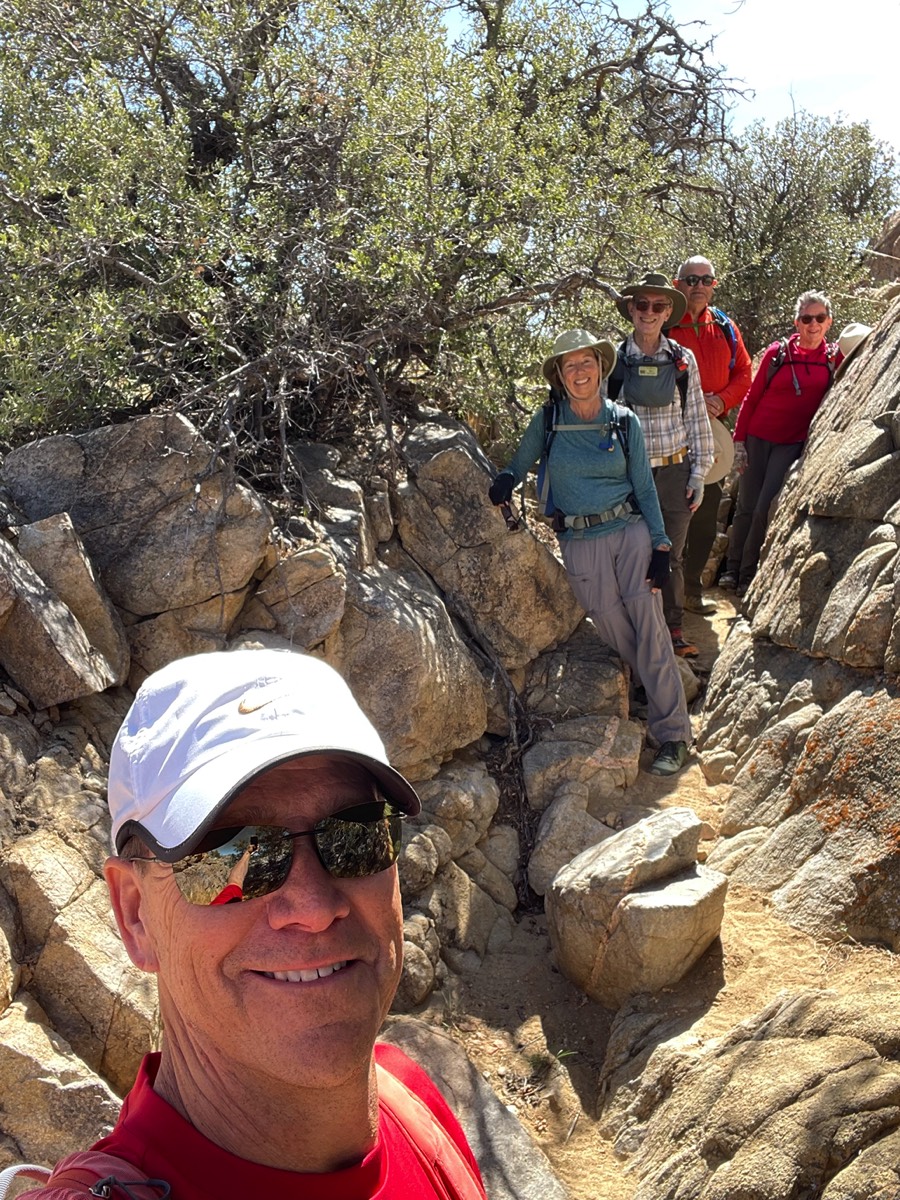
A selfie in the narrows on the Stubbe Springs trail in Joshua Tree NP.
The ‘press-on-regardless’ sides of our personalities shuddered with that forecast; we’d been deeply chilled all day under similar conditions in the past when the sun didn’t make it out from behind the clouds. Deserts can be surprisingly harsh and cold. It was about an hour’s drive each way for the planned club hike, which made it even less appealing to gamble on the weather. We’d canceled one club hike in December because of rain; persisted with a couple of rounds of drizzle for another in January; and led a determined group into snow in February; it felt like time to favor rationality over commitment by canceling our first March hike for the year at JTNP. Having canceled this first event, made doing the just-completed Stubbe Springs hike 2 weeks later all the sweeter: to end our season with a success.
Our new club president had off-loaded quite a few more chores to me as the Hike Leader Recruiter and Trainer this season than the former president, which was both incredibly time consuming and rewarding. She was masterful in her delegation: she gave me a huge amount of freedom to problem-solve and yet she always had my back. Putting the red clipboard on the shelf was a relief because it signaled reducing my involvement in club business with the end of the hiking season drawing near but, that was short-lived. A few weeks later, a serious situation erupted, a potentially catastrophic failure on the part of a new hike leader I had approved, which consumed hours of my time off-and-on for another month.
Just Maybe
Concurrent with winding down the hiking club season, we started having hope for a return to our summer fun overseas. Bill was desperate to travel after missing 2 summers abroad because of covid and I longed to escape the severe wildfire smoke that had become the new-normal for summers in the US West. Drought conditions had persisted over the winter in much of the West, making another bad fire season likely.
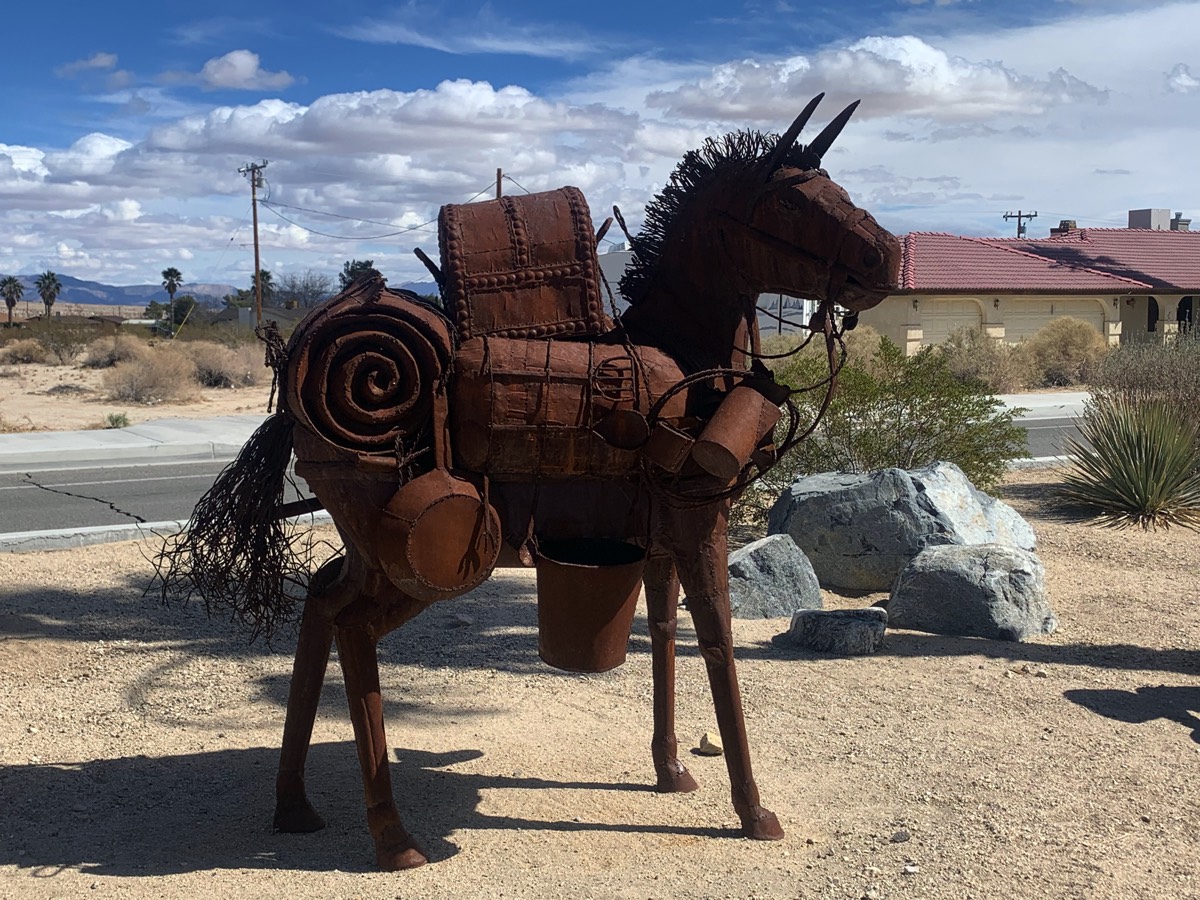
New street art in 29 Palms.
Bill bought air tickets while envisioning a walking holiday on the paths of inland England but left open the possibility of going to the Dolomites of Italy at the summer’s end, hoping for more rule clarity by then. The joy of having tickets to travel was a bit dampened by learning the day before buying them that both Italy and Austria were 100% dependent on Russia for their gas. It was a sobering reminder that the repercussions from the war in Ukraine could hamper our holiday plans in unexpected ways, compounding the unpredictability of covid-related issues.
Babying the Bodies
Bill’s
Of course, our body challenges made the trip from Palm Springs to 29 Palms near JTNP with us and were primed to join us in Europe. Despite Bill’s recent breakthroughs with his posture problems, they continued to bedevil him and, by the time we left the Palm Springs area, he was substituting laps around the RV park for trail hikes because of pain. And then, by the end of our first week at 29 Palms, he developed a “Level 4 of 4” case of pitting edema in his right leg.
“Pitting” refers to the bizarre dent in one’s swollen tissues, in his case, his lower leg, that lingers too long after you firmly press a finger pad into the flesh. There was no denying the look of animal tracks in the sand on his leg from pressing his thumb on multiple places along the side of his calf.
This alarming finding of pitting edema is associated with several nasty conditions and yet Bill lacked the constellation of other symptoms to make sense of the phenomena. He instituted his recently over-used skill of watchful waiting, and the condition was 95% resolved in about 36 hours after decreasing his salt intake and wearing a compression sock for 5 hours.
The best we could guess was it had occurred because of the collision of back pain-induced decreased exercise, increased standing instead of sitting in deference to his back, recently increasing his salt intake, and who knows what. Hopefully, it was a bizarre one-off. Nonetheless, he received an ultrasound to confirm that there was no dangerous, underlying cause of the swelling, which there wasn’t.
Barb’s
My 3 chronic complaints for years had been the intolerable side effects from high blood pressure medications; stop-me-in-my-tracks GI pain seemingly from the medications on top of hidden food intolerances; and buttock muscle spasms that would literally drop me to the ground from pain.
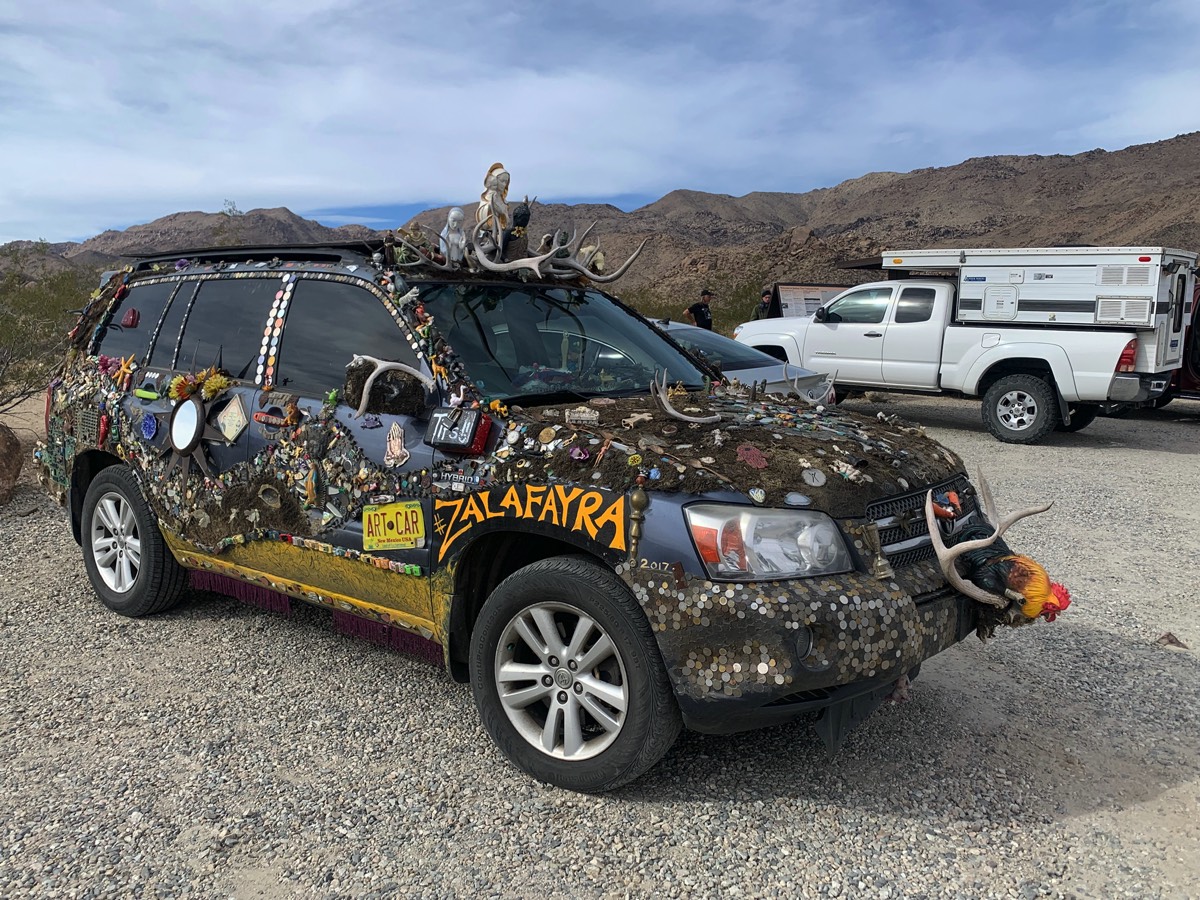
An “art car” owner visiting Joshua Tree NP.
The day after I resumed the treatment plan, the maintenance plan for my discs, my gut health improved and held. My use of Imodium to control painful abdominal spasms and distention dropped precipitously. Our best guess was that the vagus nerve was the intermediary between the disc and gut pain.
A month later, I withdrew sorbitol, a naturally occurring sugar, from my diet and my gut further improved. Not surprisingly, it took about 10 days for it to be a clear association. My diet, limited because of food intolerances, just got smaller with now needing to avoid treats like dates and figs, but I was thrilled to have a more settled gut. Had I still been on the prescription medications, I likely wouldn’t have been able to discern the health improvements from reducing my sorbitol intake.
Equally serendipitously, I had a dramatic improvement in my ancient buttock muscle spasms in March as well. A new friend that sought me out a couple of years ago after finding my health experiences reported on our webpage, contacted me in March after curing her pile of structural problems. In simple terms, it was seeing a chiropractor specializing in adjusting the top bone of the spine known as the atlas, that turned the tides towards good health for her.
I immediately made an appointment to see a similar specialist when home in a month and set out to find a do-it-yourself (DIY) way to tweak my atlas. Amazingly, the simple, seemingly pointless, adjustment I selected from several online choices, delivered quantifiable improvements in my neck comfort the next day. And then the following day, I had no disabling buttock pain on the trail or ever since. Incredible! Maybe, just maybe, a pro could finish-off the remaining, nagging discomfort after a month of self-treatment with a more refined adjustment of my atlas.
Intermediate Solutions
The Root Cellar: A Stellar Upgrade
I love “intermediate solutions,” like my DIY atlas adjustment, and we’d had several other noteworthy successes with them. Our best upgrade to our trailer life this season was an intermediate solution with the addition of a “root cellar.” Others would recognize it as an electric cooler, but we think of it as our root cellar.
I sponsored the purchase of the electric cooler last fall to replace a small and a medium-sized, ordinary cooler. Our primary use of a cooler, or coolers, is for our two, 2-week stays in the Grand Canyon each fall for which we haul in all our provisions for the duration.
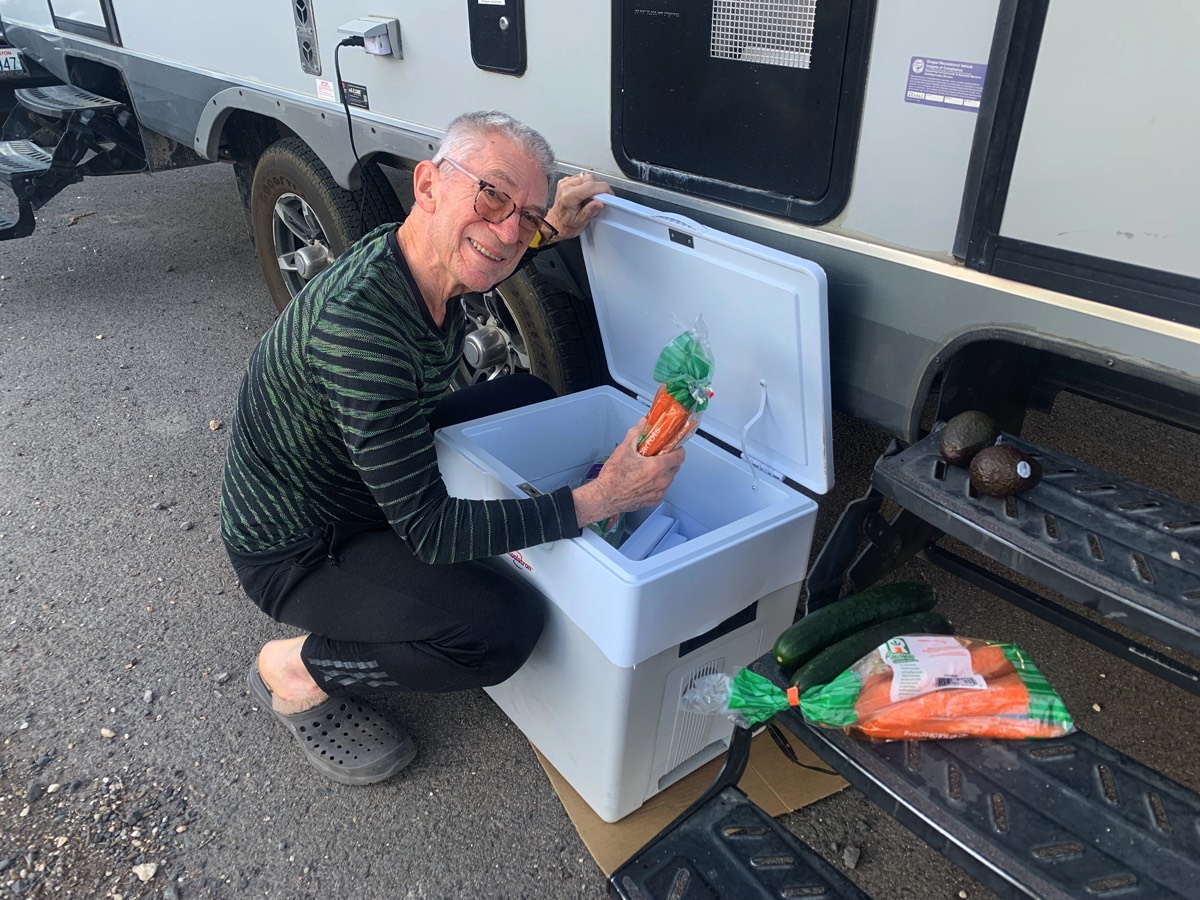
A quick trip to the root cellar.
Concurrently, Bill had longed to replace our trailer for several reasons, with one reason being so we could upgrade from a 6 cubic foot refrigerator to an 8-footer to take the pressure off his storage problems. Quite unexpectedly, as the months on the road accrued this season, he decided our current refrigerator plus the electric cooler was superior to having a larger, 8’ refrigerator, because it was more flexible, because he could run the cooler at a temperature different from that of the refrigerator. The electric cooler also helped us maintain a steadier temperature in our refrigerator and freezer by pre-cooling unrefrigerated produce outside of the refrigerator—it’s a bummer to raise our frig and freezer temperatures with a dozen warm avocados that need to be held for 10 days.
It had been a struggle, however, to get a functioning cooler. It took swapping out coolers with Amazon and the manufacturer twice to finally get one that worked but we will likely forever be electric cooler owners when living in a trailer.
Protective Headband
A much smaller, cheaper, and ‘right the first time’ intermediate solution was achieved by Bill ordering 2 different protective headbands designed for soccer players. We’ll stick to SUPs for our new sport, but soccer players are at risk for concussion and so is hiker Bill and we wanted the head protection for him that they had.
Bill was caught in an extremely frustrating conflict. Last October, we bought tiny walkie-talkies so we could split-up on our hikes and still have a hope of staying in touch part of the time. My various health issues were holding me, and him, back and the goal was to literally unleash him so he could explore his untapped athletic potential. The downside, however, was that he hadn’t mastered retaining his illusive good posture while pushing his speed on the trails. The faster he went, the worse his posture was, and his strong bias towards a head-down position when speeding along had triggered falling forward on the trails.
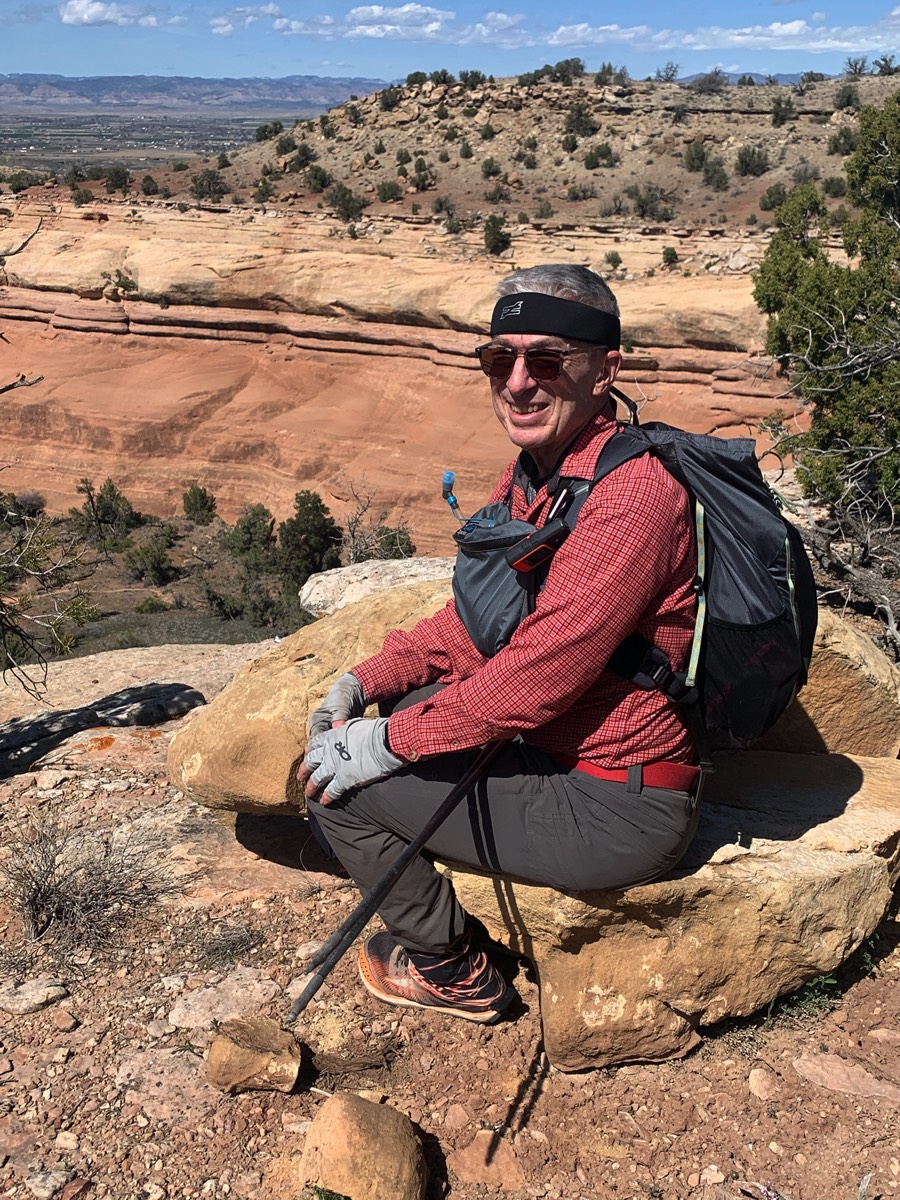
A trial run with Bill’s new protective head band at Fruita, CO.
The third such fall in 6 months was the last straw for me, especially since #2 was worrisome enough that he eventually had a CT scan to rule-out a potentially fatal epidural hematoma after landing hard on a rock on the side of his head. After fall #3, I immediately went online to find head protective gear more understated than a bike or football helmet. Bill protested, but my first online hit swayed him.
The more Bill read the studies about the soccer headbands and the more he researched the available models, the more accepting, and then pleased, he became. He recognized that he too was worried about a serious head injury but assumed that there was no intermediate solution. Ever hopeful, I ALWAYS believe there is an intermediate solution.
An agreement was made: he would willingly wear the protective headband under his yet-to-be-purchased, bigger, sun hat on steep trails, like in the Grand Canyon and where he had hit his head on a rock in Palm Springs, and go without it on flatter, less troublesome trails like in JTNP. When he consistently mastered his safer, upright posture in speedster mode, he could ditch the headband. We went from a kerfuffle to both being pleased with the intermediate solution in 2 hours. Fortunately, the promptly delivered bands were both completely comfortable, even on his first all-day hike using the bulkier one.
A Solution!
Bill finally sprung for silicon wiper blades at double the price of the standard offerings and they were worth every penny—nothing intermediate about this solution! Inexplicably, in the 6 years we’d been driving our wonderful truck, we’d never had an effective set of wiper blades. Fortunately, spending most of our time in the desert, it didn’t matter often, but it sure was annoying when we used them. They made a racket and only partially swept the windshield.
We could tell that the wipers were winners the first time we used the silicon upgrades, and they were worth their weight in gold, well, maybe in silver, a few weeks later when driving over snowy passes 2 days in the middle of April. Gone was trying to see the road surface condition in the occasional clear streak on our windshield! We delighted by having a full view through our huge window in the difficult, near white-out, conditions.
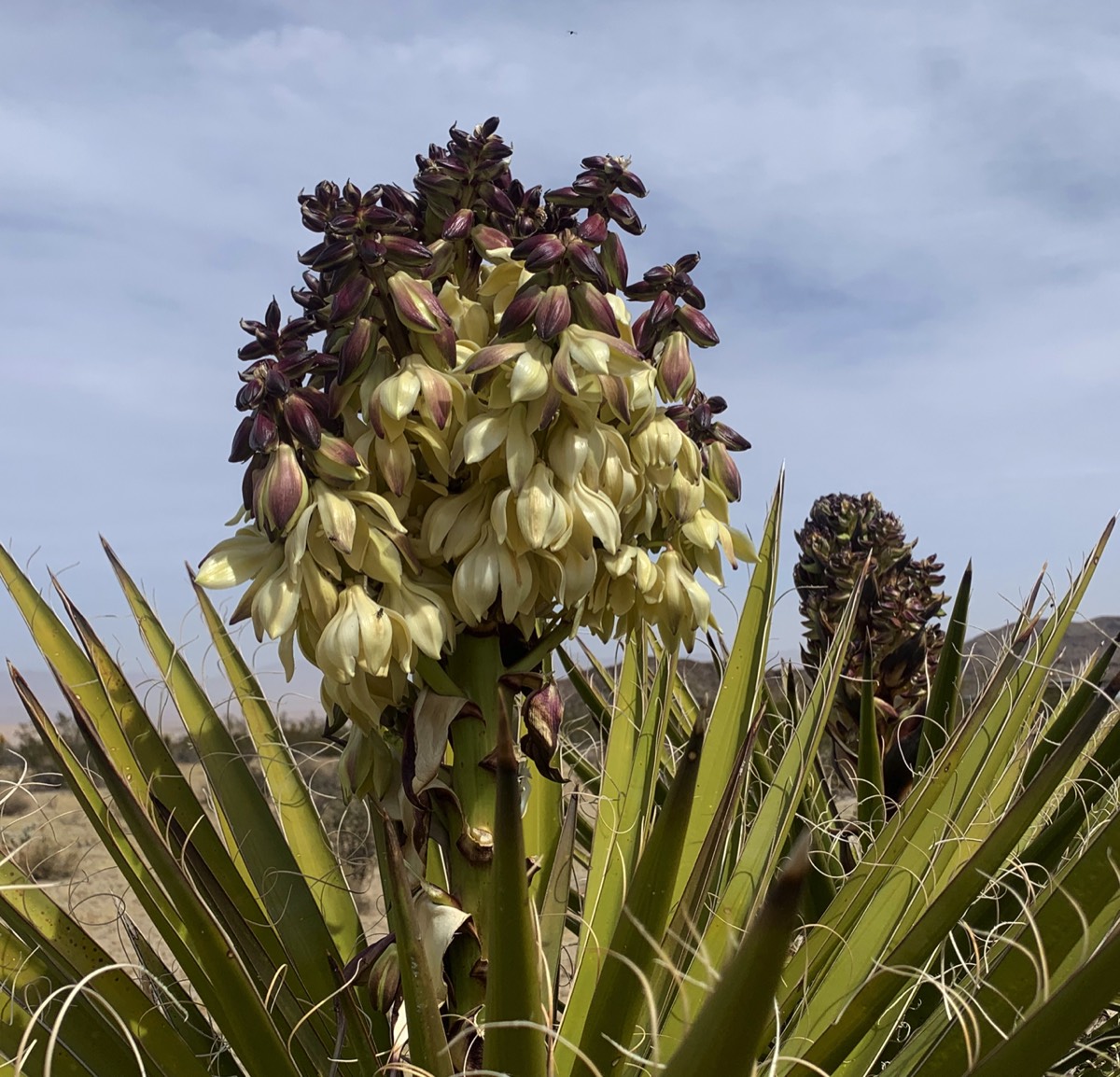
A Spanish dagger yucca in JTNP.
“It’s just like being at the Grand Canyon,” Bill blurted when he stepped into the trailer from his quick, 8 am run to our root cellar--our electric cooler tucked under the trailer. It was a typical, non-summer day for us in Flagstaff, AZ with temperatures in the 40’s, a sharp wind, dry air, and bright sun. The strong aroma of Ponderosa pine tree resins heated by the sun was the decisive signal that we were on the Colorado Plateau, not in the Mojave Desert of Joshua Tree, an unmistakable marker even with your eyes closed.
Bill’s brief, outdoor sensory experience triggered a flash of excitement because of the many associations. We’d spent 6 weeks each fall for several years bouncing between Flagstaff and the Grand Canyon and, especially since covid, it was our high-adventure time of the year. There was always a certain tension mixed with the anticipation, wondering if the weather and our bodies would cooperate with our planned epic hikes while in the area.
This late-March visit was a bonus trip triggered by a friend of a friend who wanted her first visit to the Grand Canyon to be spent making the long day-hike from the S Kaibab Trail on the S Rim, down to the river and Phantom Ranch, then returning to the S Rim before sunset on the Bright Angel Trail. Their group of 4 was spending 2 or 3 nights at the Grand Canyon whereas we couldn’t resist making it a 10-night stay. We treasure giving our bodies a week to partially altitude acclimate, and time recalibrate on the unusually steep trails.
The Grand Canyon: Always the Same, Always Different
The “big hole” that we overheard visitors using to reference the Grand Canyon, is a constant. The Colorado River only erodes the thickness of a sheet of paper a year from the canyon and we always comment upon how static the scenery is while simultaneously being mesmerized by it. It is the social overlay and that of our own experience in the Grand Canyon that makes every visit feel fresh and fascinating.
We’d been coming to the Grand Canyon in October for years, so this March visit spurred by the invitation of our friend, was novel. Even though we had light snow on our heads, then rain, on our arrival day and inches of snow 10 days later, on our last day, we were suddenly dreaming of resuming routine March visits. The weather at JTNP, our usual March destination, was much warmer but the hiking in the Grand Canyon was orders of magnitude better than that portion of the Mojave we hike, as well as having superior eye candy.
Our big, 17-mile hike down the knee-crushing but gorgeous S Kaibab trail to Phantom Ranch at the Colorado River about 4500’ below the rim and then up the longer Bright Angel Trail was a rip-roaring success. I had finagled my chronically irritated buttock muscles into just enough submission that I completed the entire hike without pain or dysfunction, only suffering from constant aching.
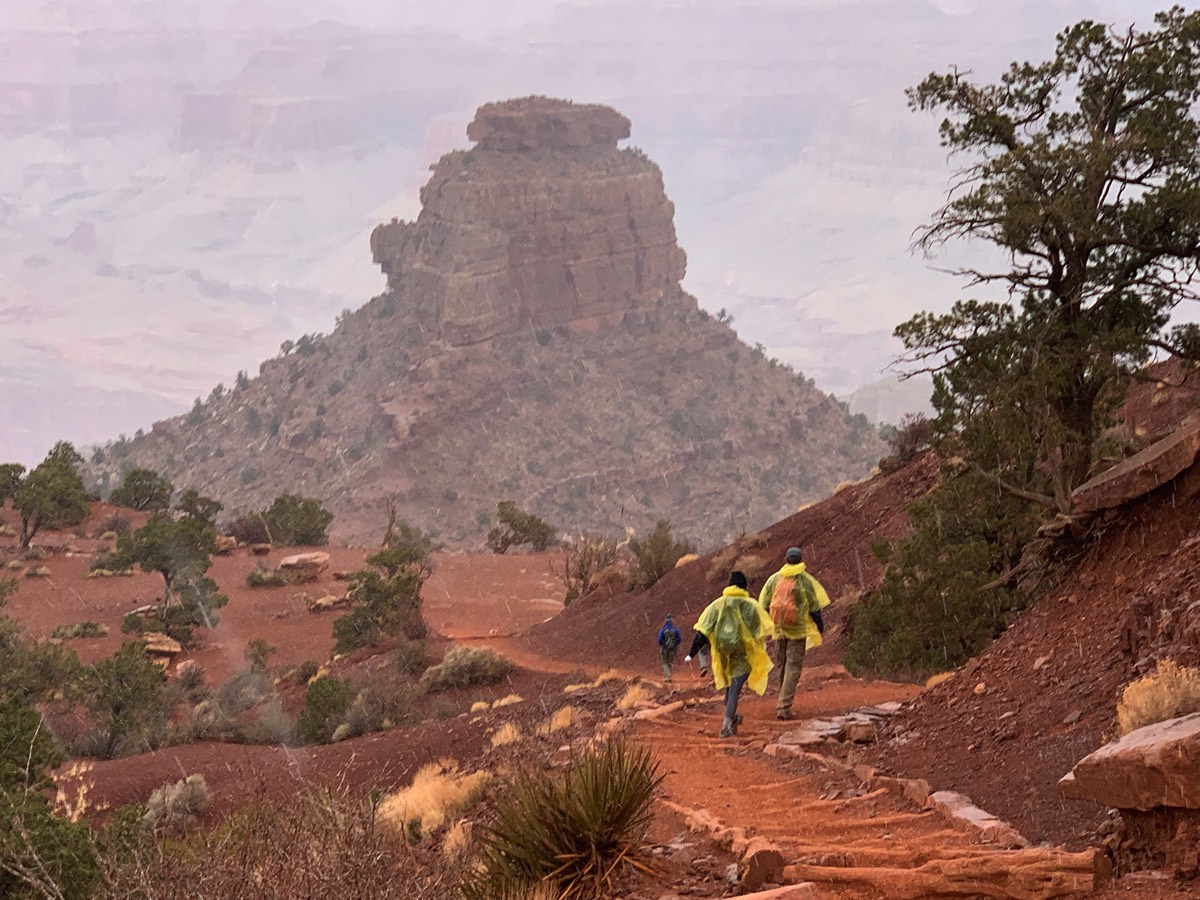
Light snowfall on our first day in the Grand Canyon.
I’d aggressively managed our daily exercise schedule for the week before the event to give me 4 hikes down the steep trails to let my mind and body recall how to finesse my footwork on the terrain, to optimize our altitude acclimation, to collect our 40 miles for the week that ended the day before the big hike, and to have 3 days of relative rest preceding the huge effort. We had to navigate around wind, rain, and treacherous ice on the 2 main trails, but we met all our week’s training objectives and it showed on the day that mattered.
The totally unexpected events of the familiar, big-loop hike were tending to 2 of the 4 other hikers in our group, people we didn’t know, who had significant performance failures. We often help ailing strangers on the below-the-rim trails but hadn’t expected to do so with this group of capable athletes.
The former ultra-runner, as in before he destroyed his ankle 2 years ago falling off a roof, had a new, custom, $10,000, carbon-fiber ankle brace that he’d chosen not to test on trails before the event and was in their group of 4 that departed 30 minutes before us. We began catching up with them about 2 ½ hours into the big descent. He was lagging his group and his horrific body mechanics made him look like the Tin Man in the Wizard of Oz from afar.
Unexpectedly, he knew he was destroying his body on the trail and didn’t have a shred of denial about how miserable he was when we overtook him. Bill had begun using a front pack last fall to achieve a better front-to-back balance of forces on his lumber spine and I adopted his innovation on big-hike days, like the one we were on.
I suggested to Bill that he approach the man about front-loading his pack weight a bit to improve his frightful mechanics. The hobbled hiker was very receptive, and they settled upon moving his entire load to his chest, with great success. His quads were off-the-charts sore that day and the next from the strain, but he was able to move more comfortably for the rest of the hike, picked-up speed on the ascent, and dropped the group at the end.
Bill was called into action again, less than a mile from the top of the S Rim, when one of the other members of our extended group was periodically puking. Her inability to walk more than a few minutes at a time slowed our long-awaited finish of our all-day hike by more than an hour. Our target time dropped by the wayside and the goal became getting her off the trail before sunset and before we became overly chilled from our sweat-saturated clothes in the strong winds so near the top.
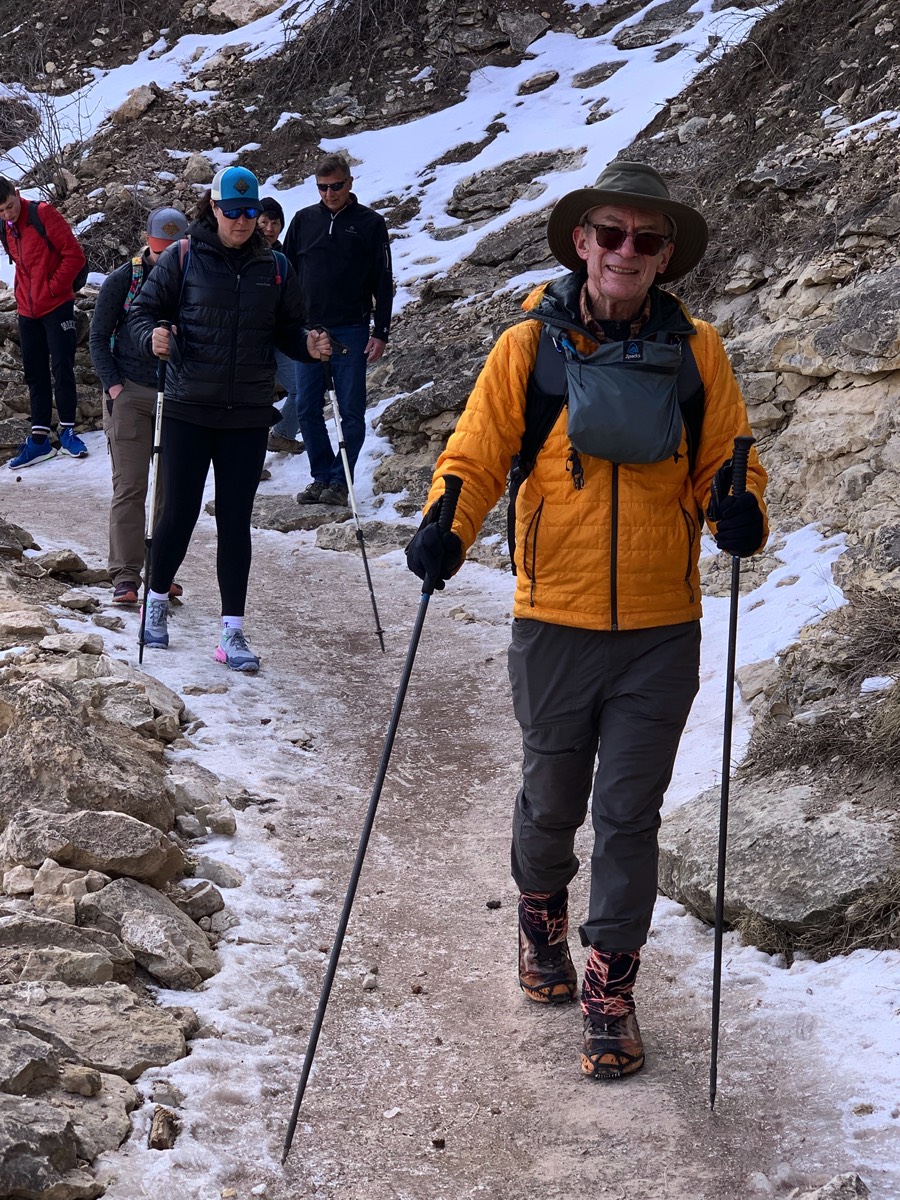
Light-duty traction devices saved us on one of our chilly training hikes.
Her friends had kept prodding her to press-on, believing that getting her off the trail quickly was the best approach, but Bill eventually put the brakes on that failing strategy. Decades ago, we had observed the amazing capacity of our beloved dog to stop, puke, then go bounding-off like nothing happened. We marveled at the time at how different humans were: if we puked, we needed many minutes of recovery to do much of anything. Pressing this woman to get moving after she had finished vomiting only served to trigger more puking sooner, which is how people are wired. The brain is shouting as loud as it can: “Stop! You idiot! Aren’t you listening?!”
Bill prevailed in reining-in the group’s restlessness, giving her longer and longer rest periods. It worked. The color came back into her face, she looked less distressed, and she gradually felt better. It was a painfully slow shuffle to the top, with her needing to rest again, seemingly feet from the finish, but we made it out before sunset and were met by our ultra-athlete member who was drinking his celebratory beers on the Rim.
Amazingly, of the dozen or more strangers we’d helped on the trail over the years that were dehydrated or salt-short, this person in our group was the most severe case we’d encountered. Vomiting is well-along in the progression to a medical emergency, the most significant marker for dehydration we’d ever seen or experienced. She still wasn’t fully recovered the morning after the event, further indicating how severe her case had been.
The group had much to celebrate at their victory breakfast the next morning: none had succumbed to their known weaknesses. One woman had questioned her fitness, another her ability to survive the heat at the Ranch and a third, to master her fear of heights on the trail and when crossing foot bridges. Curiously, the 4th person, the man with the life-changing ankle break, stated that he chose not to train, not to prepare, and not to test his ankle brace—the opposite strategy that we employ for big events. I guess that’s why he was an ultra-athlete and we weren’t.
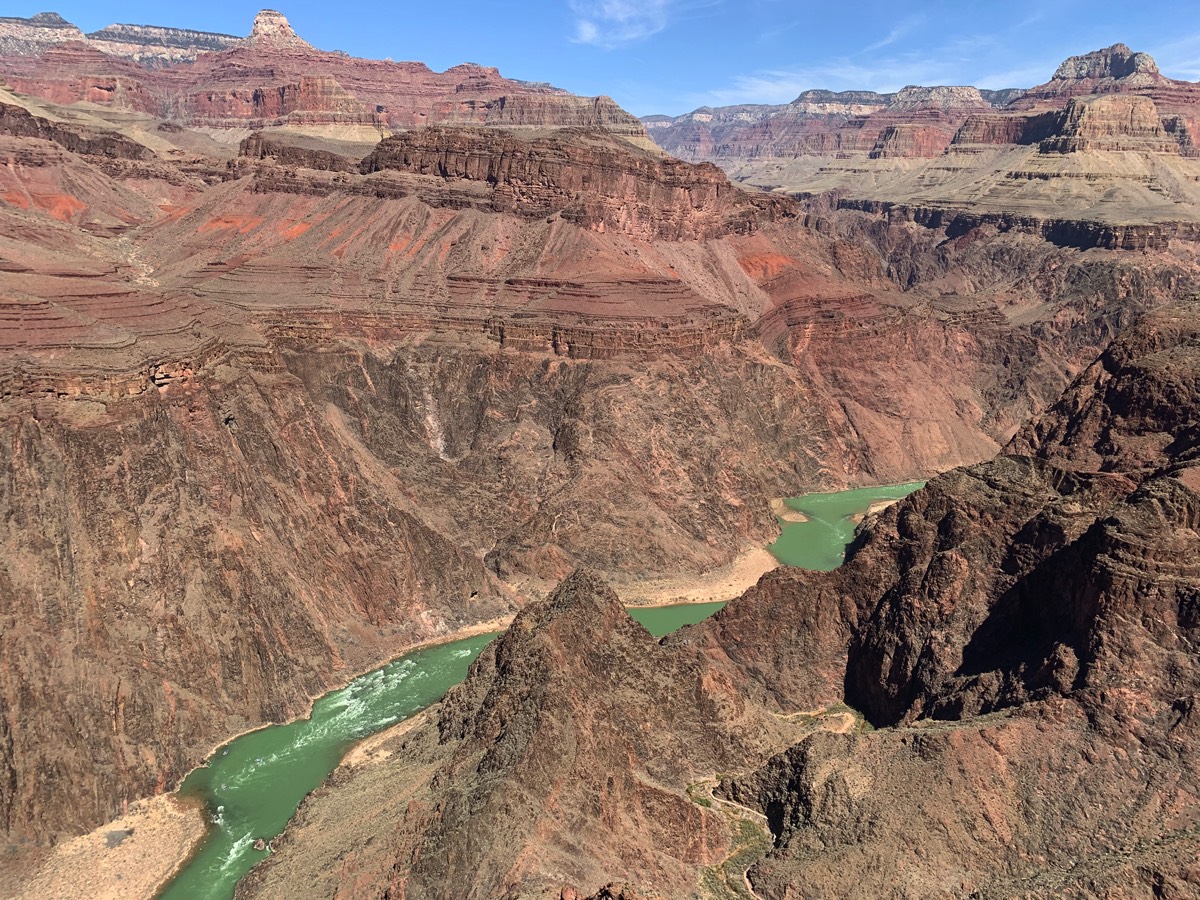
An especially clear air day for enjoying the Colorado River.
The group’s savoring of their triumphs morphed into a review of what they had learned, particularly comparing their conclusions about the emergency, and informally establishing their group’s protocol for addressing dehydration and future problems. We had dropped by at the end of their meal, with Bill further broadening their analysis and deepening their understanding of the physiology of the situation.
Once again, our self-appointed roles as informal Trail Ambassadors had expanded our personal experience in the Grand Canyon, that social overlay which makes each visit different. We’d loaned the group a phone charging cable when at Phantom Ranch; a sun umbrella that ultimately wasn’t used; a pair of walkie-talkies that had helped us all stay in touch in the canyon; as well as recommending a specific, post-event stretch at breakfast; and Bill suggested the man with the brace engage his provider about specific refinements to be made to it. We both had been brought-up to ‘mind our own business’ but the perils of hiking below the Rim had increasingly encouraged us to instead ‘lean in’.
The group of 4 hikers began their respective drives’ home after the breakfast and we continued our 5 mile walk along the S Rim in the fierce winds to improve the recovery of our muscles and other tissues. We occasionally paused to stare through the peek-holes between the Ponderosa pines on the rim at the Bright Angel trail, the place where we had been at the end of the hike the day before. The rim walk gave us nice closure to both the social and physical side of the signature hike to the river the day before; it marked the end of another great adventure for us at the Grand Canyon.
For 24 hours after the event, we continued to debrief the various situations that had emerged on the trail as well as our successes. We recalled that the ultimate measure of success in peaking for the epic hike had occurred earlier in the morning, always before sunrise on the morning after. That is when we ask the question: “Could I walk back today if yesterday had been a Rim-2-Rim hike?”
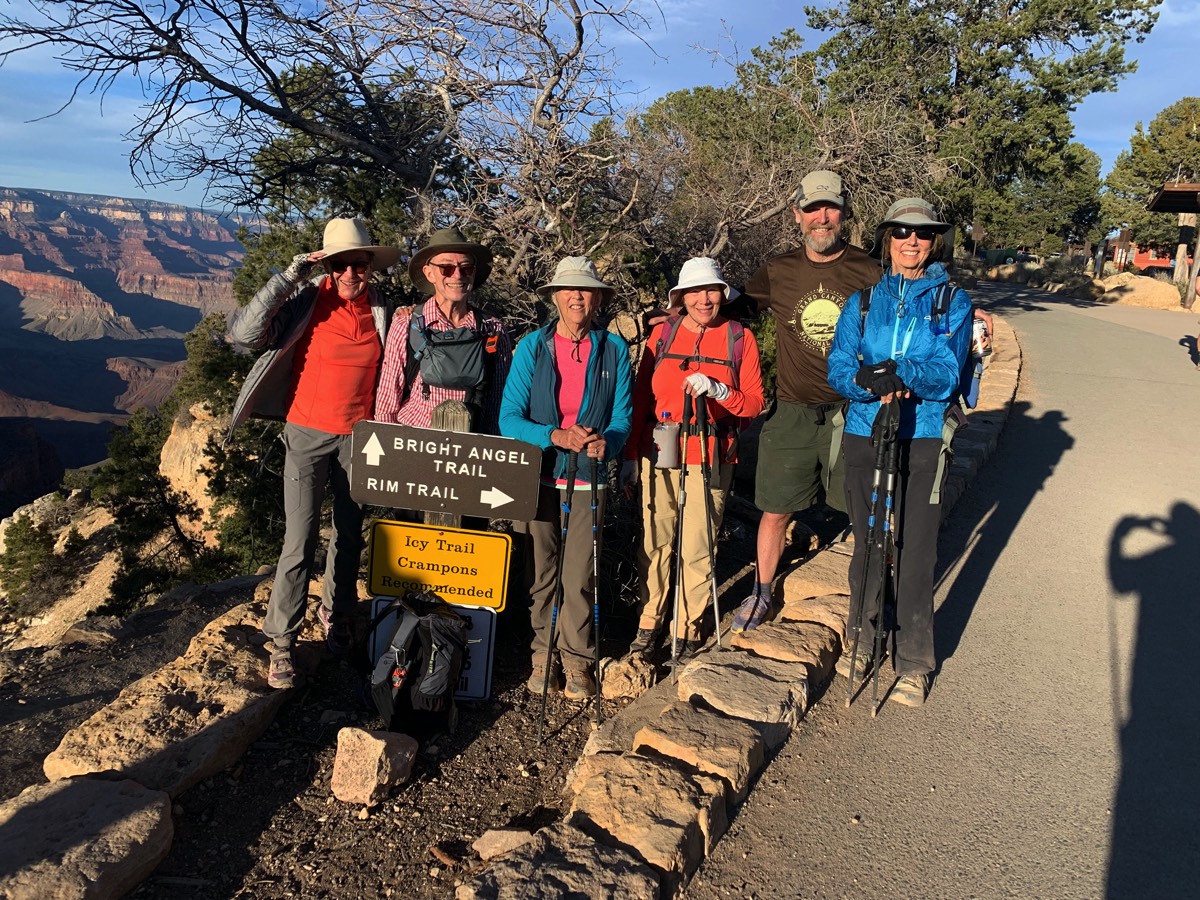
The team at the top of the S Rim before sunset.
The good news continued while my inspection tour moved to the quads where I was currently combatting near-chronic adhesions with my ITB; into the buttock tissues that had been dropping me to the ground with pain; and on to my very vulnerable lumbar disc area. The final report was excellent for both of us: we would be fit for a return trip to the S Rim had we walked to the N Rim the day before. We of course were just as happy not to be doing that, though the winter closure of the N Rim until May made it only an academic question, but an important one.
Déjà vu at Fruita, CO
The lack of available RV sites forced us to relocate from the Grand Canyon, but we weren’t ready to face the cold, wet, weather at home, so Bill buried his nose in his maps and came up with a great add-on: Fruita, Colorado. We’d been there, the host city for the Colorado National Monument, for 5 months in 2020, beginning almost exactly 2 years ago at the start of the pandemic. We wondered if it would be slightly traumatizing to the return to the place where covid became too real but decided to risk it and it proved to be an exceptionally grand idea.
Like the West had been all winter, the weather was challenging but we were out every day, either on the trails or our road bikes. Five months and too many 100° days had made the previous stay an ordeal, but this season’s 8-night visit felt like a teaser—there wasn’t nearly enough time to do everything we wanted to do.
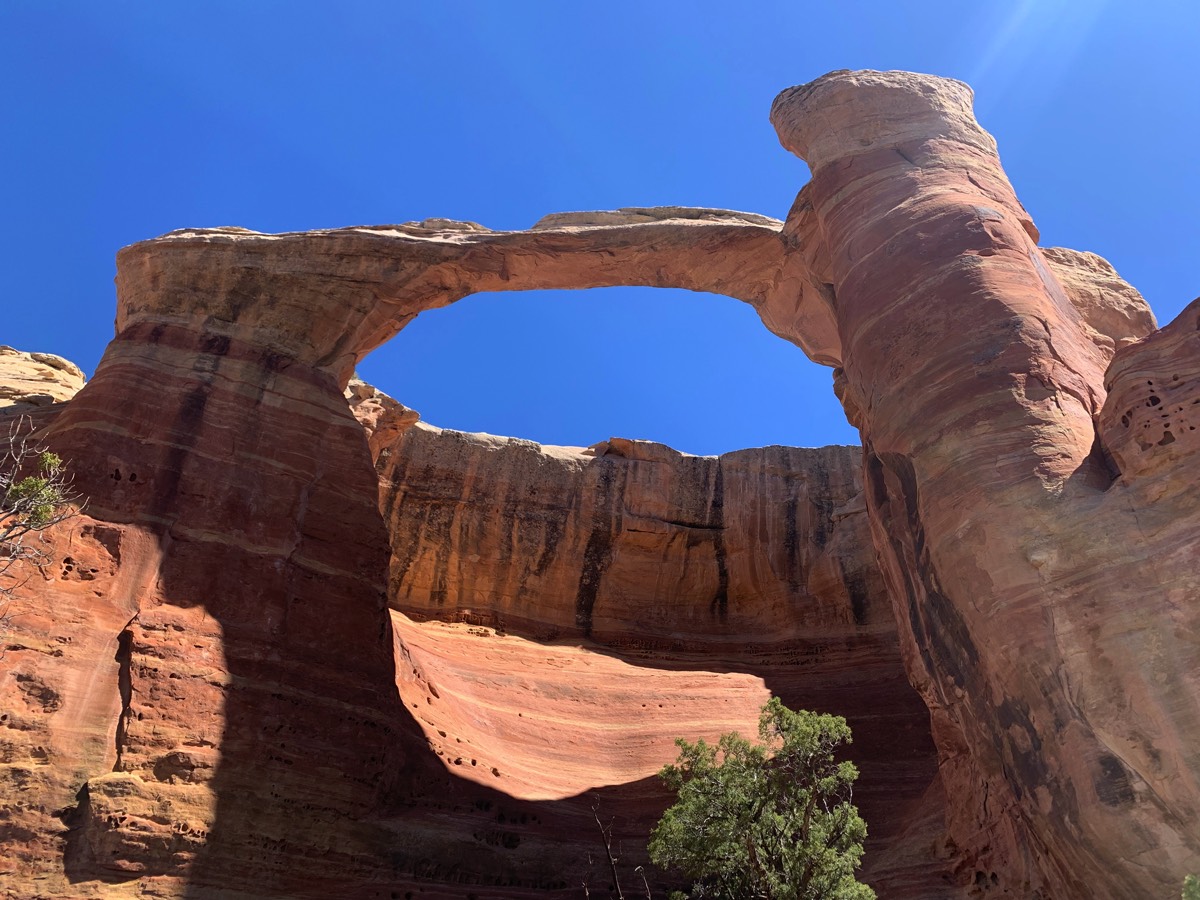
One of the arches on the Rattlesnake Arches trail.
It was 15 miles long and a little over 2800‘ of gain, and it is one of the most dangerous hikes we do. Midway to the turnaround, to the arches, one drops down into a canyon and then goes up the other side. Much of it is walking or scrambling on rough sandstone ‘slick rock’, or smooth, steep, bare rock. We do bits of it on all 4’s. Other stretches are very narrow segments of trail. Fortunately, the dicey part represents a small length of the entire route, but you do it both directions. It demands confidence and caution but is of course, doable, but it’s something you wouldn’t tell your mother about.
We were quite pleased with our performance on all aspects of the trail and had a wonderful time. It was just above freezing when we started and it never got particularly warm, which was perfect for a trail that is notoriously hot when there is full sun, like the day we were there. Route finding and navigation made for a bit of trial-and-error on the almost sheer, inner walls of the canyon, but that too went well. Neither of us was as depleted when we finished at the end of the day like we expected to be.
We each had a personal triumph with our body issues on the Rattlesnake route. Bill completed the hike with no back pain, which was an accomplishment for him. I had badgered him in the trailer before we left for the day about how his chronic, hanging-head posture was hurting his back. He only protested a little when I tied him up with a stretchy exercise band so the band would hold his head back in the right position while in the kitchen. He didn’t like it but could feel what he hadn’t been willing to believe, which was that his default head position was terrible for his low back. That ‘muscle patterning’ before getting on the trail helped him be more upright, making him noticeably more comfortable. He also noted at the end of the day that his good posture made the hike less tiring for him.
I had my own break-through on the trail, which eased my buttock pain. I used a new, light weight, 3” plastic ball I’d been testing for use on the trail and in Europe instead of the heavier lacrosse ball I use to ‘trigger point’ muscle pain. I’d had one stashed in a small bag with a string at the top so it didn’t roll away so readily when I used it at our lunch stops on the trail. About 2/3’s of the way to lunch on the Rattlesnake trail, I ran my belt through the cords on the bag and stuffed it between my pack and upper pelvis so I could massage, or trigger point, my butt muscles while I walked. I’ve massaged like that with other tools on the trail but reaching back to hold them in position is very awkward; this variation while moving allowed me to ease the pain without stopping or stumbling.
For our 4-hour return, I stuffed the ball higher under my pack to put pressure on the vertical back muscles where I’d had some ‘involvement.’ Regardless of the exact position, with each step, I got a little micro-massage of the tissues. I surmised after the hike that those usually quiet back muscles were more important than I realized in my pain pattern because my butt and back muscles were more comfortable at the end of the hard hike than when I started 8 hours earlier.
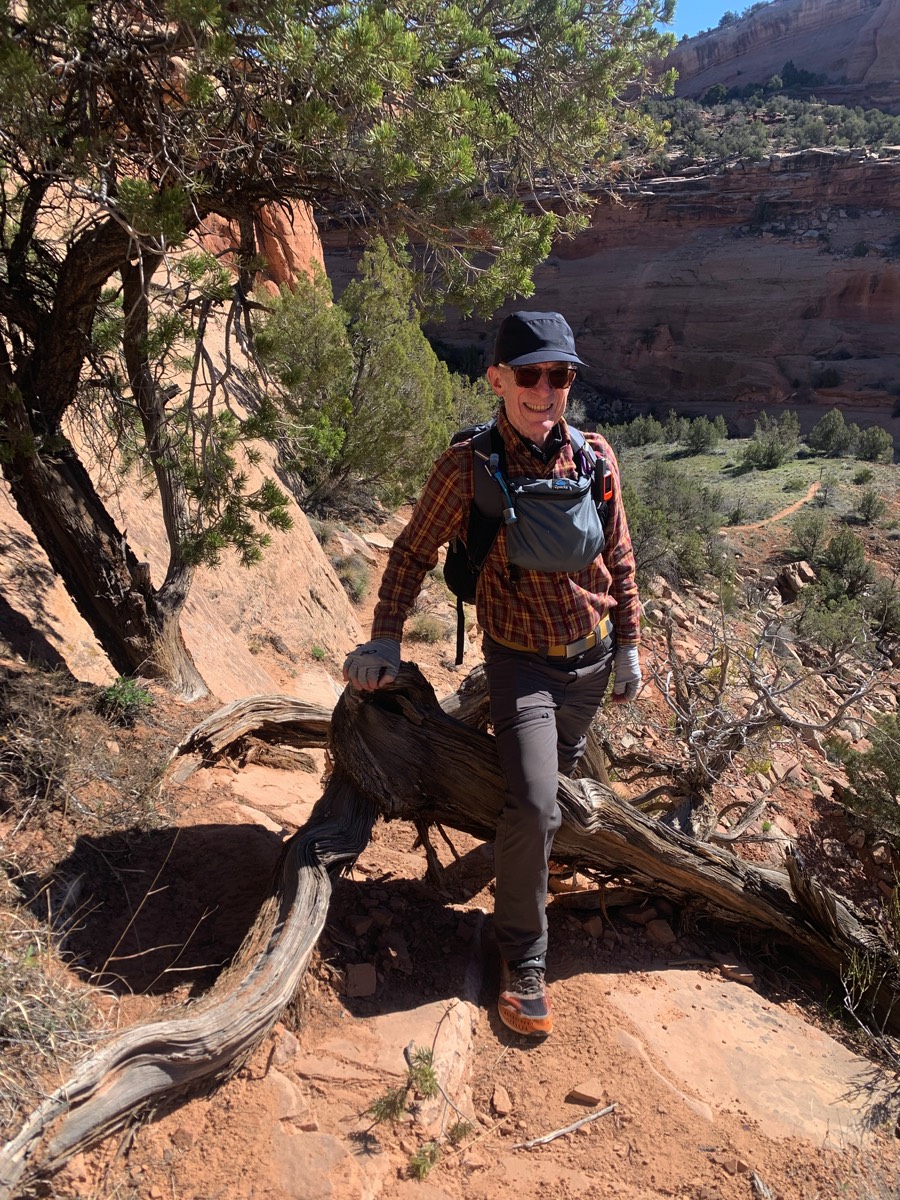
A welcome secure place on the inner canyon trail on the Rattlesnake Arches route.
Snowy Return
We were on a roll: with the benefits of good luck and careful observing, we made it over the 2 snowy, low passes on either side of LaGrande, OR, where we stopped for a night for scheduled trailer service, on our way home. The first pass was closed for 16 hours because of jacket-knifed semis and ice on the road, though the closure only stalled us for an hour. Unusually, because of the low angle of the winter sun and peculiarities of the storm systems, 1 – 2 pm was THE window to traverse the passes each day if the freeway was open, which is what we did both days. We still drove in low visibility due to strong winds whipping the falling snow around on both days, but the anti-icing road program was highly effective, especially when the sun’s radiation through the cloud cover was at its greatest in the early afternoon.
We were gloating during a little snow flurry in a Pendleton RV park about our good fortune in “making it through,” as the locals said about driving the passes, when sobering news hit us: we’d be returning to our new, expensive by our standards, apartment without the benefit of heat. Snow had been on the ground there too, which made a devastating vision of being chilled to the bone in our north-facing unit with 9’ ceilings.
The morning email indicated that the heating system was down in our apartment building and was expected to be restored by the end of the day. The next email, a few hours later, stated that the needed part wasn’t available for 5 days and left it opened-ended as to whether installation would be that day or the next. Our landlady then wrote, saying that when a similar problem occurred in the sister building, those residents were without heat for weeks.
We were shell-shocked by the vision of our chilly homecoming! Our joy-bubble formed from the anticipation of seeing our new apartment for the first time since friends had finished unpacking our belongings and partially decorating it, abruptly burst. Instead, we glumly visualized being hunkered down, packing for our long-awaited trip to England and Italy in the cold for days or weeks.
If it weren’t for the time-pressure of our May 4th European departure, we would have returned to the SW for the drier weather and life in our cozy trailer. Even continuing to live in our small trailer in town would have been far more comfortable than a cold apartment, which we gladly would have done, if there had been a suitable RV hook-ups nearby. Like with going to a hotel, both of those options would have drastically interfered with preparing for 4 months overseas; with heavy hearts, we pressed-on to do the best we could in the disappointing and uncertain situation.