
Palm Springs, CA January & February 2022
Wrapping-Up December’s Loose Ends
At last, in January while in Palm Springs, a sense of normalcy briefly returned to our days. The unseasonably cool temperatures of December nudged their way into the low 70’s that we all love, the sun shone almost every day, and our personal trials and tribulations were easier to live with than they had been for 6 months.
Our early January, follow-up appointment results were better than expected. My predicted week of 24/7 pain from having sun damage to my lower lip “burned-off” didn’t materialize at all—probably because the nerve endings were obliterated in the process. There were two nasty, brief, stings when the dermatologist zapped my tender lip with liquid nitrogen, and then I was pain-free, really pain-free.
I’d been living with near-constant pain for months, waking several times almost every night from it. Instead of whimpering in pain the first night like anticipated, I savored the bliss of the complete absence of pain while I slept. She was right: it was an ugly mess, but in the world of masking when out-and-about, no one saw it. It unexpectedly would need further treatment in February and April, but at least the process was underway.
Wrapping-Up December’s Loose Ends
At last, in January while in Palm Springs, a sense of normalcy briefly returned to our days. The unseasonably cool temperatures of December nudged their way into the low 70’s that we all love, the sun shone almost every day, and our personal trials and tribulations were easier to live with than they had been for 6 months.
Our early January, follow-up appointment results were better than expected. My predicted week of 24/7 pain from having sun damage to my lower lip “burned-off” didn’t materialize at all—probably because the nerve endings were obliterated in the process. There were two nasty, brief, stings when the dermatologist zapped my tender lip with liquid nitrogen, and then I was pain-free, really pain-free.
I’d been living with near-constant pain for months, waking several times almost every night from it. Instead of whimpering in pain the first night like anticipated, I savored the bliss of the complete absence of pain while I slept. She was right: it was an ugly mess, but in the world of masking when out-and-about, no one saw it. It unexpectedly would need further treatment in February and April, but at least the process was underway.
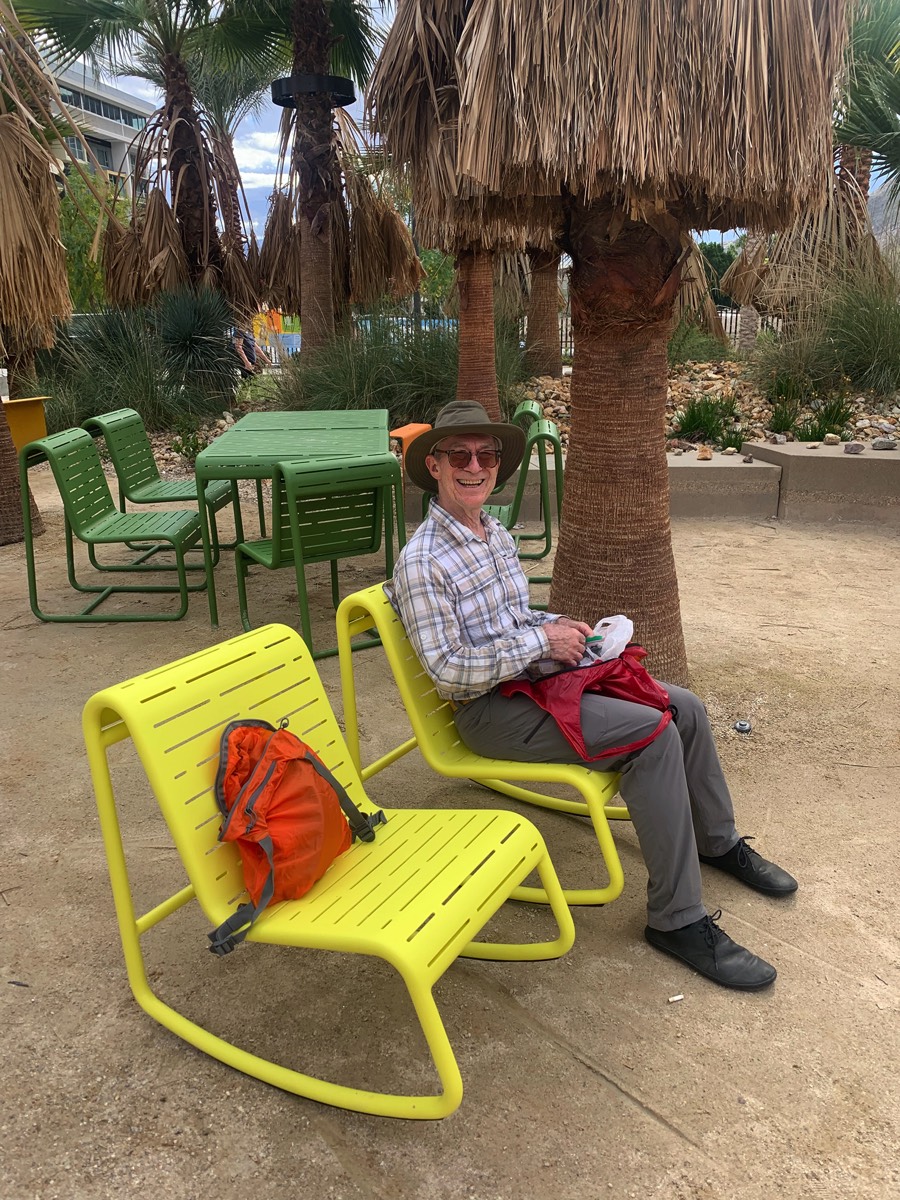
Enjoying the new rocking chairs in Palm Spring’s new downtown pocket park.
The same day that Bill had his eye appointment, I was treated to my first appointment with a massage therapist who came highly recommended from a hiking club triathlete. She jokingly referred to herself as a snake charmer of muscles, to which I agreed. Unlike others in the valley that I’d seen before, she knew the anatomy, knew what she was doing, was decisive, and immediately delved into my chronic issues. At last, I had professional help with my body pains when on the road!
Also on that day, Costco staff confirmed that the correction in my new lenses was as prescribed but that they weren’t ground in the proper positions in the lenses—the definitive explanation that I wanted for why I couldn’t see well. They would remake them at no charge, which was far superior to me continuously using one hand to shove the frames towards my eyebrows to read small print.
Bill’s New Dramas in January
Bill flirted with potentially serious, new dramas that fortunately were self-limiting. On the 3rd of January, he took a nasty, short, uphill-fall 3 minutes into a steep hike he was doing as a speed event alone. He came down hard on the left side of his head on a large rock in the classic epidural hematoma spot that can be fatal. I was about 10 minutes ahead of him and in cell range. After alerting me, he sat on the rock waiting for me to escort him back to the trailer. Amazingly, he had no dizziness, no superficial bruise, and no broken skin, but his temple was swollen and tender for a week. We cautiously watched for days for the classic symptoms of the dangerous condition to present but they did not even come close to materializing.
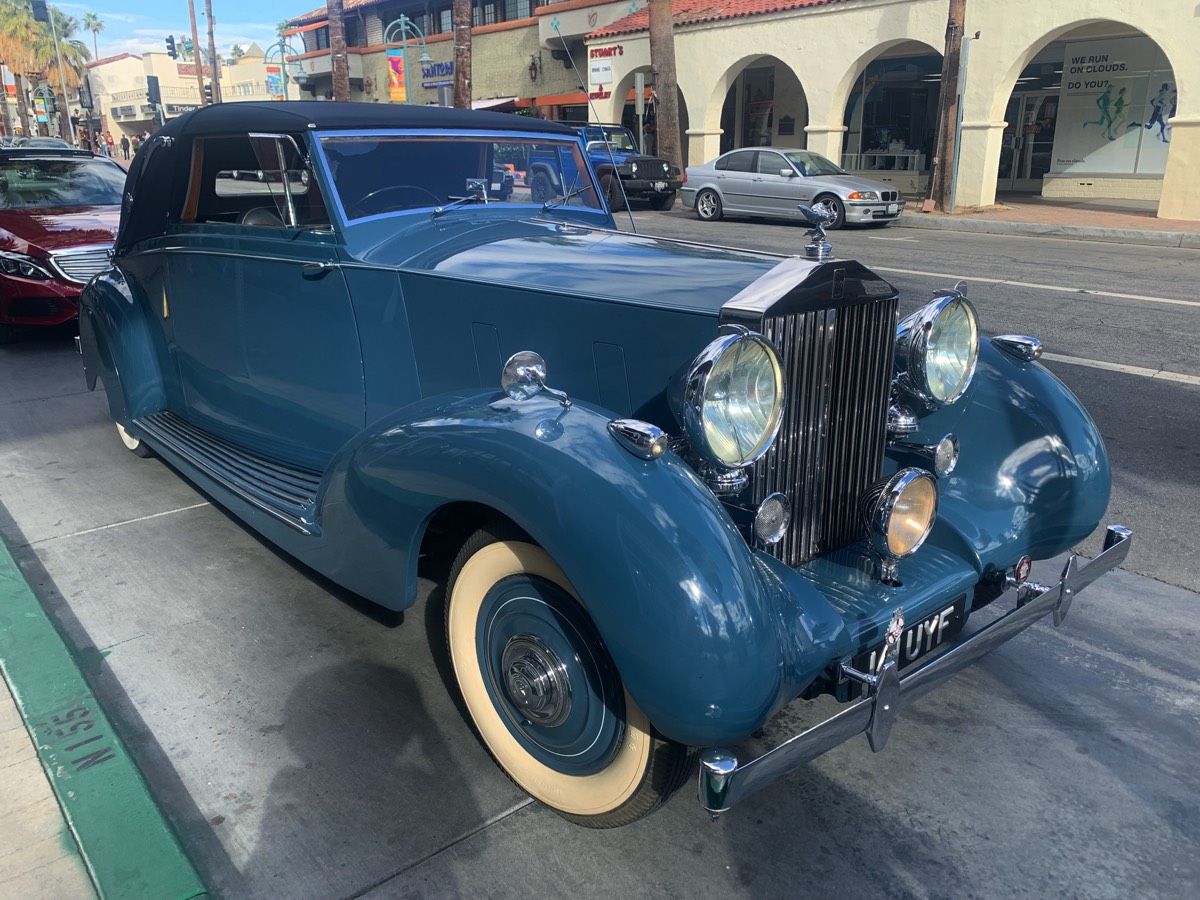
Head-turning vintage cars casually on display are SO Palm Springs!
Six days later, on the same nearby trail, Bill began feeling ill and after resting several times, he slowly walked back to the trailer. I carried-on to avoid aborting a 2nd fitness hike that week, and while I walked, he called about 15 pharmacies in search of the precious covid home test kits. He thought it highly likely that he had covid and hatched a plan that answered the question as to how we would manage life in a small trailer if one of us contracted the virus.
Upon my return from our hike, I barely entered the trailer for the next 48 hours. Instead, I immediately drove to the distant pharmacy Bill had located that had received a shipment of covid test kits the day before, a pharmacy that was receiving 100 calls a day about their inventory. I bought the limit of 6, then went on to stock up on groceries. Back at the trailer, Bill was reading more about how to handle our quarantining situation, making a motel reservation for me, and preparing my take-out dinner and breakfast.
After Bill confirmed the absence of covid in his system with 2 of the test kits and decided that his generalized icky feelings were likely bad heartburn from too much coffee, our one-and-only covid scare was behind us. A little blip in the radar with some inefficiencies in our days, but that was it.
A week later, our roller-coaster ride while hoping to resume living uneventful lives again had us gasping in disbelief: while leading our signature “½ Way to the Aerial Tram” club hike on Mount San Jacinto, Bill and I both had ‘all-systems’ failures when our back muscles gave out on the descent. We both limped home with a heavy reliance on our poles.
We concluded that our poor performance was core muscle weakness from too little recovery time the previous 4 days. Bill’s situation was likely compounded by perpetually weak back and ab muscles whereas mine was yet another manifestation of my chronic buttock muscle issue. We had both been treating our vulnerabilities but the apparently the combination of the strenuous hike and too little recovery time did us in.
After 2 days of light exertion and massages, we did another 15 mile hike, this time in Indian Canyons. It was about half the elevation gain as the 1/2 Tram hike and I did well, but Bill again struggled during the last miles.
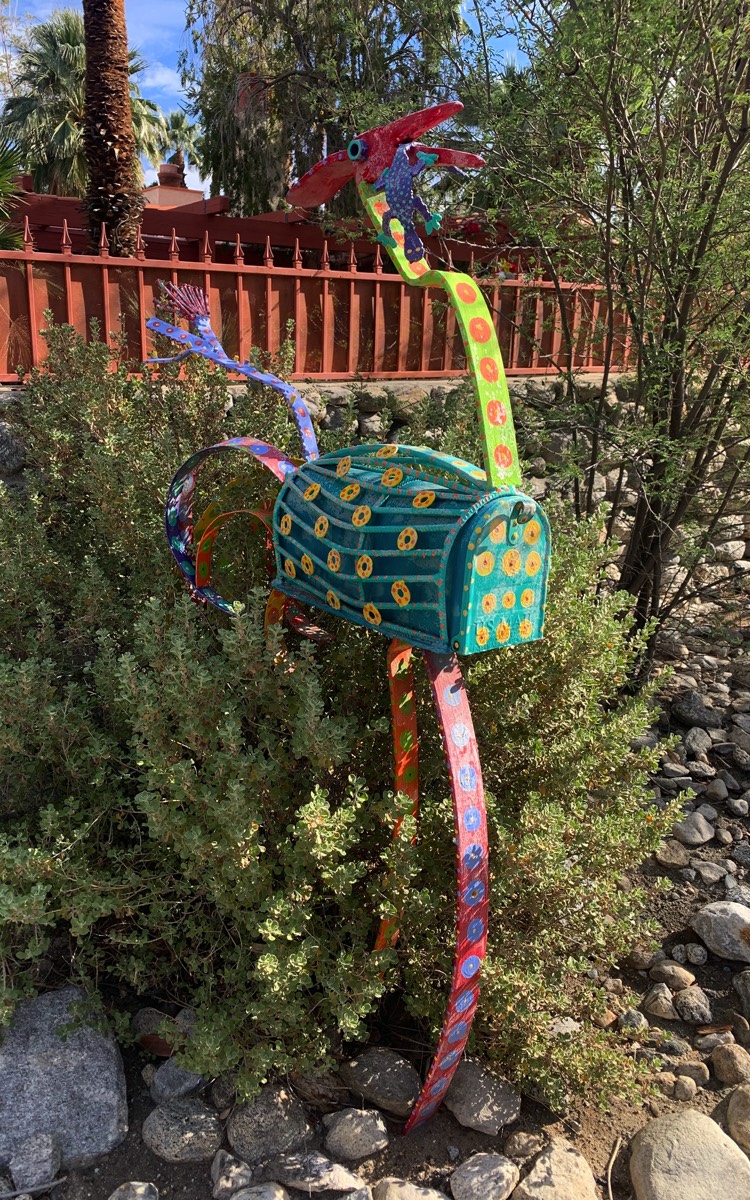
Road runner mailbox: there is no end to the eye candy in the Palm Springs old town area.
Bill’s slumped stance is his most comfortable position, but it exhausts the inappropriately used muscles. Once they are fatigued, it’s difficult to continue on. By rallying all his concentration for the last 1-2 miles of the long hike, he was able to engage the underused muscles that should have been holding him up all day. Of course, those muscles weren’t tired, but some of the overused muscles were needed as well, so it was a struggle, but he got off the trail in good form and with decreased pain. Two days later, we did a 10 mile hike during which he prevailed: he maintained good posture the entire time and was pain-free. A hard-won, but powerful lesson about the power of the mind.
Interestingly, Bill’s success in eliminating pain while hiking harked back to the book “Unwinding Anxiety” that we both had recently listened to. It was a game-changer for Bill. The book is about breaking bad habits by being mindful, by feeling your body.
Bill had always taken great pride and comfort in his intellect and had been relatively dismissive of feeling-based-knowing but he did an about-face while listening to this book. The question recommended by the author to ask oneself that hit home for Bill was “How am I going to feel later if I do ‘X’ now rather than putting it off until later like I usually do?” In this case ‘X’ was standing well and he knew the answer: procrastinating on his posture correction was a prescription for pain.
On the next big hike, Bill revived his old trick of setting a 90 second timer to “ding” to remind him to check his posture, and he kept reminding himself of how bad it would feel later to give-in to his comfortable slouch. Asking the author’s question: “How is that going to feel in my body if….” had instantly liberated him from his bad posture, at least in the moment.
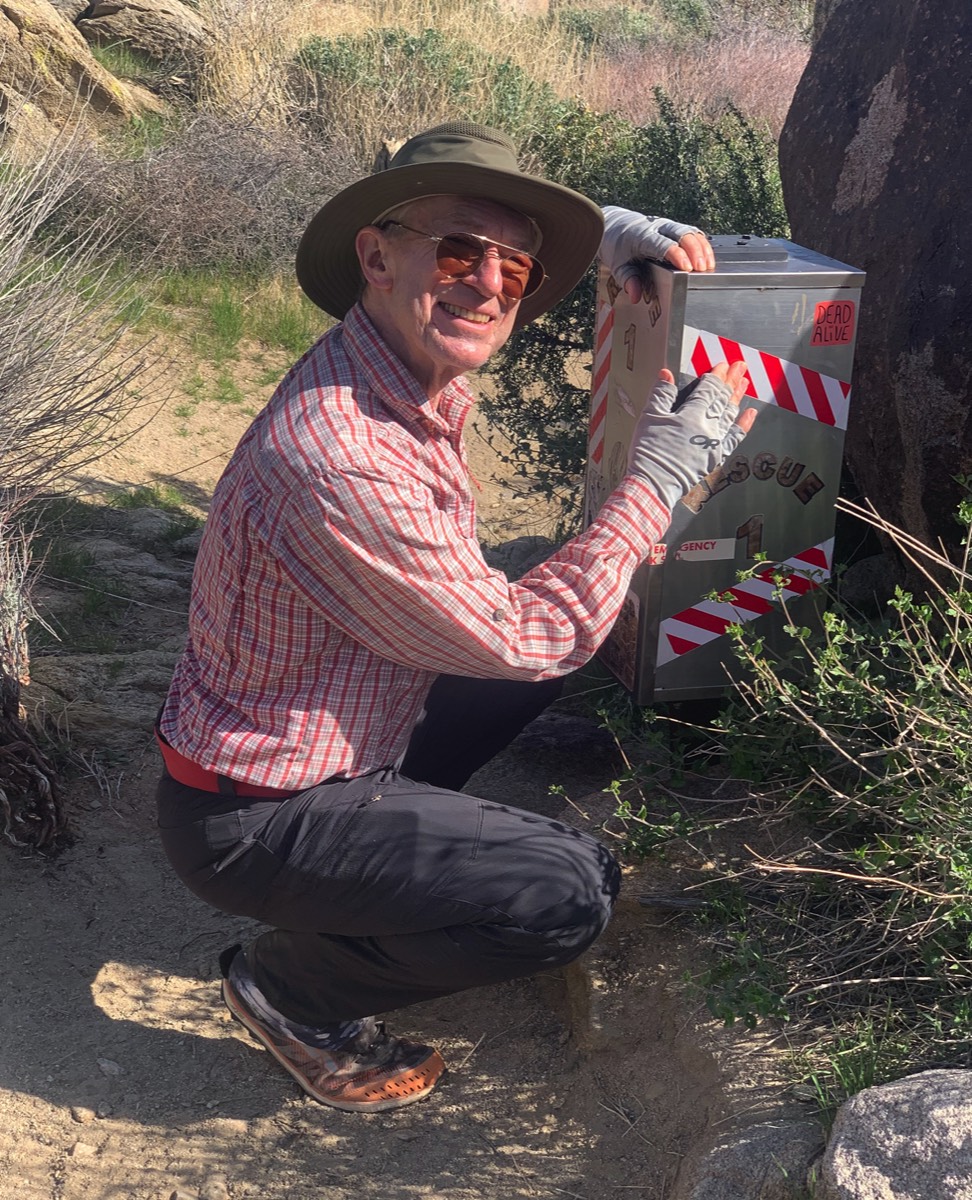
Applying new reflective tape at the 2500’ level on the “1/2 Way to the Tram” hike.
What Happened To Normal?
“Normal” in our bodies was eluding us, and then normal also eluded us on the trails. We set-out on our last club hike for our winter season in late February, our signature “1/2 Way to the Tram” hike with a threat of rain.
The night before, we anticipated that we might not make it to the 4800’ elevation point because of overnight snow and in the morning, we warned our half dozen hikers that we might only make it ¼ - 1/3 of the way. All but one were game to get as far as we could on the iconic route from our starting elevation of 400’ (120 m) and we pressed-on up the difficult trail despite the rare drizzle. The first remnants of snow on the ground were at 1850’ (565 m).
The rare sight of significant snow so low on this prominent, urban mountain energized our group, all asserting that they wanted to at least reach the elevation where the ground was covered by snow before turning around. None were strangers to snow but that was irrelevant, snow on this iconic desert mountain trail was irresistibly beckoning.
At the 2500’ landmark, we were all overly damp, even with rain jackets on, but suddenly we were locked-in on a mission by the sight of so much snow above us. One woman voiced her apprehensions, indicating that she too wanted to get that trophy snow photo but that she also wanted to limit the additional commitment in the worsening conditions to 15 minutes.
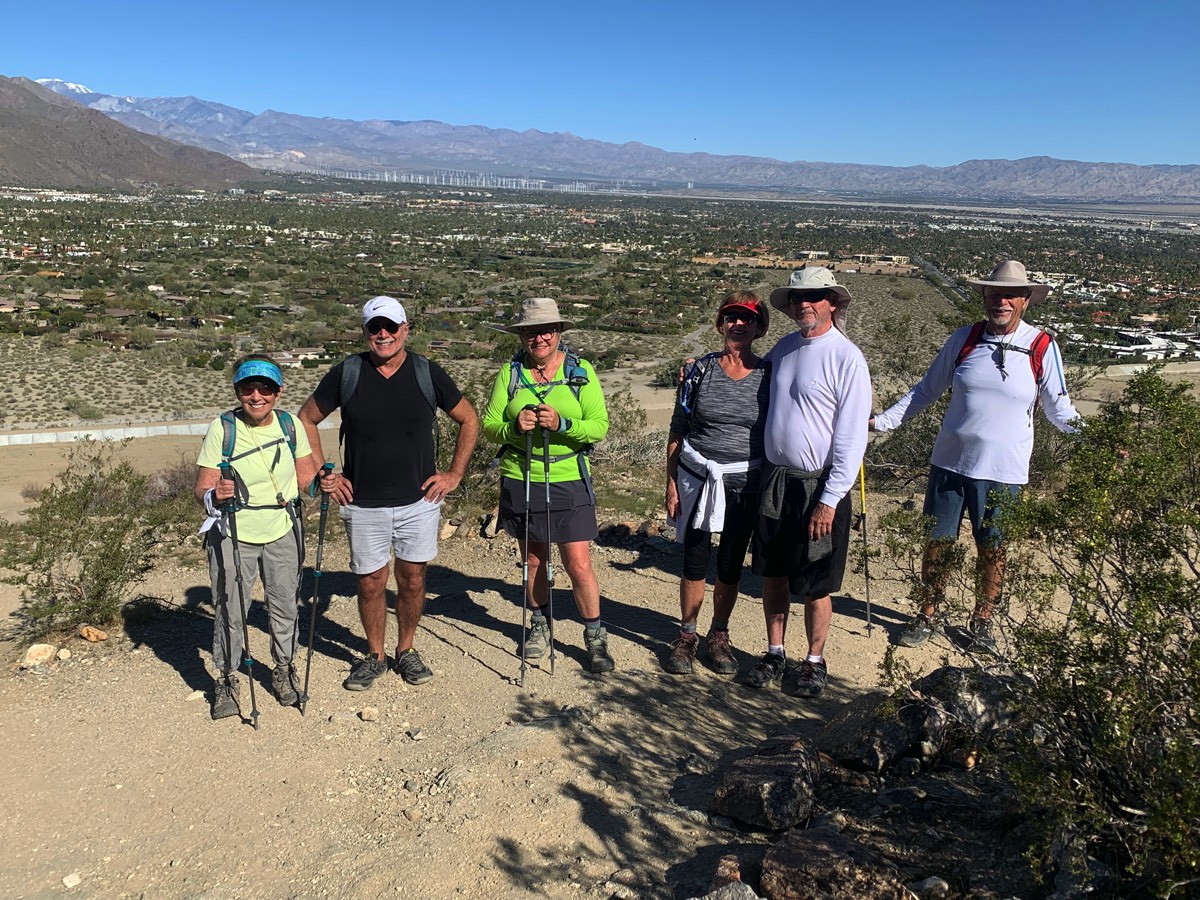
Luckily for all, almost exactly at 15 minutes, at 2800’, I found a photogenic setting for a group shot and phones were passed around so each person had their own shot on their phone as well. Abruptly after taking our group photo, a brisk wind came up and the wet falling snow became intense.
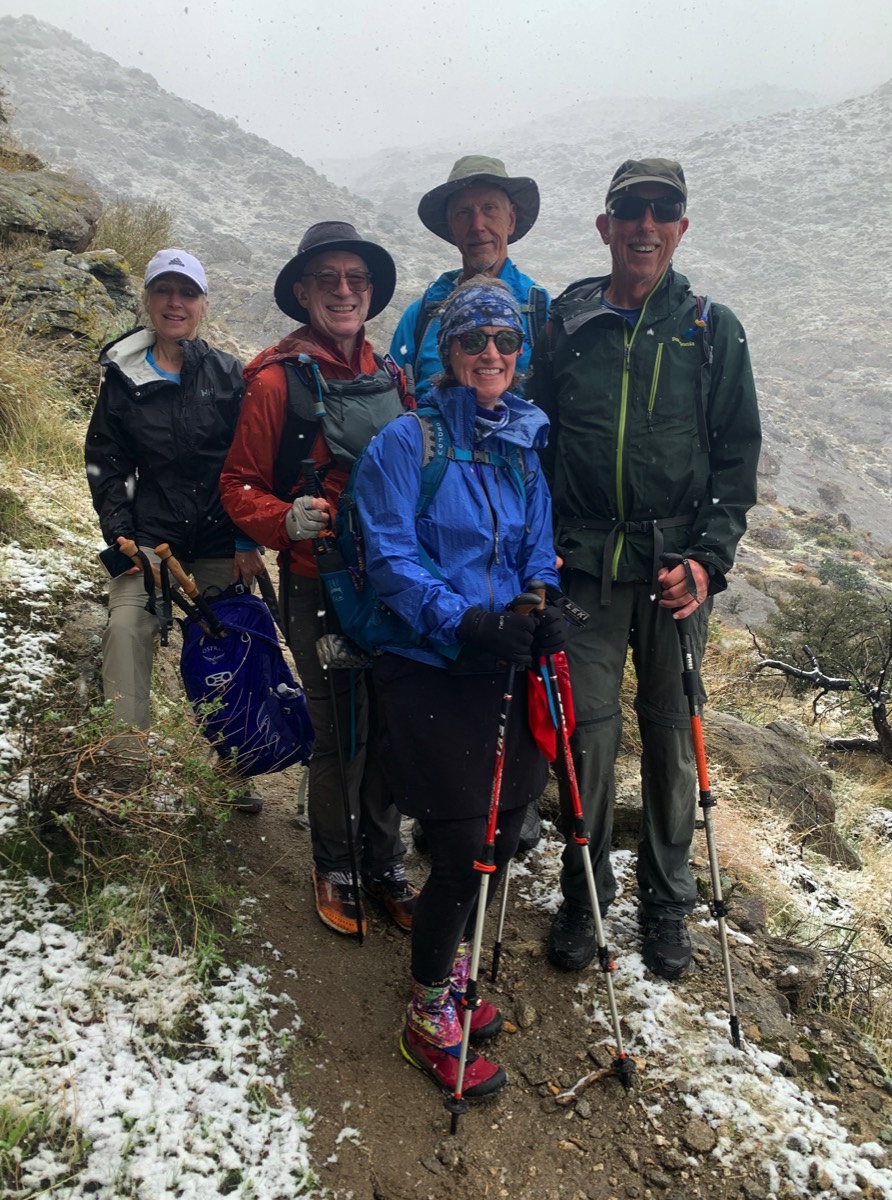
The trophy group hike shot in the rare snow fall at 2800’.
The situation quickly became uncomfortably urgent feeling in the heavy snowfall after the photo op. I directed the first 3 hikers that were ready, and had the least extra clothing on, to head down the trail to warm themselves by moving in near-white-out conditions. I fumbled a bit and was delayed in following them. It took about 5 fretful minutes for me to get them back in sight, but they had stayed together and were clearly on the trail I knew well.
One guy wanted to linger at the photo stop to pee, so Bill remained with him. They drifted off trail as soon as they launched but Bill whipped out his trusty Gaia navigation app and quickly got them sorted out. This experienced hiker, who had wanted to go much higher despite the snow, was shocked at how quickly they had lost the trail, though by only a few feet. This was little too much disarray for a few minutes for our comfort level on a club hike and later we crafted a plan as to how to do better if such a highly unlikely situation arose again.
Fortunately, no one slipped or was injured on the upper segment of this descent, which would have been a difficult situation because we were all overly cold. But, almost as suddenly as the snow dump began, it stopped. We were soon under full sun and we were drying out by the time we returned to the 2500’ landmark like nothing unusual had happened. It was more adventure than we like to have on a club hike, but it was a fun day for me and the best that we could tell, everyone was pleased with the unique experience and their photos to document the rare snow event they had witnessed.
The Big Picture
I arrived in Palm Springs in December with athletic performance anxiety, wondering if I could restore my flagging fitness in time to run with our pack on the trails. Once there, I discovered that I was both gaining and losing capacity, like many of our trail peers.
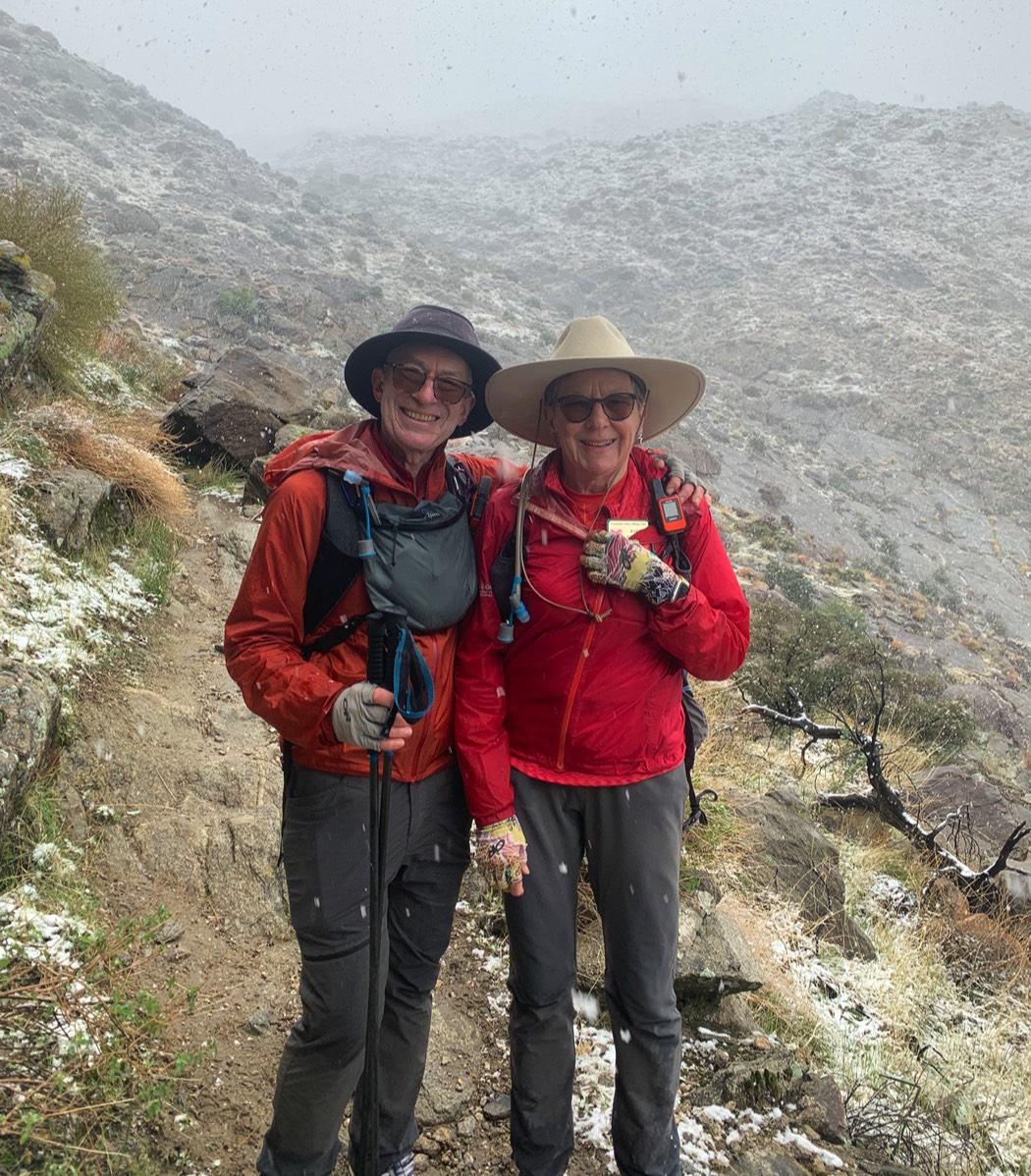
We weren’t left out of the photo op.
I also discovered that last year’s 10, one-minute jogs up a steep city street inexplicably took 1:40 each this season on precisely the same route. I was horrified to expose another facet of my insidious performance degradations.
There was nothing to do with these punctuated failures other than acknowledge the sadness and frustration and to keep pushing to do better. I made small gains on my hill work while in Palm Springs but even by the end of February, my performance was well below my starting point a year earlier. I was baffled but couldn’t evade the numbers.
My fears of being exposed for my performance losses, of being ejected from my pack, largely disintegrated because I wasn’t alone in loosing ground in the face of aging. I couldn’t even retain the list of body issues one of the triathletes rattled off because I was so taken aback by her unseen ailments. She was still performing at a high level, but scoliosis and other back issues seemed poised to drop her to her knees at any moment. Others weren’t as lucky, they had already been stalled-out this season with bunion surgery, anticipated foot surgery, multiple arthritic joints that might require surgery, a cornea replacement, knee problems, mysterious lung problems, and cognitive issues.
When we joined the desert hiking club 6 years ago, our mentor commented that the high achievers hit the wall at age 75 and faded away, that they just couldn’t do it anymore. We had hoped that we would be spared, that perhaps this tier had been heavy drinkers and smokers and that we’d out last them on the trails. There were essentially no organized club hikes last season because of covid and when operations resumed this season, the last of that tier was nowhere to be seen on the trails. They had faded away. And now, as our peer group had risen to the top of the heap, we were prematurely sinking, largely before age 75. We weren’t gone yet, but it wasn’t looking good us or for our tier.
In light of my shortcomings this season, I’d concurrently grieved my personal losses and focused on leveraging my role as the club’s Hike Leader Recruiter to actively support and create new opportunities for the next wave of younger hikers. I wasn’t fast enough to lead hikes for them, but I could facilitate making new roles for them in our existing structure. Aging gracefully, mentoring, and finessing had become my unexpected focus.
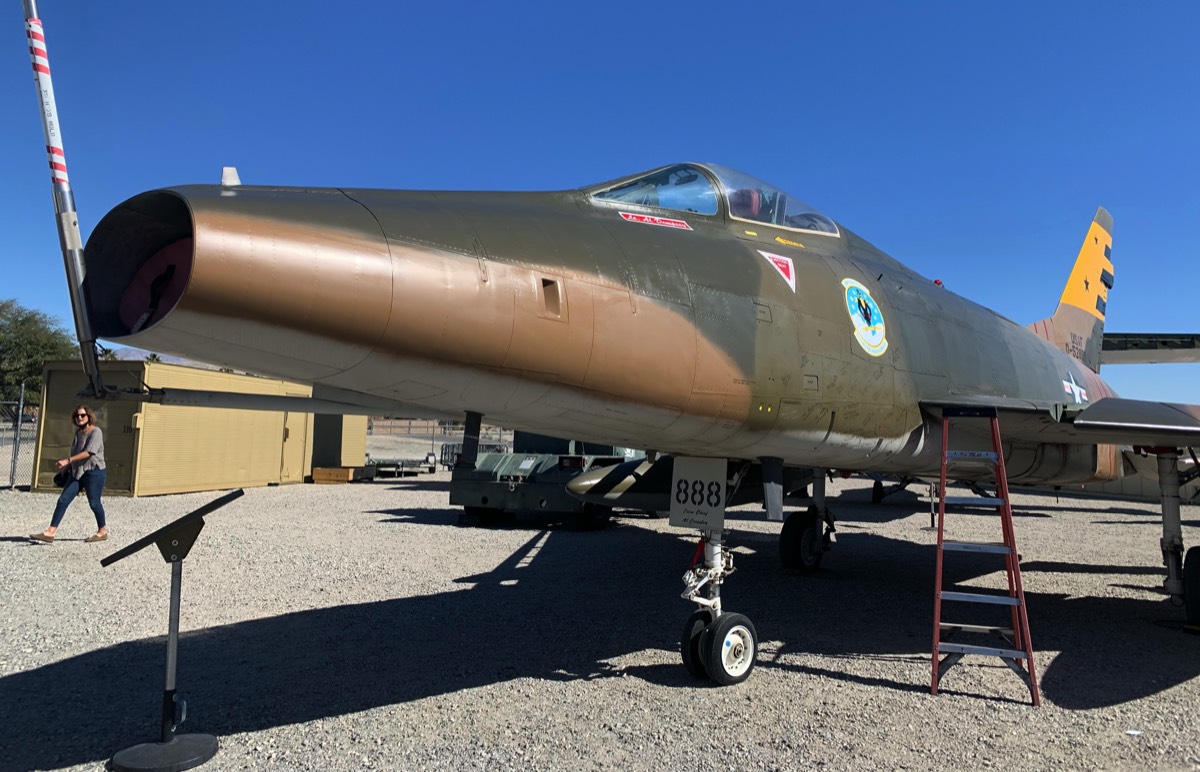
A Cold War era F-100 fighter jet given to the museum by a hiking club member.
We knew we had met him several years ago when he graciously drove a shuttle vehicle for one of the Club’s signature, epic hikes, the Guadalupe Trail. He and another man in the old guard had given up hiking years ago but still attended the monthly club socials and could be counted-on for the unglamorous, but much appreciated job of shuttle driver. They would take over 2 hours out of their day to drive up the windy mountain road to pick-up hikers who then had had the luxury of doing an exhausting, 1-way hike and being driven off the mountain at dusk.
We were shocked to look up at the F-100D Super Sabre fighter jet on the museum tarmac to see this man’s name hand painted under the cockpit window. I later learned that he donated $200,000 to purchase the only airworthy, privately held, F-100 in the world. We were deeply touched: the man we barely knew had never given up, he was always engaged in the world, always contributing, even after his athletic abilities waned.
In a newspaper article at the time of his donation, he described his experience of piloting F-100’s during the Cold War in the 1950’s as “I’m going to put this airplane on”. In a flash, we understood why we had felt like this old guy we’d never met before was driving like a bat out of hell down the mountain from Guadalupe. We had only been off by a little bit: he no doubt was re-living flying the tactical fighter jet-bomber 60 years ago through all of those twists and turns on the narrow mountain road with a dramatic panorama of the valley floor opening below him.
Gifts To Others
We were particularly gratified this season to share much of our sports knowledge with a few club members. A new club member, who was also new to hiking, directly implored us to teach him how to be a hiker and we did. We actually ran into him on a trail on a non-club hike and gave him our website link to answer some of his questions. He dove into our many files, reading about the technical issues of hiking and about our travels.
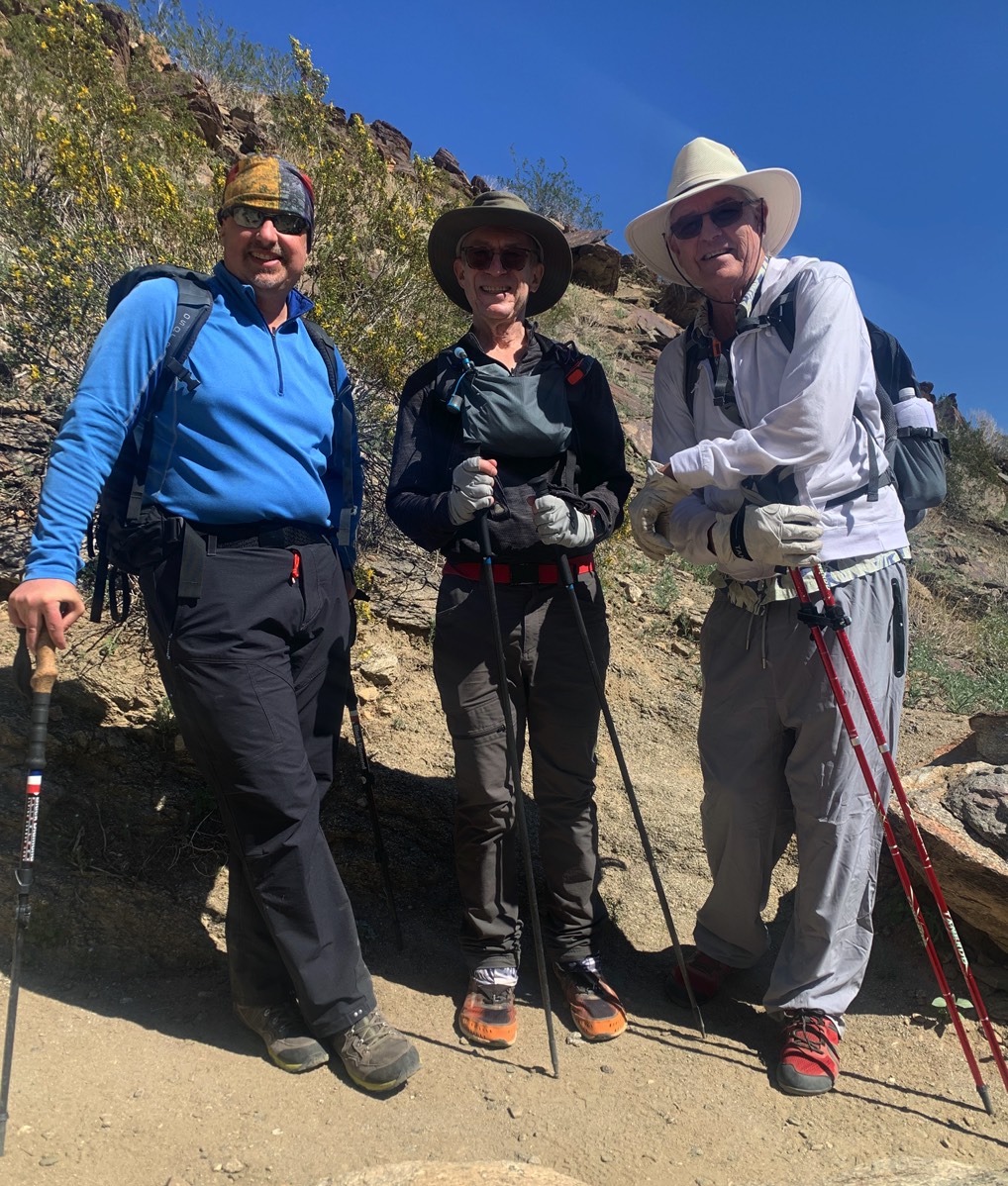
Bill with 2 new club members: a French-American Antarctic mountaineer & a former surfer-turned-hiker.
In addition, we worked intensely on 2 hikes with a Pacific Crest Trail backpacker who lacked the footwork she needed for steep descents on the rocky terrain of the ½ Tram hike—a skill we had refined out of defense of our knees. She couldn’t make the speedy strategy that many sturdy hikers use of going down the fall line work for her and only had scooting down on her hinny as a back-up. We literally broke our technic down to “put your right foot there, then the left one over here” to teach her our mini-zig-zag pattern on narrow, rocky trails as well as how to utilize seemingly too small-perches for her toes. She also was a quick study and was thrilled with the power of now seeing the trail surfaces as being full of opportunities for good footholds instead of as insurmountable barriers.
A far less labor intensive, strategy-sharing success was off the trail with our RV park manager. Our usual superficial chit-chat over the incoming mail resulted in me sharing my latest sleep strategy, which was silently creating alphabetized lists of objects in the dark. I combine that intentionally mind-numbing brain activity with slow, conscious breathing, only allowing one word for each inhale and exhale cycle. If the night’s project is fruits, it might go like this: “apple, apricot, almond, banana, blueberry, cantaloupe, coconut…” I’ll do all the “a’s” I can think of, then the “b’s” and “c’s” and then go back and repeat them all a few times before going on, always going slowly and sequencing the words with the breath. She reported back a few weeks later saying that her sleep disruptions due to ruminating about work in the wee hours had completely disappeared by using this technic! A couple of minutes of coaching about my mental trickery may have transformed her sleep issues for her lifetime. How sweet is that?
“Move over! The woman on the far left is 80 years old, had a hip replacement, and also still skis & cycles.
Our 3 month stay in Palm Springs is literally our longest time spent in one place in the year and that has been the case for over 10 years now. Often by mid-January, we are becoming restless and ready to move on. Bill starts dreaming again about a mid-winter get-away to the Canary Islands, though covid keeps quashing that bucket-list adventure for him. But this season was different for me. When asked by a neighborhood while we were hooking up the trailer to leave: “Did you do everything you planned to do?” my knee-jerk reply was “No.”
It wasn’t obvious at the time, but we’d apparently introduced enough variety into our weeks that I found myself saying that I wasn’t yet bored with our 14-15 mile hikes in Whitewater Preserve to admire snow-topped San Gorgonio Peak or the long look of the Coachella Valley from the Palm Canyon Trail in nearby Indian Canyons. We’d done them each several times, but not so much that they’d lost their freshness. Rain and windstorms had made good hiking and biking days more precious this season. Indulging in our personal favorites had been curtailed a bit by being low-keyed trainers backing-up new hike leaders and sweeps.
Two and sometimes three, appointments a week for acupuncture, massage, dentistry, and eye exams siphoned half-days off of our calendars with the associated driving time. Finding time to do laundry each week suddenly became impossible while maintaining our fitness schedule and we stretched the intervals from 7 days to 10 or 11. There hadn’t been time to be bored with our routines because most of our routines had been disrupted this season.
Additionally, we didn’t quite get the closure on our personal issues we’d hoped for during our long stay in Palm Springs. We’d spend a day driving back to Coachella Valley from our 29 Palms RV park in March for one more follow-up appointment for Bill’s new vision problem. I didn’t get the cure I was hoping for with my chronic buttock pain issue despite weekly appointments with a massage therapist, an orthopedic acupuncturist, and a visit to my physical therapist. And I didn’t restore my lost fitness with our little running intervals on a very steep hill, revealing that was I far below my performance level a year ago.
There was more work for us to do to heal our bodies after relocating part way up the distant mountain near Joshua Tree National Park on March 1. The sense of normalcy that we had hoped to re-experience while in Palm Springs would continue to elude us while there. But, new adventures were on the horizon.
We'd shorten our annual, month-long stay in 29 Palms to spend the end of March in the Grand Canyon. There we would do a favorite, all-day hike with a trail buddy from the desert hiking club and her friends from the Pacific NW. And Bill boldly booked fully-refundable flights to London for May, hoping to escape breathing wildfire smoke for a 3rd summer at home.