
Mountain Season October-November 2021
Flagstaff, AZ
“The unexpected” had taken control of our time and lives the last several months and our 2nd week of 2 weeks in Flagstaff was no exception.
Bill dug-in to his newly completed trailer toilet repair project once we were back in Flagstaff and in easy shopping distance of hardware stores, to release the excess tension he had inadvertently created on a plastic pipe. Then, the bathroom fan that had been a bit wonky, abruptly stopped, so it was next on his to-do list.
Bill held his breath, hoping the next shop down the road had the right fan motor in stock because the first shop we checked with did not. The feuding retail staff at the counter was clueless about the motor, were bickering about whether to even look in back for it or not, and Bill stood there, at risk of being a victim of their infighting.
Flagstaff, AZ
“The unexpected” had taken control of our time and lives the last several months and our 2nd week of 2 weeks in Flagstaff was no exception.
Bill dug-in to his newly completed trailer toilet repair project once we were back in Flagstaff and in easy shopping distance of hardware stores, to release the excess tension he had inadvertently created on a plastic pipe. Then, the bathroom fan that had been a bit wonky, abruptly stopped, so it was next on his to-do list.
Bill held his breath, hoping the next shop down the road had the right fan motor in stock because the first shop we checked with did not. The feuding retail staff at the counter was clueless about the motor, were bickering about whether to even look in back for it or not, and Bill stood there, at risk of being a victim of their infighting.
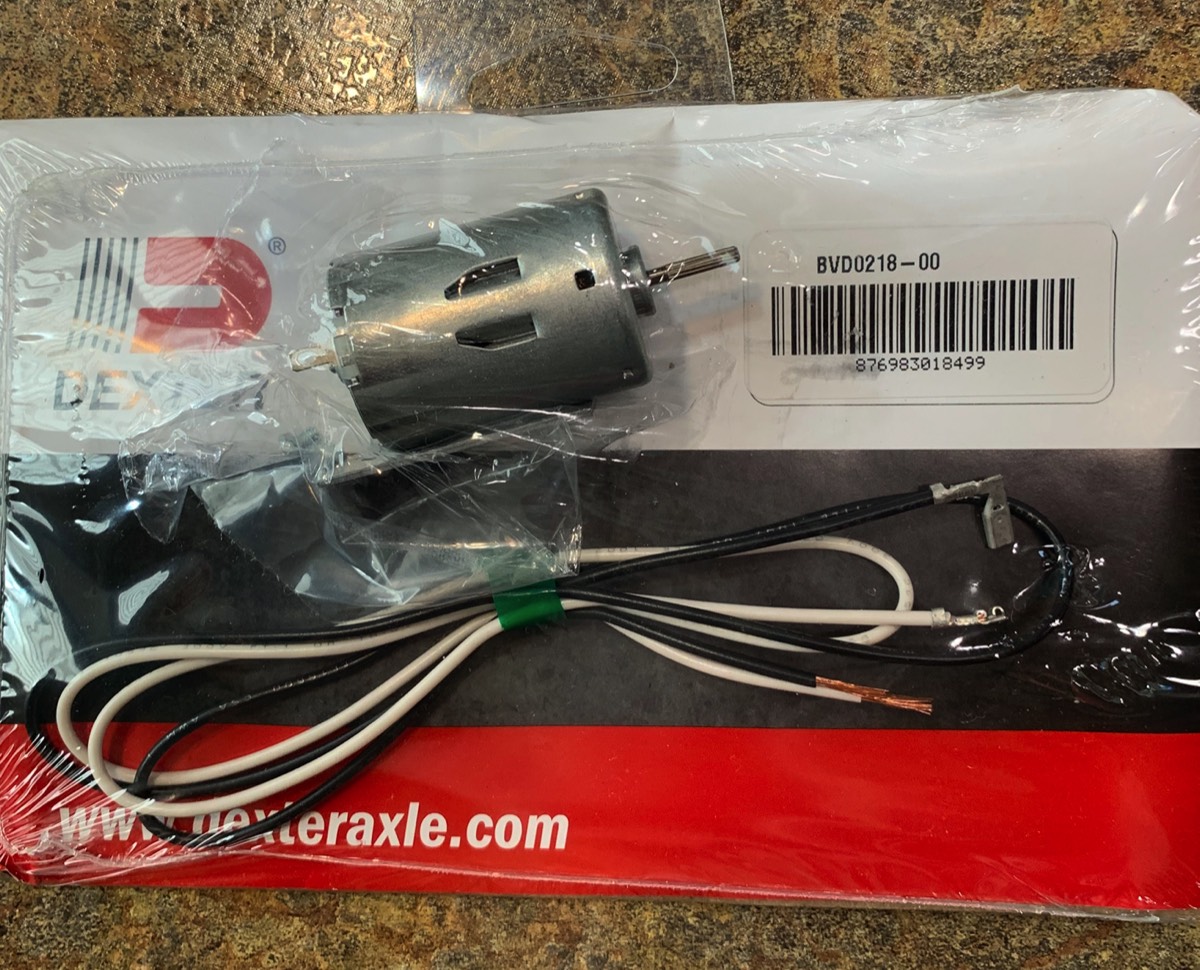
It seemed that the brightly colored fan motor packaging would have been hard to miss.
Refining the previous toilet repair and replacing the on-again, off-again fan motor were welcome accomplishments but receiving the Moderna booster the morning we left Flagstaff was the real prize. We’d been hanging on the recommendations of each of the 4 committees in the vaccine approval process and cheered when the 4th committee gave the go-ahead for immediate administration of the Moderna booster to seniors on Thursday night.
Bill had been carefully following the Walmart pharmacy booster website because they appeared to be the most organized and up-to-date brand. Walmart looked poised to jump in to action that Thursday night and indeed, when he checked the site again at 6 am Friday morning, he was able to book appointments for any time we wanted, starting that morning.
I checked the site for the more convenient Safeway pharmacy and their vaccination criteria didn’t reflect the new rulings—they were days behind Walmart in making the boosters available to the over-65 crowd. We were #2 and #3 to receive our booster the first morning at the Flagstaff Walmart and we were ecstatic. By the time we exited the Grand Canyon National Park in 2 weeks, we would have achieved the fullest immunity available to us in the foreseeable future.
We’d checked out of the KOA campground on our way to get our boosters and while Bill drove us out of Flagstaff, I made one more call to the KOA front desk in hopes that our 3rd cooler from the manufacturer had arrived and, amazingly, it had, minutes before I called. It likely cost us another 30 minutes during the frustratingly slow get-way and yet we were delighted.
The jury-rigged solution to the broken fan blades received on cooler #2 had been cutting off equal-sized chunks of the remaining blades to quiet the horrific noise from the imbalance and prevent the motor from self-destructing. (Cooler #1 didn’t cool at all). The 4 weeks in the Grand Canyon were the primary reason for upgrading to an electric cooler this fall and it would have been a shame to have not had the properly functioning cooler for any of our stay there. The KOA staff would have held the new cooler for us, but not returning to Flagstaff two weeks later saved us several hours of additional driving time.
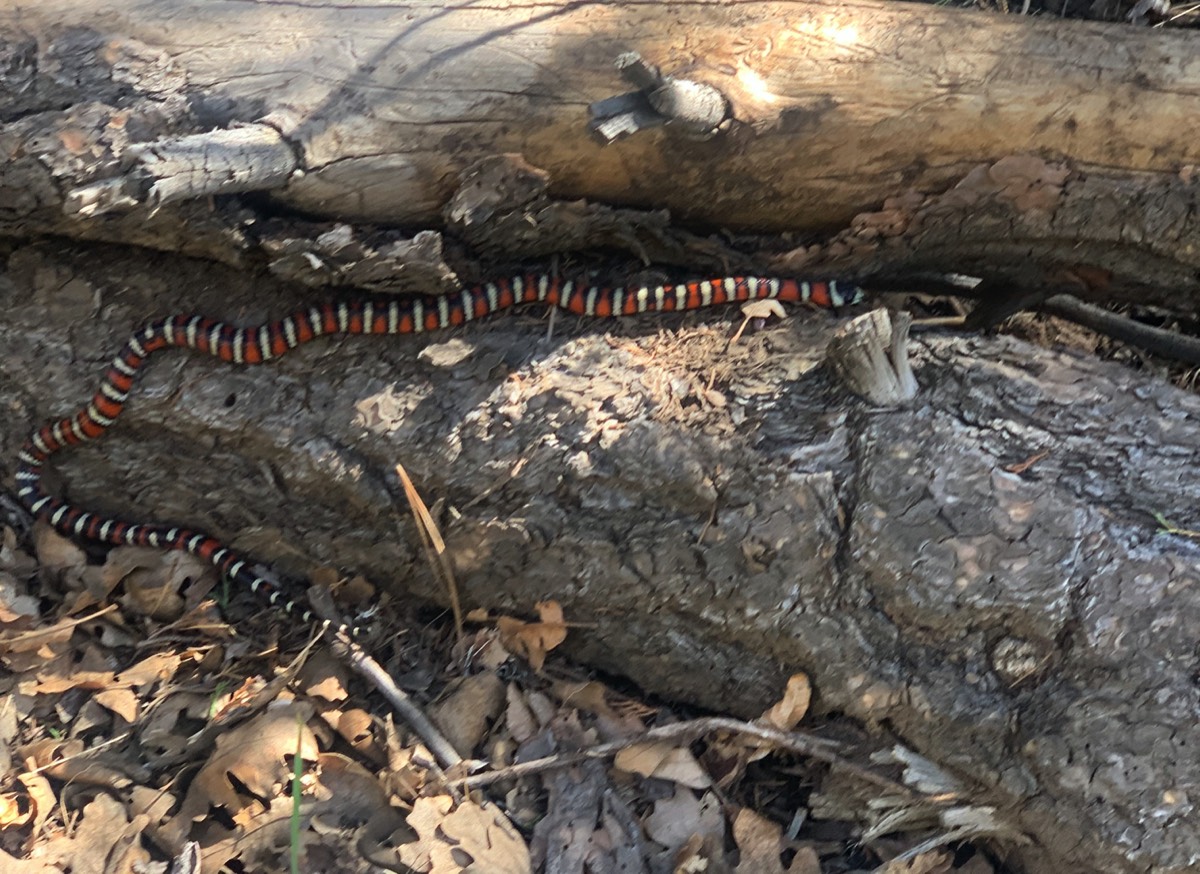
Bill always sees a non-venomous King Snake on the Flagstaff trails near our KOA. (They kill rattlesnakes!)
Life in the Grand Canyon National Park is different every year and especially the second of our 2, two-week stays because the indoor lodging on the N Rim is shuttered by then. There is almost a melancholy when we return but also a sense of emotional spaciousness because of the lack of performance pressure from being unable to stay at the N Rim. We are always acutely aware of the energy shift that parallels the fading of fall and the coming of winter in the Canyon, but we quickly succumb to the magic of the bright, sunny skies and unique panoramas.
Usually there are Halloween decorations on display and perhaps a few Trick-or-Treaters in Trailer Village, though not in 2021. I still remember the expression on her face when handing out apples to the children of a French-speaking mother several years ago who was in awe that the apples were organic. No matter that they were purchased for us and we had no candy. It felt like that simple act of desperation to be polite elevated Americans in her eyes.
This year however, there were several young adults in Halloween costumes on the trails: 2 women in bright yellow banana costumes; 2 women in black leggings with skeleton bones painted on them that of course, had lunch at Skeleton Point; and a few other nods to the holiday. We didn’t bother putting our ½ life-sized skeleton on display in our window or hanging our Dollar Store bat like we usually do—our over-stressed hearts just weren’t in it.
We finally concluded that it was life drifting towards normal while the pandemic marched-on that accounted for 2 other changes in the ambiance this October: the near-absence of children in the campgrounds and the marked decrease in the number of people on the trails.
Last year, the Grand Canyon Trailer Village was a raucous place, with brash Trump supporters flying colorful political flags from their dune buggies that they hauled behind, or in, their RVs and their animated children running loose. They set a cringe-worthy tone in the campground for us but they certainly were entertaining to stare at while we stood in front of our kitchen sink making our meals.
This ‘party on wheels’ contingent were nowhere to be seen this year and even though the RV sites were usually all taken, I’d look around every now and then to make sure that we hadn’t been the only one’s spared from some fatally toxic event on the grounds. It was a little cooler this year too, but rarely did we see more than a couple of other people in the entire compound. I suspect part of the reason for the eery quiet in the RV park was that, unlike a year ago, many kids were back in school.
The RV parks were busy but the number of people on many of the trails was down this season. Places where we’d seen dozens of people on the trail in the past, we might see 4. Some trails had lighter use than even in pre-covid years. My best guess was, like the kids being back in school, the adults who had flocked to the trails during covid were eager to flock to restaurants and less dusty outdoor entertainment venues than hiking offered. Of course, classics like the Grand Canyon trails were busy, but not everywhere we went was bustling, not even the very popular Elden Lookout Trail in Flagstaff only 70 miles away.
The cooler October weather in the SW that was in part due to the horrific storms that pounded the West Coast and some western mountain ranges, also curtailed some of our activities. We completely abandoned cycling for all of October and November, it was just too cold and windy, and most of our favorite routes that time of year are at 7,000’. Fortunately, we’d ‘banked’ extra miles during our short-lived Oregon Coast Cyclotour in July, so we’d still make our target of 1,000 miles per year by being diligent upon our return to Palm Springs in December. Even the bike rental shop within the Park had to shut-down its e-bike rentals for several days because it was too cold to charge their batteries.
“The approach of winter” seasonal imagery wasn’t accurate this late October, however. Oddly, the big thunderstorms and snow events had occurred during our first weeks in the Canyon and were completely absent during our second stay at the end of October. Our last weeks for 2021 there had perfect Rim-2-Rim weather: the temperatures at the Rims were solidly above freezing, the highs at Phantom Ranch were in the 80’s instead of mid-90’s, and at the major rest stop for many hikers, the intermediate elevation Indian Garden, they were, well, intermediate.
In late October, we didn’t need to take our sun umbrellas down to Phantom Ranch for our 18 mile excursions between the two S Rim trailheads, the S Kaibab, and the Bright Angel, because of the more moderate high temperatures. Interestingly, for the first time, we saw 2 other people, a Park Service ranger and a professional guide, with similar sun umbrellas in their packs.
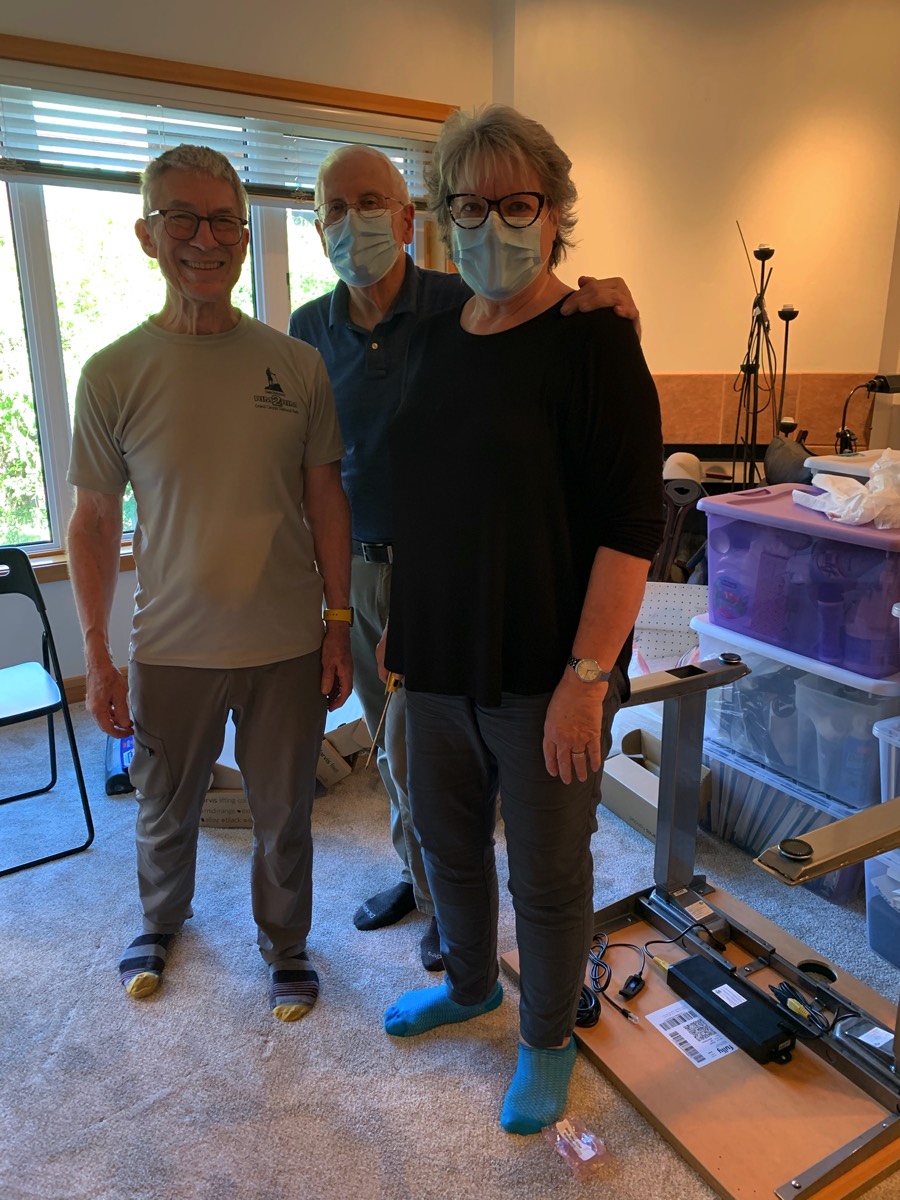
Bill, Larry & Robin making our recent move easy.
Once again, the stresses in our world had us resorting to keeping the external stimulation low to maintain our emotional resilience: the TV remained unplugged and we didn’t need audio books to fill our minds on long hikes. The potency of the Grand Canyon’s serenity and sense of timelessness helped us maintain our personal equilibrium, and to sleep at night, during this continuously stressful 4 month period.
Trail Elders
I put the brakes on my speedy descent on the Bright Angel Trail on my way to meet even speedier Bill, who was waiting for me on a bench in Indian Garden for our picnic at our turn-around point. A limp, 36 year old woman was sitting in the dirt on the narrow trail’s edge discreetly puking into the bushes. I stopped, inquired, and asked if she might be low on salt. Her husband thought not but I offered our help if they wanted to retreat a few minutes down the trail to where Bill was waiting for me.
Slightly ambivalent, they accepted my offer and I used our new, mini, walkie-talkies to give Bill a heads up about reaching out to hikers in trouble. The hike out of the Grand Canyon on any trail is notoriously difficult and we are always on the look-out for hikers in metabolic trouble, which is usually easily seen in their faces; our offers of help in these cases are rarely turned down.
I mentioned that we were no strangers to the perils of being dehydrated, overheated, low on salt, or having difficulty with the altitude and might be able to help them sort through her issues. They had about 1/4th of their long day hike ahead of them and we hoped to improve her odds of making the last 5 miles and 3200’ of gain on their ambitious hike between the S Rim and Colorado River and back. Rae had her doubts that she could make it and her calm and attentive husband was clearly concerned too even though they had trained for the event and were appropriately equipped.
Sitting socially distanced on benches in partial shade, Bill took the lead in sharing information about how we tease out whether our lapses are due to salt or water shortages. She tried our experiments, like sucking on a few chunks of rock salt to determine if it was palatable or not and checking how she felt when she drank water. At 3800’, altitude sickness shouldn’t have been the issue and it was an unusually cool day in the Inner Canyon, so the common state of heat exhaustion at that level wasn’t likely. Bill guided her through a further self-assessment by asking how much she’d had to eat, how much she’d been drinking, how often she was peeing, and how often she was puking. It didn’t take long to concur with her best guess, which was that she had a stomach bug.
Rae went off to puke in private in nearby bushes while we sent her husband to the nearby ranger’s residence in hopes that they would put them up for the night but he returned empty handed, saying that a sign on the door indicated that they were closed for the winter. There went the Level 2 Option for helping out, a level to which we’d never escalated when assisting ailing hikers. Contrary to what some visitors expect, riding out on one of the twice-daily mule trains is never an option.
It was on to Level 3, which was the 4 of us visualizing how they were going to hike out with her in this condition, something they had been working on when we met. Bill urged her to put a tiny bit of the salt he gave her in her water bottle and to keep drinking a little bit, even though she was still puking. Her husband rearranged their day packs, carrying hers on his chest and refilling their water, and we gave them our treasured, new headlamps because they surely would be hiking out in the dark.
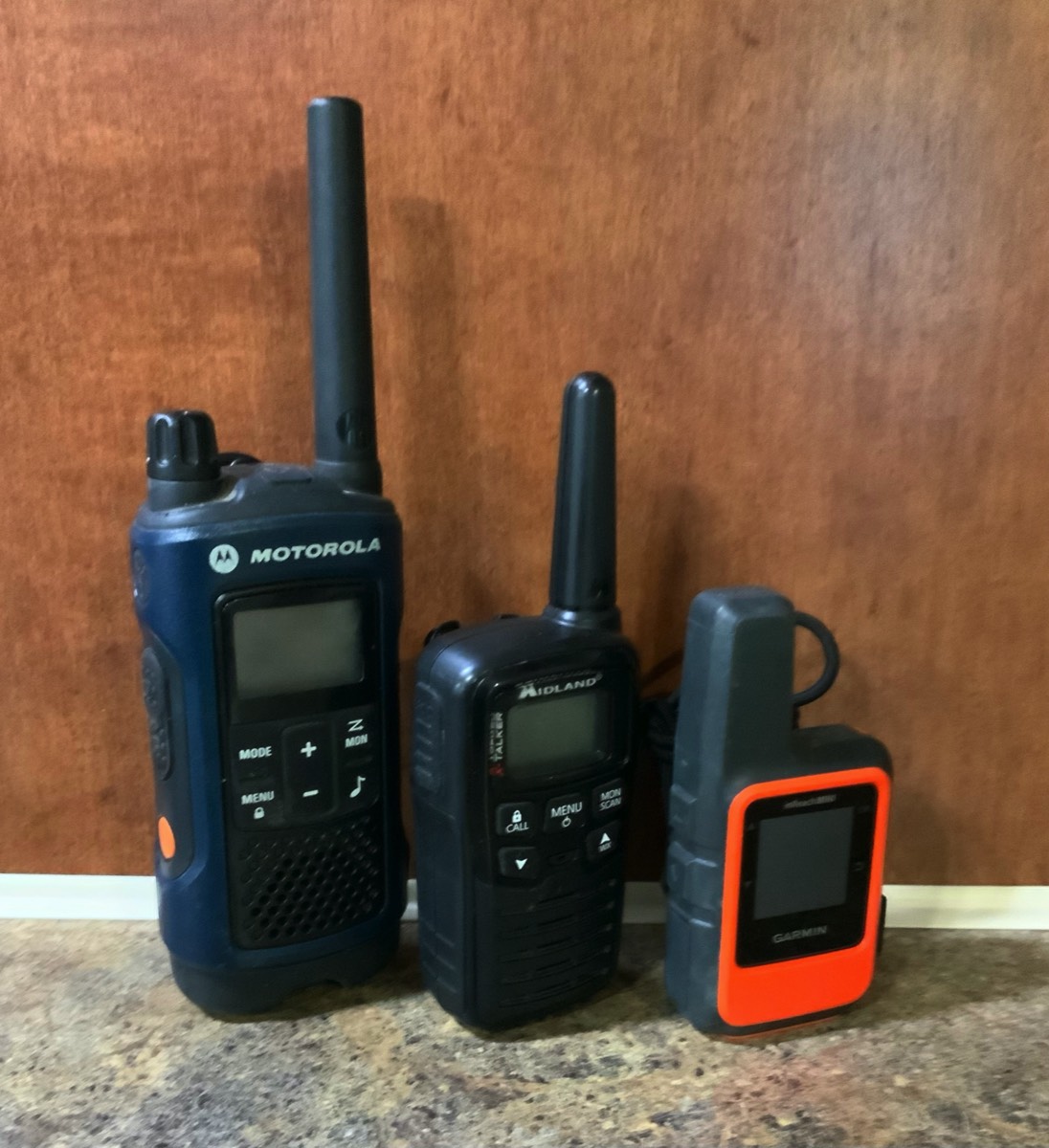
Our large, original walkie talkie, our new mini walkie talkie, & the Garmin in-Reach Mini satellite device.
They took off while we lingered to eat our lunch, knowing that we’d be passing them soon and have another chance to evaluate their situation. We didn’t immediately recognize them as oncoming traffic with their big grins about a mile into the 5 mile return to the S Rim. They were sandwiched between 2 rangers, one out of uniform that we happen to see on the same trail every year. Luckily, our hikers encountered the rangers and from our little-known tip about the sleepover option, they knew to ask about being put-up for the night in the rustic clinic. Their wish was granted and Rae was going to have an afternoon and night off the trail to rest, if not fully recover, from her stomach bug.
Her husband had the presence of mind to return our headlamps while we all chatted on the trail, which was welcome closure for us. A perfect ending to a difficult predicament for them. All 6 of us were cheery and extremely pleased with the outcome for our own reasons.
This encounter exemplified our self-appointed role as Trail Elders on the Grand Canyon trails: we habitually scan for individuals in metabolic chaos and use our knowledge to help them diagnose and treat their problems. Usually that involves inviting them to cool off in the shade, to drink more water (which we supply if they are out), and helping them determine if they are salt short, which is almost always the case.
In this instance, in which Rae was likely dealing with an infectious disease or food poisoning, educating them about the unadvertised option of spending the night with the rangers at Indian Garden proved critical, even though the ranger’s station was technically closed for the season.
This was also the first instance in the Grand Canyon in which we’d given up our headlamps to fellow hikers, though when hiking to San Jacinto peak in Southern California, we do carry new, inexpensive headlamps to give away because novice hikers routinely finish in the dark, much to their surprise.
In Rae’s case, having extra help in problem-solving her situation was clearly a gift to her—who doesn’t savor support when they are sick? We had the immense pleasure of our information learned the hard way benefiting more people than us, which always makes us beam. It such simple information and yet so potent in the Grand Canyon.
Authenticity in the Inner Canyon
The physical and emotional stresses of the climb-out of the Grand Canyon, whichever trail you are on, triggers a delightful authenticity, a sharing of self, that isn’t easy to come by, and I revel in the camaraderie it fosters. One big, young man in red shorts and a black T-shirt blurted out with a belly laugh as we approached him “I’m SO fat, I feel terrible!” and he continued to laugh. His lean and athletic companion behind him had a sly smile and we mirrored his laughter back to him. We hoped we were sharing in a turning point moment for him to lose weight, or perhaps, it will require a dozen more epiphanies, but it was fun to experience his spontaneous report on his state of being.
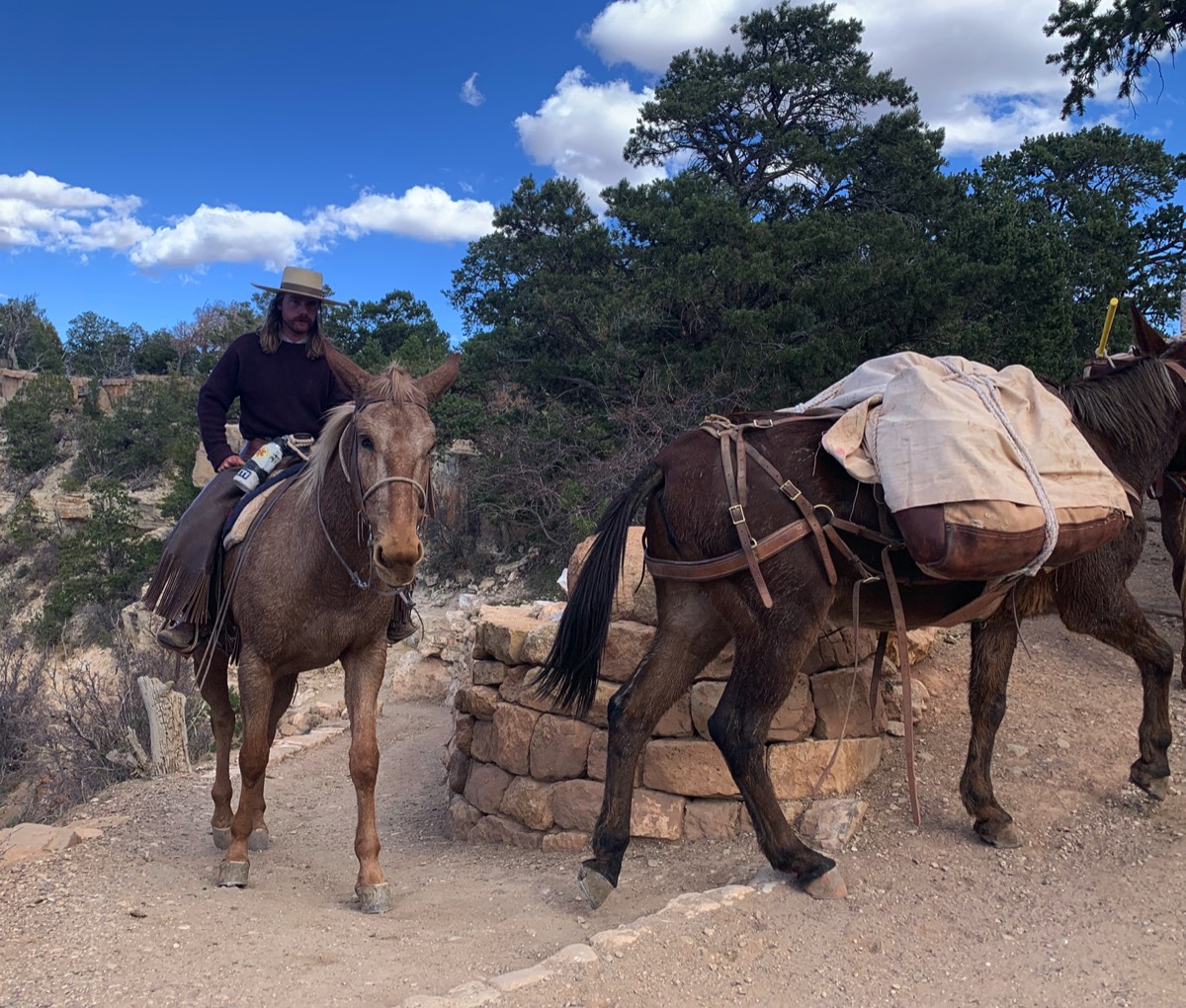
A mule train cresting at the top of the S Kaibab trail.
As soon as they knew our ages and more about what we do for fun in the Grand Canyon, one asked “What’s your secret?” I was giving them the brief list of the elements of our near-monastic lifestyle choices: no alcohol; essentially no sugar; being keto or low carb; when one interrupted by saying “And no weed?” “Yup, no weed!” That clearly was a stunning bit of abstinence to them that abruptly ended the questioning. We parted ways with us all laughing and while walking for nearly an hour back to our trailer on the paved Rim Trail, I would occasionally blurt out with a laugh “And no weed!” Such fun bits of banter that get exchanged when people are stressed in the Grand Canyon, banter that often makes my day and sometimes permanently shifts our perspective.
Rocket Man
Whoosh! And He Was Gone! Bill Was Unleashed!
“Don’t acquire each other’s disabilities” had been one of my mantras for decades that Bill had given lip service to, but had not acted upon. When he was injured or sick, I would carry-on with my hiking and biking; if I was injured, Bill was less likely to get out the door alone. My health had been degrading with the use of antihypertensive medications for over 3 years and, against my protests, Bill had kindly slowed for me. But, in late September, he accepted my long-standing invitation, dropped his resistance to leaving me behind, and began hiking at his own speed in Flagstaff. Unfortunately, it was overlayed upon a bit of familiar carelessness towards his back, and he was injured in a few days. But, over the next 6 weeks while in Flagstaff and the Grand Canyon, he got it together and found the athlete lurking within.
We capped the end of our season in the Grand Canyon with the most strenuous hike we can do once the N Rim closes on October 15, which is the 18 miler from the S Rim’s S Kaibab Trail, down to Phantom Ranch on the Colorado River, and back up to the S Rim at Bright Angel Lodge. Bill knocked it out of the park, completing it in a record-setting moving time of 6½ hours. I put in a respectable showing of about 8½ hours of moving time but we were now different classes of hikers. I was great for an older woman, Bill was great for a man of any age.
Concurrent with hiking at his own pace, Bill had devised a small front pack system to shift about 1/3 of his pack weight to his upper chest to reduce the strain on his back, strain like he had recently triggered with an 18 pound load all on his back. Doing so, dramatically counter-posed his chronic head-forward position, which repeatedly strained his back. With the counter balancing weight on his chest, if he didn’t shift his head back, he’d fall forward. This healthier position for his vertebrae and discs no longer required intention, it was triggered by force vectors.
A Gift From A Friend
Upon hearing the bizarre story of my brother’s choice of committing suicide by hiding his prostate cancer from his family and physicians, a retired therapist offered to explore with me some possible answers to the mysterious question of “Why?”. Amazingly, after the exchange of 2 pithy emails, he landed on a theory that made sense, one that resonated for me, for Bill, and for my nephew. Here is the condensed version:
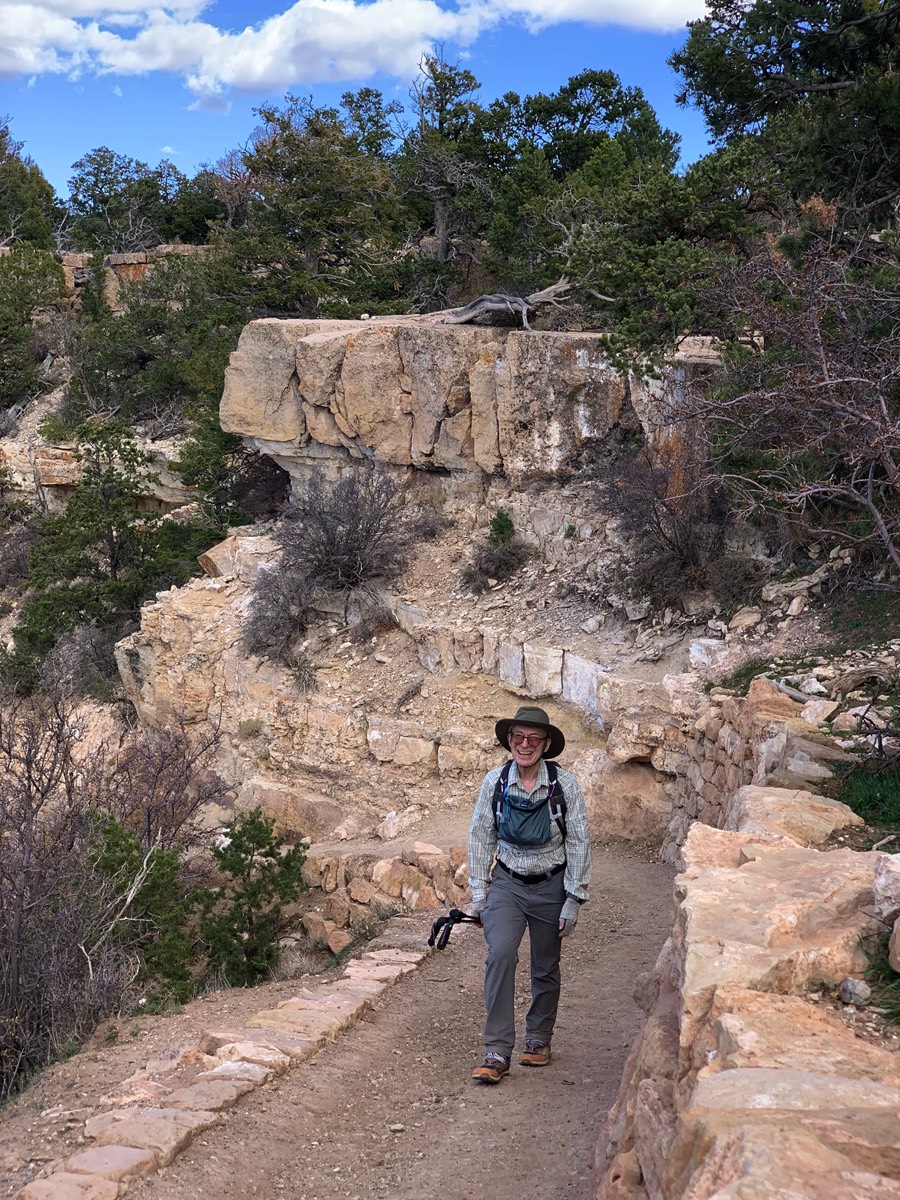
Elated Bill with his new chest pack, reaching the top of the S Kaibab Trail on the S Rim.
The happy ending to this pathetic story of my brother’s life and death was that, to his horror, Bill identified with too much of my brother’s lifelong lingering, childhood resentment and rebellion and Bill recognized how those positions had fueled his own persistent, self defeating behaviors. The therapist’s email regarding my brother resonated with him so much that, several times, Bill said “He is writing about me!” It took about 10 days of contemplation and conversation for Bill to ditch his entire package of self defeating behaviors.
A day later he commented “I feel so much calmer” and his incident rate of spontaneously smiling soared! Bill was suddenly able to get on board with doing his back strengthening exercises to prevent injury, not just treat recurrent injury, which made his body healthier and him happier by being out of chronic, low-grade pain. How unexpected for us to get a happy ending from my brother’s unfulfilling life--such a wonderful gift from our therapist friend. Even more surprising, Bill’s sudden, additional, speediness on the trails a week or 2 later seemed to have had at least some of its roots in the dramatic mental shift he had made.
What’s Next?
The challenge now was to create a sports environment in which Bill could continue to expand. We were already hoping to buy a second Garmin inReach Mini satellite communication device on a Black Friday sale so we could be in touch with each other in an emergency when we were hiking, but Bill was also going to need a bigger playground. Our venues would need to be viewed through a new lens to allow him to excel, to spread his wings further. Oh, to have such problems! After decades of biking, and then hiking, in lockstep with each other, his new found athleticism was requiring making some big changes in how we organized our sports lives.
Waiting
I found myself asking “Is it me, a sign of the times, or a stage of life-cycle?” that my life seemed to be defined by the stresses of waiting for weeks and sometimes months or perhaps, years. Waiting for the new medication to kick-in to learn if it will be effective or make me sick or both; waiting for our friend on a ventilator in an out-of-town ICU to recover; waiting to learn if we will miss a third summer season in the Alps because of covid; waiting for the RV parts to arrive; waiting to see if the new RV parts will fix our chronic slide-out problem; waiting for the labs or medical reports to come in for us or friends; so much waiting. And all of this waiting precedes dominos falling, sometimes troublesomely, once the ‘waited for’ event passes. Perhaps it was delusional, but it seemed like life used to be defined more by doing than waiting.
Waiting for our trailer parts was a tortuous journey. The mechanism for moving the slide-out box in and out of the trailer interior, a 3-sided box that feels like it doubles our living space when extended, failed our 2nd night on the road in the middle of September. Even though supply chain shortages had become a way of life, our La Grande service man said it would only be 2 to 3 weeks for our parts to arrive. The manufacturer reported that they were newly on top of things now and it was a solid forecast.
Bill wanted to return home to our new apartment, or at least stay in Oregon until the parts arrived, to have the repair done by the man who diagnosed the problem. Our long-time service wizard assured us that even though their shop was booked 6 weeks or more out, that they would work us in. The alternative was to live with the slide in, choking us for space, for 7 weeks until we could get the first available appointment near Palm Springs on November 9th for the parts installation. We’d used that shop before and weren’t impressed with their caulking job, but that wasn’t a fair test of their expertise with mechanical systems.
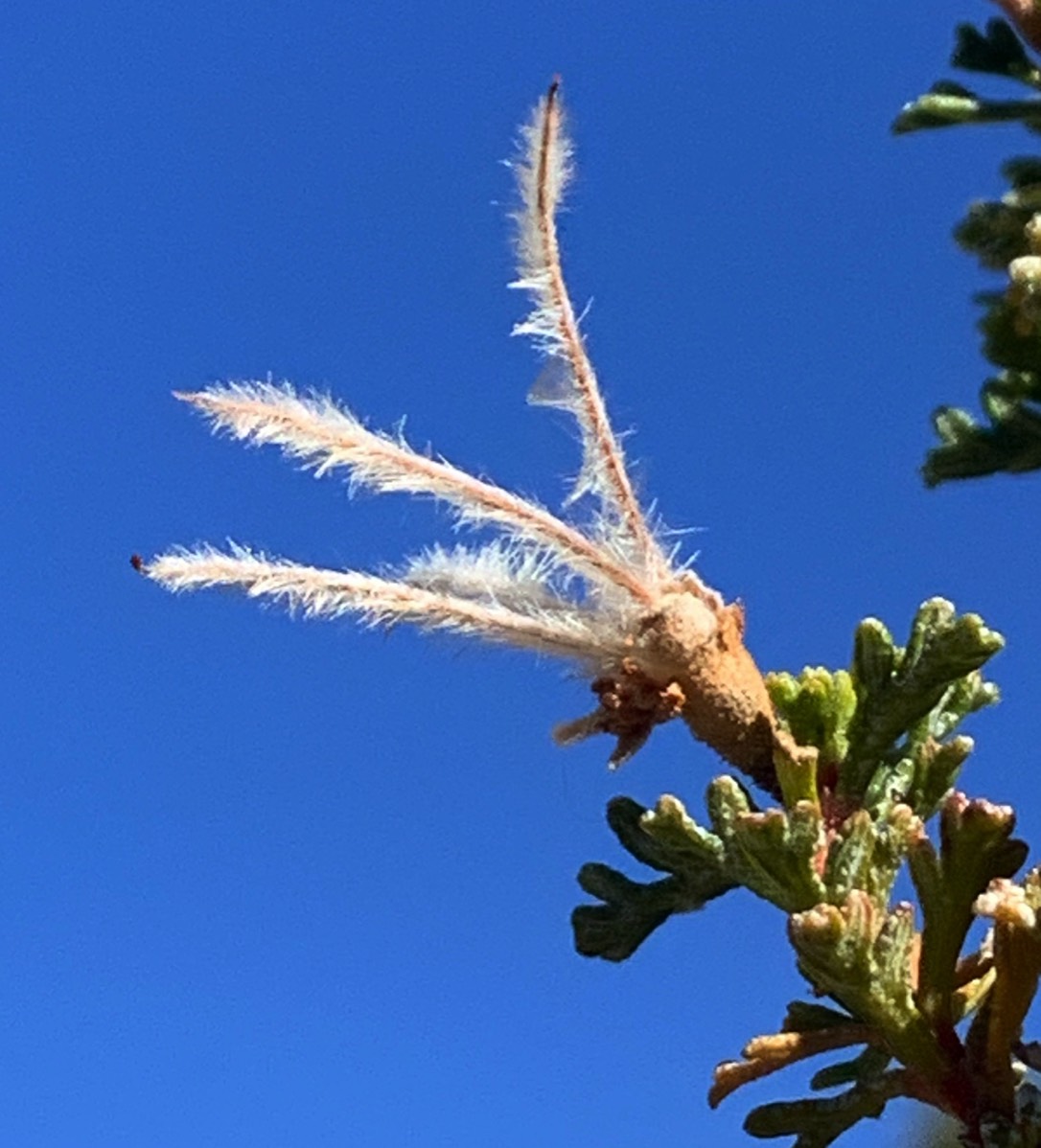
The seed dispersal plumes of a Cliffrose.
We’d reconciled ourselves to living in what felt like a cereal box but went into a tailspin when, at the 3 week point, there was no cheery call announcing our parts had arrived. Instead the update was “No delivery date, none.” I immediately booked the first available date for a back-up service appointment in California, which was an excruciatingly distant December 15th.
On November 2nd, my heart sank when I was again greeted with “I was going to call you”, but this time, the news was good, the parts were in. We were clueless as to whether the parts had arrived that day or a week earlier, but it felt like our sense of urgency for getting them shipped to California wasn’t shared. I suppressed my eruptions of frantic, frustrated emotions while doing my best to politely get the parts moving.
Two days later, on Thursday morning, our slide-out parts were finally underway by FedEx cargo. “I’ll pay whatever it takes to get them there on Monday for our Tuesday appointment” didn’t seem to accelerate the process. We were paying handsomely, close to $1000, with more than half of that being for shipping and fees, but apparently not expedited shipping.
It wasn’t until late Friday morning that we received a tracking number, which mercifully, indicated a Monday delivery. We were on Cloud 9. We were still in “wait to see mode”, waiting to see if the parts were delivered on time and that there were no spurious flub-ups like with other shipments: “Could not deliver, gate locked” when there was no gate.
Then we would wait to learn, in hindsight, the level of expertise of the California shop guys with our brand of parts and if there were sufficient parts and the correct ones were shipped. We would be holding our breath until the trailer was back in our possession, until we pressed the “Slide Out” rocker switch, and heard the familiar, weird sound, without the more recent, expensive noise of metal pieces out of alignment self-destructing. We’d been so traumatized, that we might even have to wait to successfully use the slide several days before we trusted that the almost 2 month-long ordeal was really over.
I manically confirmed that our delivery date was solid, checking multiple times on Friday, Saturday, and Sunday and inexplicably, at bedtime on Sunday night, the delivery date slid to “by the end of the day on Tuesday”, the service date. It was 6:30 pm and we were on our way to an early bedtime of 7 pm to support rising at 3 am for an all day hike up to San Gorgonio peak on Monday and suddenly, we were deeper into crisis.
The trailer repair shop didn’t have a voice mail option on either of their 2 numbers and their website crashed every time I tried sending an email to notify them of the delivery delay. Fortunately, as soon as I had a tracking number in hand on Friday, I’d called to beg for mercy should the parts be delayed for some reason. The receptionist took my plea seriously, discussed it with the service manager, and reported back that they would “work with us.” I gave her the Fed Ex tracking number, indicating we’d be out of cell range for all of their business hours on Monday but invited her to leave voice messages.
Bill doggedly checked his cell phone for a connection for about 6 hours during the hard Monday hike and managed to speak to the receptionist in the afternoon, explaining the delay. She accepted our offer for us to show-up on their doorstep as scheduled at 8:30 the next morning but with an overnight bag in hand in case we had to leave the partially disassembled rig with them until the next day.
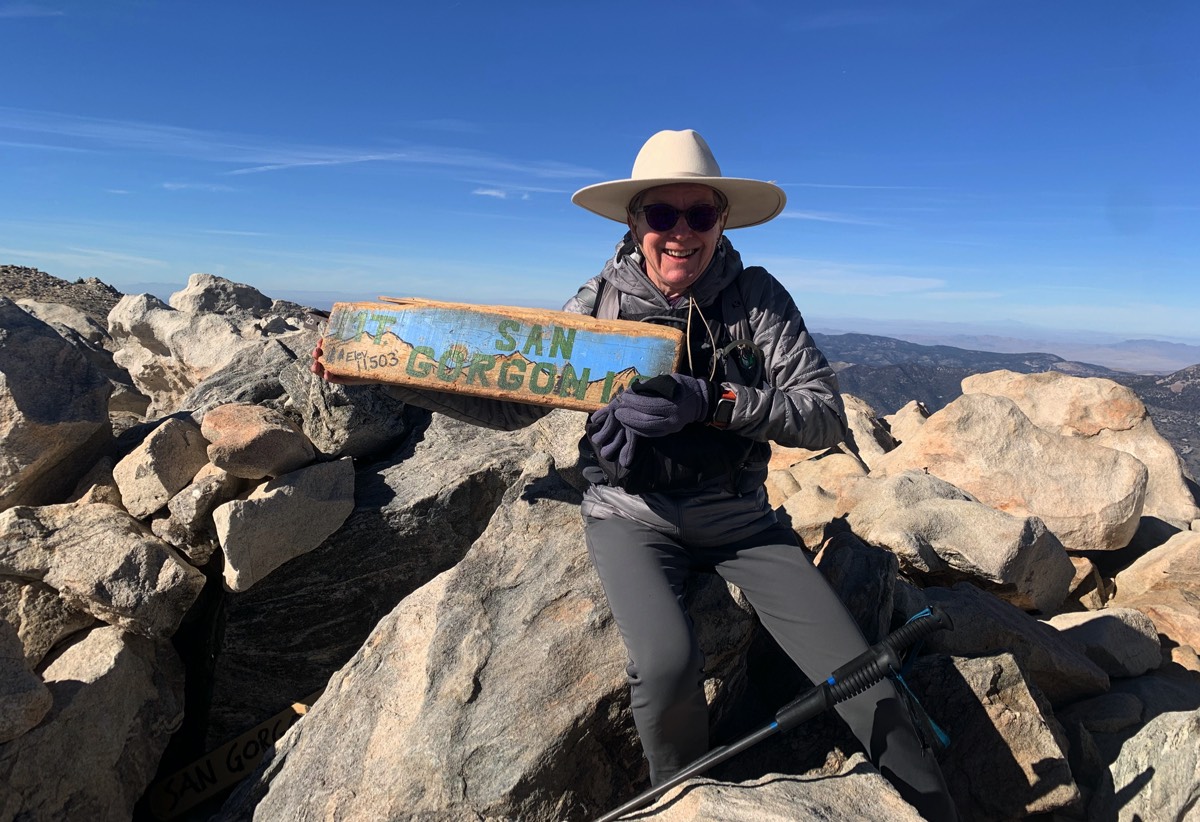
Freezing our hinnies-off in the brisk winds on San Gorgonio’s peak.
Early in the 45 minute drive back to our trailer, when I finally had solid cell phone reception, there was a 10 second voice message from the California RV shop indicating that our parts had been delivered at 2:43! In total disbelief, I tracked our package with FedEx and they concurred with “Delivered”. Inexplicably, it was real. The last 24 hours of despair, sleeplessness, and problem solving had been for naught. But the suspense, the waiting, wasn’t over yet for us.
Our trailer was in the shop, on schedule, for the entire day on Tuesday morning for the less than 4 hour job but finally, the news was good. Unfortunately, our trail-weary bodies and frayed brains didn’t have time to internalize from the phone conversation in our moving truck that the parts were successfully installed and slide worked well before we were presented with the need to make an instantaneous decision: “Do you want us to install the parts on the other side, they were unexpectedly shipped too.”
Still brain dead from the big hike the day before and filled with anxiety about how successful the repair would be when were we presented with the option, we finally decided to go for installation of the identical parts on the other side of the slide box the next day. It was either have them installed for another $400 and spend another day treading water in cell range or carry the extra 6’ long metal track in our rig.
By the end of Wednesday, after 7 anxious weeks, the waiting was over and the news was better than expected: an “inborn error” of manufacturing had likely resulted in the slide never operating correctly. The manufacturer’s installation of the slide mechanism wasn’t according to spec’s, which the California shop manager showed us on a hardcopy. Shockingly, both of the 2 sides were out of tolerance, though it was the left side at the top of the slide that was off and the right side at the bottom that measured too long. Thank goodness we’d given the go-ahead for them to install the new mechanism on the second side or we never would have known.
Not only did the slide now perform smoothly and quietly, its movement path was symmetrical instead of being a little lopsided like it had always been when it pulled into the trailer. Not using our usual trusted, La Grande, OR repair guy may have gotten us a better repair job than if he had done the work and, at last, we had reason to hope that our chronic problems with this lovely rig’s slide-out were over forever.
It took us at least 3 days to largely emotionally recover from the waiting and the suspense of the slide-out repair drama, a drama that had the potential to go on for many months. And it was so unexpected, so incredible, to most likely have the mechanism made better than when it was when new by the end of the saga.
We were actually a little weirded-out from suddenly living in a vacuous space once inside the trailer, it was like we were bunking in a concert hall. The compressed feelings in our bodies required closer to a week to recede. We’d been so physically confined: we’d each continuously had to make ourselves small and curtail most spontaneous movement to share the limited space. We’d each been physically compressed for almost 2 months while indoors. At last, one of our big ‘waiting’ dramas was over, really over, and our bodies slowly unfurled while the reality sunk in.
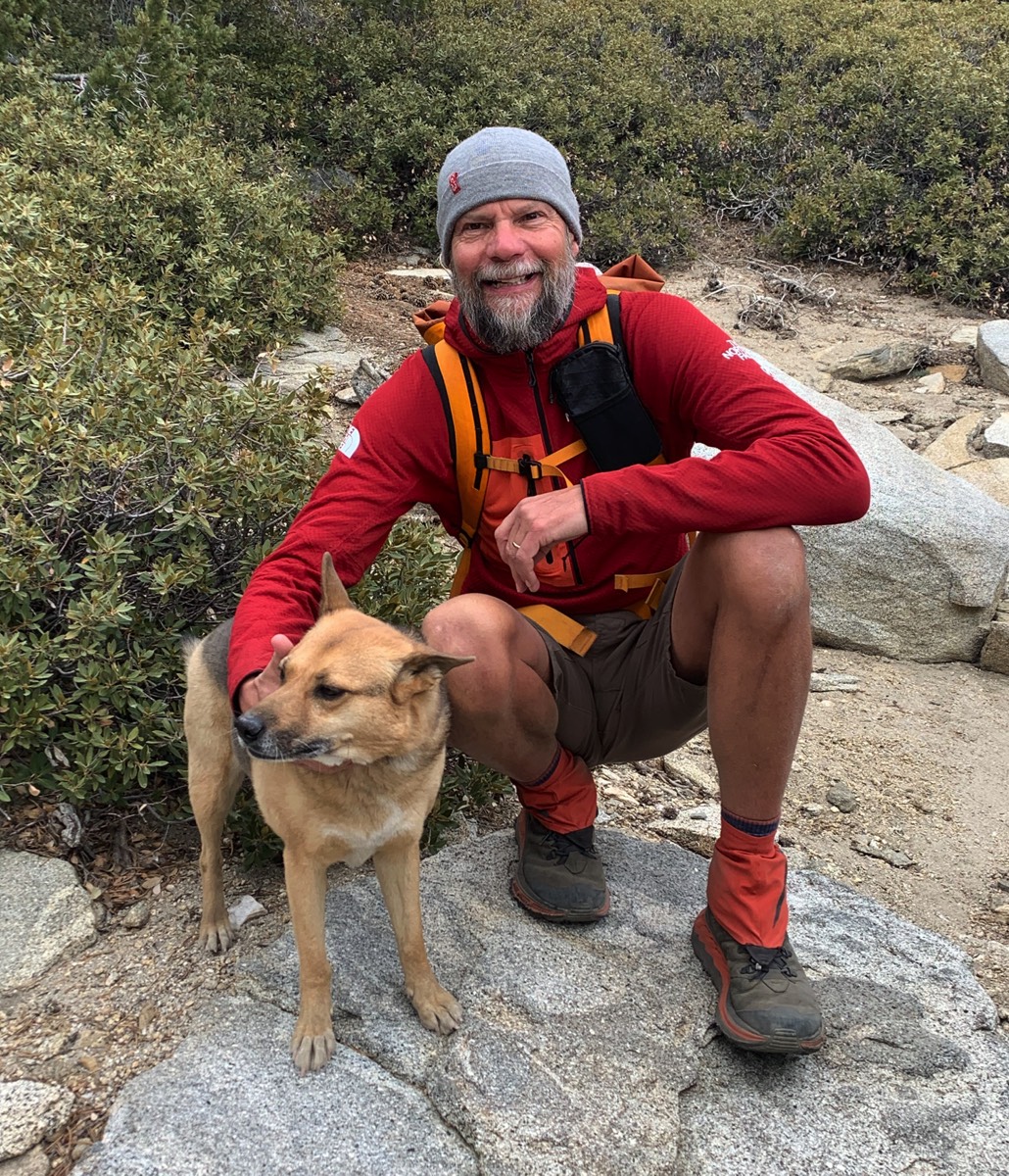
Meeting local celebrities & trail condition reporters, Anabel & San Jacinto Jon, on the trail.
We redeemed ourselves in October at the Grand Canyon, like we’d hoped we’d do, by hitting the trails hard. Reaching our training goal of 2,000 miles per year had been slipping away from us since July but we stabilized our spinal problems and improved them, then hit the ground running when we were better in October. We actually did 5, twenty-mile hikes in 30 days while in the Grand Canyon, 4 in October and 1 in the first days of November, without any set backs and were nicely closing-in on our annual target.
When back in the mountains of Southern California in November, we both continued to heal and then we began collecting what had been vanishing elevation gain on the trails. Our annual elevation gain that had peaked at over 500,000’ in 2017 had plummeted to less than half of that in 2021. Antihypertensive medications that tanked me with shortness of breath and other dysfunctions had triggered that slide in 2018 and then structural problems in both of us put further downward pressure on our performance. We struggled but were able to keep hiking 2,000 miles per year but we just couldn’t do the climbing; wildfire smoke air pollution the last 2 summers had compounded our physical problems.
We took advantage of the almost 5,000’ of elevation gain from hiking between the Grand Canyon’s S Rim and the Colorado River in October and in November, the still-snow-free peaks of San Jacinto and San Gorgonio mountains in Southern California allowed us to match or exceed those numbers with weekly hikes. The third peak in the cluster, San Bernardino, wasn’t open in 2021 because of the wildfire damage in the summer.
Our bodies were tolerating the increased stress of doing the peaks, so we committed to doing at least 2 such hikes a month while in Palm Springs. It looked impossible to ever again reach the 500,000’ of gain a year mark without evading the wildfire smoke by spending the summers in the Italian Alps, but we were committed to at least reversing the sorry trend. Pushing my body to do these peaks was part of my new training plan for myself to regain some of my depressing performance losses and the peaks would also provide venues for Bill to expand his newly accessible athleticism.
Social Season
Our unofficial “Mountain Season” in Arizona’s Grand Canyon and the San Jacinto and San Bernardino mountain ranges of southern California would come to an end on December 1 when we towed our newly repaired 28’ Nash trailer to the desert of Palm Springs for 3 months. I kept the back-up, December 15th trailer service appointment on the books until about a week before, just in case another problem arose.
We’d still have the opportunity to hike on San Jacinto from the east side, from Palm Springs, for much of the winter but our focus would be split between attaining our individual fitness and wellness goals and being hike leaders for the desert hiking club.
Oddly, the winter months away from home were always our peak social season each year. Time would tell how much social engagement our still-frayed nervous systems could tolerate after so many months of emotional stress. Layers of stress and apprehension from waiting were dropping away but we still were compelled to buffer ourselves from much external stimulation; we were still healing on many levels and still waiting for resolution of some issues.